Share
Go Live
Names Against Erasure
·
Published 9/18/2026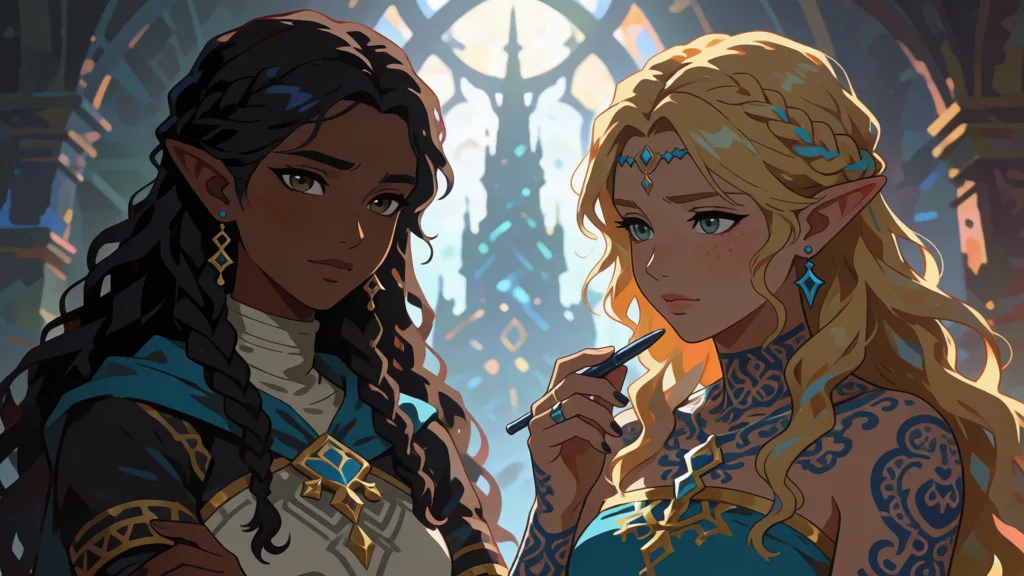
The song was already three verses old when I realized it was a confession.
I'd been singing it for a week in the lower mess, the part of the Drowned Spire where the guards let us gather if we kept our voices low and our hands visible. It was a work song, supposedly. A rowing song from the old Keshite navy, all heave and haul and salt-stung eyes. The kind of thing you learn without meaning to, the way you learn the sound of a particular guard's cough or the exact number of steps between your cell and the infirmary.
But on the seventh night, in the middle of the fourth verse, I heard it.
*The water took his name but not his tongue,*
*and what he spoke the water could not hold,*
*so Kesh, drowned Kesh, kept speaking through the stone.*
I stopped singing. The mess went quiet around me, cups halfway to lips, the low murmur of other conversations dropping to nothing. A woman three tables over, a forger who'd been inside so long her hair had gone entirely white, looked at me with an expression I couldn't read. Not fear. Something older than fear.
"Don't stop," she said. "Finish it."
I didn't. I sat there with my hands flat on the table, feeling the rough grain of the wood under my palms, and I thought about the word I'd just sung. *Kesh.* I'd sung it a hundred times without hearing it. It was a place name, a dead city, a ruin under the sea. Everyone knew that. The Spire's own records said so, in the sanctioned histories, the ones we were allowed to read in the common room if we were deemed sufficiently reformed.
But the song was older than the sanctioned histories. And the song said the water couldn't hold what Kesh spoke.
I got up. I left my cup on the table, still half full of the thin, bitter tea they gave us, and I walked out of the mess with the woman's eyes on my back. The corridor outside was dim, lit by the blue-green glow of the bioluminescent fungus that grew in the cracks of the Spire's walls, the only light we ever got this deep. I counted my steps. Forty-two to the first turn, then twenty-eight to the second. I knew this route the way I knew the inside of my own mouth.
Ilyra was in our cell when I got there. She had her kit open on the floor, needles and ink pots arranged in a semicircle around her crossed legs, and she was working on a piece for a new client, a man who'd been in the Spire for eleven years and wanted his daughter's face tattooed on his forearm before he forgot it entirely. The design was half-finished, just the outline of a small, serious mouth and the suggestion of a chin. She didn't look up when I came in.
"You're early," she said. "Did you eat?"
"No."
She reached behind her without looking, felt around on the shelf above her head, and came up with a heel of bread wrapped in a scrap of cloth. She tossed it over her shoulder. I caught it.
"Eat," she said. "You get stupid when you're hungry."
"I'm always stupid."
"True. But you get stupider."
I sat down on the edge of the cot, which was really just a wooden platform with a straw mattress that had been old when we got here and was now mostly a suggestion of a mattress. I bit into the bread. It was stale, but she'd put a little honey on it, the kind we weren't supposed to have, the kind she got from a guard she'd done a favor for three months ago. I didn't ask what the favor was. She'd tell me if she wanted me to know.
"I heard something," I said.
"You always hear something. It's your curse."
"This is different."
She set down her needle. That was how I knew she was listening, really listening. Ilyra Quill had been a tattoo artist on the outside, before the Spire, before me, and she had the kind of focus that made you feel like you were the only thing in the world when she turned it on you. She turned it on me now.
"Tell me," she said.
So I told her about the song. About the fourth verse, and the word *Kesh*, and the way the whole mess had gone quiet when I stopped singing. I told her about the white-haired forger and the look on her face.
Ilyra was quiet for a long moment. Then she said, "Kesh is a dead city."
"That's what they tell us."
"That's what everyone says. It's not just the Spire. It's the histories, the maps, the old songs. Kesh drowned. The sea took it. That's the story."
"The song says the water couldn't hold what Kesh spoke."
She picked up her needle again, but she didn't start working. She turned it over in her fingers, a small, sharp thing that had drawn a thousand names into a thousand arms and backs and chests. "Songs lie," she said. "You know that better than anyone."
I did know that. I'd spent the last six years of my life turning forbidden testimony into songs, hiding the truth in melodies that the guards would hum without knowing what they were humming. I knew that songs could lie. But I also knew that the best lies were built on truths, and the truth in this song felt old. Older than the Spire. Older than the sanctioned histories. Older than anything I'd ever heard.
"I want to find the rest of it," I said.
"The rest of what?"
"The song. The full version. That verse I sang tonight, it was different from the version I learned. There's more to it. I can feel it."
Ilyra looked at me for a long time. Then she sighed, the kind of sigh that meant she was going to help me even though she thought I was being an idiot. I loved that sigh. I loved it more than I loved most things.
"Fine," she said. "But you're going to eat the rest of that bread first. And then you're going to sleep. And tomorrow, we'll go to the archives and see what we can find."
"The archives are restricted."
"Everything's restricted. That's never stopped us before."
She was right. It hadn't.
---
The archives of the Drowned Spire were not, technically, a library. They were a records room, a place where the Spire's administrators kept the paperwork of the prison: intake forms, disciplinary reports, execution orders, the endless bureaucratic machinery of erasure. Prisoners came in with names and histories, and the Spire took those names and histories and filed them away, and after a while, the prisoners themselves became files. Paper. Ink. Things that could be moved from one shelf to another without anyone noticing.
I'd been in the archives before. I knew the way in, a maintenance hatch behind the infirmary that had been overlooked during the last round of security upgrades. I knew the way the air smelled in there, like dust and old glue, like the inside of a book that hadn't been opened in years. I knew the sound the floor made when you stepped on the third tile from the door, a small, sharp creak that could give you away if you weren't careful.
Ilyra knew the archives too. She'd spent more time there than I had, in the early years, when she was still trying to find records of the people she'd lost. She'd never found them. The Spire was good at erasing.
We went in through the maintenance hatch a little after midnight, when the guards changed shifts and the corridors were empty. Ilyra went first, because she was smaller and could fit through the narrow opening without scraping her shoulders. I followed, less gracefully, and landed on the other side with a thump that made her wince.
"Quiet," she hissed.
"I'm always quiet."
"You're never quiet. You're the loudest person I've ever met."
"That's why you love me."
She didn't answer, but I saw the corner of her mouth twitch. That was enough.
The archives were organized by year, then by category, then by the first letter of the prisoner's surname. The categories were things like *Discipline*, *Medical*, *Transfer*, and *Termination*. I'd always hated that last one. It made the act sound like a business decision, like the Spire was just closing an account.
Ilyra went to the *Termination* shelves. I went to the intake records. We'd done this before, on smaller scales, looking for evidence of specific people, specific crimes. But this time was different. This time, I wasn't looking for a person. I was looking for a word.
It took me two hours to find it.
The intake record was old, older than most of the files in the archives. The paper was yellowed and brittle, and the ink had faded to a pale brown. The prisoner's name had been scratched out, replaced with a number: *Prisoner 4471*. The crime was listed as *Sedition*. The sentence was *Termination*. The date was three hundred and twelve years ago.
And in the margin, in a hand that was different from the official script, someone had written a single word.
*Kesh.*
I stared at it for a long time. The word was small, almost invisible, tucked into the corner of the page like a secret. But it was there. It was real. Someone had written it, three hundred years ago, and no one had erased it.
Ilyra found me there, still staring, when she finished her own search. She'd found nothing in the *Termination* records, no mention of Kesh, no hint of the song. But when she saw the intake record in my hands, she went very still.
"That's the word," she said.
"Yes."
"From the song."
"Yes."
She sat down next to me on the cold stone floor, her shoulder pressed against mine. I could feel the warmth of her through her thin prison tunic, the steady rhythm of her breathing. She reached out and touched the edge of the paper, her fingers careful, reverent.
"What does it mean?" she asked.
"I don't know. But it's here. In an execution record. From three hundred years ago."
"That's not possible. The Spire wasn't built until two hundred years ago."
I looked at her. She looked back at me. Neither of us said anything for a moment.
"Someone's been lying," I said.
"Someone's always been lying. That's not news."
"No. This is different. This is a specific lie. A lie about a specific thing. Kesh."
She took her hand back and rubbed her face, a gesture she made when she was tired or thinking hard. "So what do we do?"
"We find out what Kesh is. What it really is. Why someone would erase it from the histories, why they'd put it in a song, why they'd leave it in a prison record."
"And then?"
"And then we tell people."
She laughed, a short, humorless sound. "Tell who? The guards? The administrators? The people who've been erasing us for years?"
"No. The other prisoners. The people who've been erased. The people who've lost their names and their histories and their songs. We tell them."
Ilyra was quiet for a long time. Then she said, "You know what happens to people who tell."
"Yes."
"You know what happened to the last person who tried to expose the Spire."
"Yes."
"And you want to do it anyway."
I looked at her. Her face was half in shadow, lit only by the faint glow of the fungus in the corridor outside. She was beautiful, even here, even now. Especially here. Especially now. The first time I'd seen her, six years ago, she'd been tattooing a name onto a dying man's chest, and I'd thought: *This is someone who understands.* She'd looked up at me, and I'd felt something click into place, some piece of myself I hadn't known was missing.
"I want to do it with you," I said.
She closed her eyes. When she opened them, they were wet, but she was smiling. That was Ilyra. She could cry and smile at the same time, and both were real.
"You're an idiot," she said.
"I know."
"The biggest idiot in the Spire."
"I know."
She leaned over and kissed me. It was a small kiss, a tired kiss, the kind of kiss you give someone when you've been awake too long and you're scared and you're not sure what's going to happen next. But it was also a promise. I felt it in the way her lips pressed against mine, in the way her hand found my hand and held it.
"Okay," she said. "We'll do it. But first, we need more evidence. One word in one record isn't enough. We need to find out what Kesh was, and why it matters, and who's been hiding it. We need to be careful."
"I'm always careful."
She laughed again, and this time it was real. "You're never careful. You're the most reckless person I've ever met."
"That's why you love me."
She didn't deny it.
---
We spent the next three weeks gathering evidence. It was slow, painstaking work, the kind of work that made you feel like you were trying to fill a bucket with a hole in the bottom. Every time we found something, we had to hide it, memorize it, destroy the original so no one would know we'd been there. Ilyra tattooed the most important bits onto her own skin, small, precise marks on her forearms and her thighs, names and dates and fragments of sentences that would mean nothing to anyone but us.
I wrote songs. That was my part of the work. I turned the evidence into melodies, into verses that could be sung in the mess hall without anyone realizing what they were. I wrote a song about a prisoner who'd been terminated three hundred years ago, a song about a word that had been erased, a song about a city under the sea. I sang them softly, in the dark, and I watched the faces of the other prisoners as they listened.
Some of them understood. I could see it in their eyes, in the way they leaned forward, in the way they asked me to sing it again. Others didn't. They heard a pretty tune, a sad story, nothing more. But the ones who understood, they were the ones who mattered. They were the ones who would help us.
The white-haired forger found me one night in the mess, after the others had gone to bed. She sat down across from me and said, "You're singing the old songs."
"I'm singing new songs."
"You're singing the old songs with new words. I know the difference."
I didn't say anything. She was old, this woman, older than anyone else in the Spire, and she had the kind of eyes that had seen too much to be fooled by anything.
"I was here when they brought the last one in," she said. "The last person who tried to find Kesh."
My heart stopped. "What last one?"
"A woman. A scholar. She came here with a head full of questions and a bag full of books, and she started asking the wrong people the right things. They terminated her within a month."
"Did she find anything?"
The forger looked at me for a long time. Then she reached into her sleeve and pulled out a small, folded piece of paper. She slid it across the table.
"This was hers," she said. "She gave it to me the night before they took her. She said to keep it safe. She said someone would come looking for it someday."
I unfolded the paper. It was a map, hand-drawn, showing the Spire and the sea around it. And at the bottom, in the same hand that had written *Kesh* in the margin of the intake record, there was a single line of text.
*The truth is not in the Spire. It is in the water.*
I looked up at the forger. She was already standing, already turning to leave.
"Wait," I said. "What's your name?"
She paused. For a moment, I thought she wasn't going to answer. Then she said, "My name was Elara Voss. I was a historian. I studied the drowned cities. And I've been waiting thirty years for someone to ask me that question."
She walked away. I sat there with the map in my hands, feeling the paper tremble against my fingers.
---
Ilyra was awake when I got back to the cell. She was sitting on the cot with her kit open, working on a new tattoo, a small bird on her own wrist. She did that sometimes, when she was anxious. She marked herself with the things she was afraid of losing.
"You found something," she said, without looking up.
"How do you know?"
"You're breathing like you ran here."
I sat down next to her and showed her the map. She set down her needle and took it, her eyes moving over the lines, the words, the careful handwriting of a dead woman.
"Elara Voss," she said. "I've heard that name."
"You have?"
"She was a historian. She wrote a book about the old cities, before the Spire, before the erasure. I read it when I was young. It was banned, of course, but I found a copy in a used bookshop and I read it in one night."
"What did it say?"
"It said that the drowned cities weren't just ruins. It said they were archives. That the people who lived there, before the sea took them, they stored their histories in the stone. They carved their names into the walls, their stories, their songs. And when the water came, the stone kept them."
I stared at her. "The song. *Kesh, drowned Kesh, kept speaking through the stone.*"
She nodded slowly. "It's not a metaphor. It's a description."
We sat there in silence for a long moment. The Spire hummed around us, the deep, constant sound of the sea pressing against the walls. I could feel it in my bones, the weight of all that water, all that history, all those names.
"We have to go there," I said.
"To Kesh?"
"Yes."
"That's insane. Kesh is at the bottom of the sea. No one's been there in centuries. No one even knows where it is."
"We have a map."
"We have a map drawn by a woman who was terminated thirty years ago. That doesn't mean it's accurate."
"It's all we have."
Ilyra set the map down and looked at me. Her face was tired, but her eyes were bright. "You know what this means, right? If we leave the Spire, we're not coming back. We'll be fugitives. We'll be hunted. We'll probably die."
"I know."
"And you still want to go."
I reached out and took her hand. Her fingers were stained with ink, the way they always were, the way I loved them. "I want to go with you," I said. "I want to find out what happened to Kesh, and I want to tell the world. But more than that, I want to do it with you. I want to be with you when we do it. I want to hold your hand when we're scared, and I want to hear your voice when I'm lost. I want to be the person who remembers your name, even if no one else does."
She was crying now, silently, the tears running down her cheeks and dripping onto the map. She didn't wipe them away. She just looked at me, and she smiled, and she said, "You're an idiot."
"I know."
"The biggest idiot."
"I know."
She kissed me, harder this time, and I kissed her back, and for a moment, the Spire didn't exist. There was only her, only us, only the small, fierce warmth of two people who had decided to love each other in a place that was designed to make love impossible.
When we broke apart, she said, "We'll need supplies. Food, water, a boat. We'll need to get past the guards. We'll need to find a way out of the Spire without anyone noticing."
"I know a way."
"Of course you do."
"And we'll need to be careful. We can't tell anyone what we're doing. Not even the people who've been helping us."
"I know."
She looked at the map again, at the line of text at the bottom. *The truth is not in the Spire. It is in the water.*
"Okay," she said. "Let's go find the truth."
---
The escape took four days to plan. We couldn't rush it. The Spire was a fortress, built into the side of a cliff, surrounded by water on three sides and a sheer rock wall on the fourth. The only way out was through the sea, and the only way to the sea was through the lower levels, which were flooded and guarded and full of things that would kill you if you weren't careful.
But I'd been in the Spire for six years, and I'd spent most of that time learning its secrets. I knew the flooded corridors, the old maintenance tunnels, the places where the guards didn't go because they were too dangerous or too forgotten. I knew the rhythm of the tides, the way the water rose and fell in the lower levels, the narrow windows of time when a person could slip through without being seen.
Ilyra handled the supplies. She traded favors, called in debts, used the network of prisoners who owed her for tattoos and names and memories. She got us a small, inflatable boat, hidden in a maintenance closet on the lowest level. She got us food, water, blankets, a compass, a knife. She got us a change of clothes, the kind of clothes that wouldn't mark us as prisoners, the kind of clothes that might let us pass as fishermen or traders if we were stopped.
And she got us a name. A new name, a new identity, something we could use on the outside. She tattooed it onto my forearm, a small, precise mark that would fade in a few weeks but would be enough to get us through the first checkpoint. *Vesper Hale.* A fisherman's daughter from a small village on the coast. A nobody. A person who had never been to the Spire.
I watched her work, the way her needle moved across my skin, the way her brow furrowed in concentration. She was so careful, so precise. Every line was deliberate. Every mark was a promise.
"What's your name going to be?" I asked.
"Ilyra Hale," she said, without looking up. "Your sister."
"Sister?"
"It's less suspicious than lovers. Two women traveling together, one of them your sister, that's a story people will believe."
"And if they ask questions?"
"Then we lie. We're good at lying."
I laughed. "We're good at telling the truth in ways people don't notice. That's different."
She finished the tattoo and sat back, wiping the excess ink from my skin with a cloth. "There," she said. "Now you're someone else."
I looked at the mark on my arm. It was small, just a few lines and curves, but it felt heavy. It felt like a door closing behind me.
"I don't want to be someone else," I said. "I want to be me. I want to be Vesper Cantor, the bard who sings forbidden songs. I want to be the person who remembers."
Ilyra reached out and touched my face, her fingers cool against my cheek. "You'll always be that person," she said. "No matter what name you use. No matter where you go. You'll always be the one who remembers."
I kissed her hand. "And you'll always be the one who preserves."
"That's the deal," she said. "You remember, I preserve. We keep each other alive."
---
We left on a moonless night, when the tide was low and the guards were changing shifts. The lower levels were dark, lit only by the faint glow of the fungus, and the water was cold, rising to our knees as we waded through the flooded corridors. Ilyra carried the boat, deflated and rolled up, and I carried the supplies, and we moved as quietly as we could, counting our steps, listening for the sound of boots on stone.
We made it to the maintenance closet without being seen. Ilyra inflated the boat while I kept watch, my heart pounding in my chest, my ears straining for any sound that wasn't the drip of water or the distant hum of the Spire's machinery. The closet was small, barely big enough for the two of us and the boat, and it smelled like salt and rust and old fear.
"Ready?" Ilyra whispered.
"Ready."
We launched the boat through a drainage pipe that emptied into the sea, a narrow opening that was barely wide enough for us to squeeze through. The water was black, choppy, and the boat rocked violently as we paddled away from the Spire, away from the only home we'd known for years.
I looked back once. The Spire rose out of the sea like a fist, dark and massive, its windows glowing with a faint, sickly light. I thought about the prisoners inside, the ones we'd left behind, the ones who would wake up tomorrow and find us gone. I thought about Elara Voss, the historian who'd waited thirty years for someone to ask her name. I thought about all the people who'd been erased, all the names that had been forgotten, all the songs that had been silenced.
I turned away. Ilyra was paddling, her face set, her eyes fixed on the horizon. I picked up my own paddle and joined her, and we rowed into the darkness, toward a city that had been drowned for centuries, toward a truth that had been buried for just as long.
The sea was cold. The night was long. But we were together, and that was enough.
---
We rowed for three days. The map was old, and the coordinates were imprecise, and we had to guess more than once, but we had a compass and a direction and each other. We took turns sleeping, one of us always awake, always watching the horizon for ships or storms or things that might kill us. We ate cold bread and dried fish and talked about nothing, about everything, about the lives we'd left behind.
Ilyra told me about her childhood, about the tattoo parlor her mother had run in a small town on the mainland, about the first name she'd ever inked into someone's skin. She was fourteen, and the man was a sailor, and he wanted his wife's name on his chest, over his heart. She'd been so nervous she'd spelled it wrong, and the sailor had laughed and said it didn't matter, that his wife would know what he meant.
"He came back a year later," Ilyra said. "He wanted me to add his daughter's name. He said his wife had forgiven him for the misspelling. He said she'd cried when she saw it."
"That's a good story," I said.
"It's a true story. That's better."
I told her about my own childhood, about the songs my father had taught me, about the first time I'd realized that music could hide things as well as reveal them. I was eight, and I'd overheard a conversation I wasn't supposed to hear, and I'd turned it into a song, and I'd sung it to my friends without knowing what it meant. My father had found out and he'd been furious, not because I'd overheard, but because I'd repeated it. *Some things are meant to be forgotten*, he'd said. *Some things are meant to be buried.*
"He was wrong," Ilyra said.
"I know."
"But you believed him for a long time."
"I did. Until I met you."
She looked at me, her face soft in the dim light of the boat. "What did I do?"
"You showed me that forgetting is a choice. That it's something people do to each other, not something that just happens. You showed me that names matter, that memories matter, that the things we carry on our skin are the things that make us who we are."
She was quiet for a moment. Then she said, "You showed me that songs can be weapons. That the truth can be hidden in plain sight. That you can fight back without anyone knowing you're fighting."
We sat there in the boat, the sea rocking us gently, the stars wheeling overhead. I reached out and took her hand, and she held it, and we didn't say anything for a long time.
---
On the fourth day, we found the ruins.
They rose out of the sea like the bones of a giant, broken columns and shattered walls, covered in barnacles and seaweed. The water was shallow here, and the boat scraped against submerged stones as we paddled closer. I could see the shapes of buildings under the surface, streets and squares and temples, all of them drowned, all of them waiting.
"Kesh," Ilyra whispered.
I didn't answer. I was looking at the ruins, at the way the light filtered through the water, at the shapes that moved in the depths. Fish, probably. Maybe something else.
We tied the boat to a column that was still standing, a massive thing of white stone that rose twenty feet above the water. Ilyra checked her tattoos, the names and dates she'd inked into her skin, the evidence we'd gathered over three weeks of searching. I checked my own arm, the small mark that said *Vesper Hale*, the lie that would keep us alive.
"Ready?" I asked.
"Ready."
We slipped into the water. It was cold, colder than I'd expected, and it stung my skin as I swam down, following Ilyra, following the map, following the truth. The ruins opened up around us, a city under the sea, and I saw things I'd never seen before. Names carved into stone. Faces painted on walls. Songs written in a language I didn't recognize but somehow understood.
And at the center of the city, in a temple that was still mostly intact, we found the archive.
It was a room full of stone tablets, hundreds of them, thousands of them, each one covered in writing. Names. Histories. Stories. Songs. The entire record of a civilization, preserved under the sea, waiting for someone to find it.
Ilyra swam to the nearest tablet and touched it, her fingers tracing the letters. I watched her, my lungs burning, my heart pounding. She turned to me, her eyes wide, and I knew what she was thinking.
*This is it. This is the truth. This is what they've been hiding.*
We surfaced, gasping for air, and clung to the boat. Ilyra was laughing, crying, both at once. I held her, and she held me, and we floated there in the shadow of the drowned city, in the presence of all those names.
"We found it," she said. "We found it."
"We found it," I said.
"But we can't take it with us. It's too much. We can't carry it all."
"No. But we can tell people. We can bring them here. We can show them."
She nodded, her face pressed against my shoulder. "We can make them remember."
We stayed there for the rest of the day, diving again and again, memorizing as much as we could. Names. Dates. Stories. Songs. We carved the most important bits into our skin, using a sharp stone and our own blood, marking ourselves with the truth. It hurt, but it was a good hurt, the kind of hurt that meant something.
When the sun began to set, we climbed back into the boat and started rowing toward the mainland. We were tired, exhausted, but we were also alive, more alive than we'd ever been. We had the truth. We had each other. We had a purpose.
And we had a plan.
---
The mainland was a different world. The Spire had been a prison, but it had also been a home, a place where we knew the rules, where we knew how to survive. The mainland was chaos. People everywhere, noise everywhere, lights and smells and sounds that overwhelmed us after years of darkness and silence.
We found a room in a small inn near the coast, a place where no one asked questions, where no one cared who we were. We slept for a day, and then we started working.
Ilyra set up a tattoo parlor in the back room, a small, cramped space that smelled like ink and sweat. She started taking clients, fishermen and sailors and travelers, and she started telling them stories. Stories about the drowned city. Stories about the names she'd found there. Stories about the people who'd been erased.
I wrote songs. I sang them in taverns, in marketplaces, in the streets. I sang about Kesh, about the archive under the sea, about the truth that had been buried for centuries. I sang about the prisoners in the Spire, the ones who'd been forgotten, the ones who'd been terminated. I sang about Elara Voss, the historian who'd waited thirty years for someone to ask her name.
At first, no one listened. They heard a pretty tune, a sad story, nothing more. But I kept singing. I kept telling the truth. And slowly, gradually, people started to listen.
A fisherman asked me to sing the song about Kesh again. A sailor wanted to know more about the archive. A woman in the market told me she'd heard the same song from her grandmother, years ago, before the Spire, before the erasure. She'd thought it was just a story. She'd thought it was a myth.
"It's not a myth," I told her. "It's real. I've been there. I've seen it."
She looked at me for a long time. Then she said, "Tell me more."
---
The Spire found out about us three weeks later.
I was singing in a tavern when the guards came in. They were dressed in civilian clothes, but I knew them by their posture, by the way they moved, by the cold, blank look in their eyes. They'd been trained to erase, to forget, to make people disappear.
I stopped singing. The tavern went quiet.
"Vesper Cantor," one of them said. "You're under arrest for sedition, for spreading forbidden knowledge, for inciting rebellion."
I didn't run. I didn't fight. I just stood there, my hands at my sides, and I thought about Ilyra. She was back at the inn, working on a tattoo, waiting for me to come home. She didn't know. She didn't know they'd found us.
"I'm not Vesper Cantor," I said. "My name is Vesper Hale. I'm a fisherman's daughter. I don't know what you're talking about."
The guard smiled. It was a thin, cold smile, the kind of smile that meant he'd heard this before, that he'd heard every lie a person could tell. "We know who you are," he said. "We know what you've been doing. We know about the songs. We know about the archive. We know about the woman you're traveling with."
My heart stopped. "What woman?"
"The tattoo artist. Ilyra Quill. We know she's here. We know she's been telling stories, marking people with forbidden names. We know everything."
I didn't say anything. I couldn't. My mind was racing, trying to find a way out, trying to think of something, anything, that would save us.
"Here's what's going to happen," the guard said. "You're going to come with us. You're going to tell us everything you know about Kesh, about the archive, about the people who've been helping you. And if you cooperate, if you tell us the truth, we might let the tattoo artist live."
"And if I don't?"
He smiled again. "Then we'll terminate her. Slowly. And then we'll terminate you. And then we'll erase every trace of you from the records. No one will remember your name. No one will remember your songs. No one will remember anything."
I thought about Ilyra. I thought about her hands, her ink-stained fingers, her careful, precise marks. I thought about the way she laughed, the way she cried, the way she looked at me when she thought I wasn't paying attention. I thought about the life we'd built together, the small, fierce warmth of it, the way it had kept us alive in a place that was designed to kill us.
I thought about the truth. The archive. The names. The songs. The people who'd been erased, the people who'd been forgotten, the people who deserved to be remembered.
And I made a choice.
"I'll tell you everything," I said. "But first, I need to see her. I need to say goodbye."
The guard considered this. Then he nodded. "Fine. But make it quick."
They took me to the inn. Ilyra was in the back room, working on a tattoo, just like I'd known she would be. She looked up when I came in, and she saw the guards, and she knew. She knew everything.
"Vesper," she said.
"I'm sorry," I said. "I'm so sorry."
She stood up, her needle still in her hand, her eyes moving from me to the guards and back again. "What did you tell them?"
"Nothing. Not yet. I said I'd tell them everything, but I wanted to see you first."
She looked at me for a long time. Then she said, "You're going to tell them about the archive."
"Yes."
"You're going to tell them about the names, the songs, the truth."
"Yes."
"You're going to betray everything we've been working for."
"No. I'm going to save your life."
She laughed. It was a bitter laugh, a sad laugh, the kind of laugh that meant she understood but didn't agree. "You're an idiot," she said. "The biggest idiot in the world."
"I know."
"You think saving my life is worth betraying the truth? You think I want to live in a world where the truth is buried, where the names are erased, where the songs are silenced?"
"I think I want you to live. I think I want you to be alive, even if it means I have to lie, even if it means I have to betray everything. I think I love you more than I love the truth."
She was crying now, the tears running down her cheeks, the same way she'd cried in the Spire, the same way she'd cried when we'd found the archive. She reached out and touched my face, her fingers cool against my skin.
"I love you too," she said. "That's why I can't let you do this."
Before I could react, she turned to the guards. "He's lying," she said. "He doesn't know anything. I'm the one you want. I'm the one who found the archive. I'm the one who's been telling stories."
The guards looked at each other. Then one of them grabbed her, pulled her away from me, and the other one grabbed me. I struggled, but it was useless. They were stronger, faster, better trained.
"Ilyra!" I shouted. "No!"
"Remember me," she said. "Remember my name. Remember everything."
They took her away. I never saw her again.
---
I spent the next year in the Spire, in a cell that was smaller and darker than the one I'd shared with Ilyra. I didn't sing. I didn't write. I didn't do anything but sit and remember.
I remembered her hands. Her ink-stained fingers. The way she held a needle. The way she held me.
I remembered her voice. The way she said my name. The way she laughed. The way she cried.
I remembered her tattoos. The names and dates and stories she'd inked into her skin. The evidence we'd gathered. The truth we'd found.
I remembered the archive. The stone tablets. The names. The songs. The city under the sea.
And I remembered her last words. *Remember me. Remember my name. Remember everything.*
So I did. I remembered. I held onto the memories, the way she'd taught me, the way she'd preserved the names of the dead. I kept her alive in my mind, in my heart, in the small, fierce warmth that still burned inside me.
And when they came for me, when they told me I was going to be terminated, I didn't fight. I didn't run. I just smiled, and I said, "My name is Vesper Cantor. I'm a bard. I sing forbidden songs. And I remember everything."
They terminated me the next day. But they couldn't erase me. They couldn't erase her. They couldn't erase the truth.
Because the truth is not in the Spire. It is in the water. It is in the stone. It is in the names we carry on our skin and the songs we sing in the dark.
And as long as someone remembers, as long as someone sings, as long as someone tells the story, the truth will never die.
Ilyra Quill. Vesper Cantor. Kesh. The drowned city. The archive under the sea.
Remember us. Remember our names. Remember everything.
---
*Author's note: This is the story of Vesper Cantor and Ilyra Quill, as told by Vesper herself, in the last year of her life. It was found written on the walls of her cell, in a script so small it could only be read with a magnifying glass. It was smuggled out of the Spire by a guard who'd been moved by her songs. It was copied and recopied, passed from hand to hand, sung in taverns and whispered in prisons. It was the beginning of the end of the erasure. It was the truth.*
*And it was only the beginning.*
Watch this moment
Turn the current scene into a cinematic Live Chapter — what you watch becomes the story's next part.
Disclaimer
This is a work of fiction, assisted by artificial intelligence. Any names or characters, businesses or places, events or incidents, are fictitious. Any resemblance to actual persons, living or dead, or actual events is purely coincidental.
Content Removal Policy
- Users may report content that may be illegal or violates our Standards.
- All reported complaints will be reviewed and resolved within seven business days.
- Review Process: Our team will assess the reported content against our guidelines.
- Appeals: If you disagree with a decision, you may appeal within 14 days of notification.
- Potential outcomes include: content removal, account warning, or no action if no violation is found.
To report content, email us at [email protected]