Share
Go Live
Bare Justice
·
Published 9/25/2026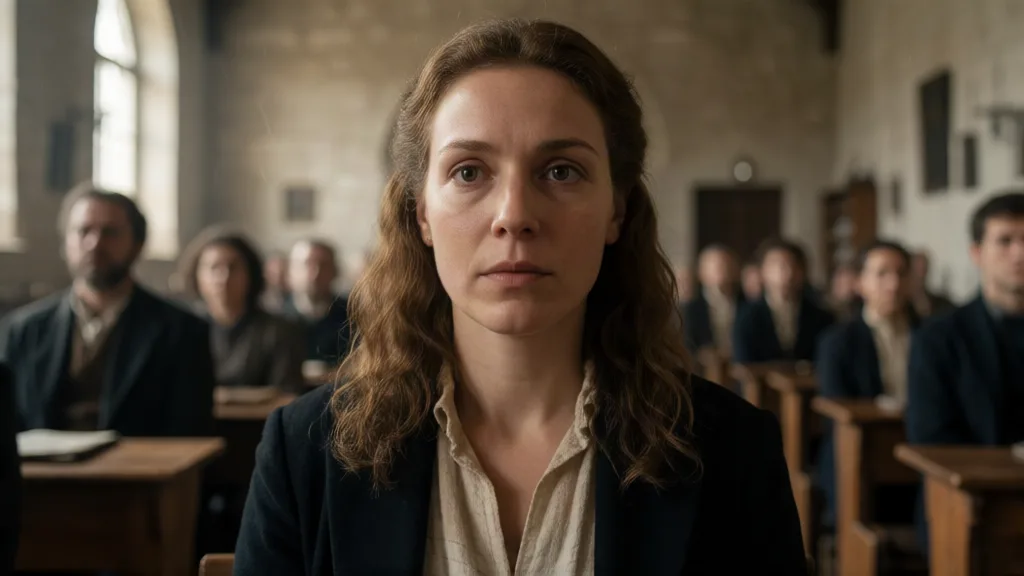
The cobblestones were still wet from the morning market when they brought me to the square. I remember that because I was barefoot, and the cold seeped up through the soles of my feet before anything else had even begun. A woman selling dried figs from a wooden cart watched me pass. She didn't look away. Nobody looked away.
My mother had warned me about this day. Not in words, exactly. She'd warned me the way mothers do, with the tightening of her jaw when I came home late, with the way she'd leave a bowl of soup on the table and not ask where I'd been. She knew what I was doing. She knew about the letters.
The magistrate's platform stood at the north end of the square, three steps up, made of the same gray stone as everything else in this town. I'd walked past it a thousand times. Bought bread near it, argued with my sister near it, once kissed a boy behind it when I was fifteen and stupid. Now two men I didn't know held my arms and walked me toward those steps, and the crowd parted for us like water around a stone.
I counted the faces. I don't know why. Maybe to keep from counting the seconds. There was old Marta from the bakery, flour still on her apron. There was the blacksmith's son, who I'd gone to school with, his mouth a flat line. There was the priest, standing near the fountain, his hands folded into his sleeves. And there, at the edge of the crowd, half-hidden behind the well, was my sister. She was crying. I wanted to tell her to stop, that crying made it worse, that people would remember her tears longer than they'd remember my punishment. But I couldn't say anything. My voice had gone somewhere I couldn't reach.
The magistrate read the charge in a bored voice, the way a man reads a grocery list.
"Public indecency. Unlawful correspondence with a married man. Conduct unbecoming a woman of this parish."
Conduct unbecoming. I almost laughed. The letters were in a box under my bed, tied with blue ribbon, and they were the only beautiful thing I'd ever made. Not the letters themselves. What I'd written back.
The magistrate asked if I had anything to say. I shook my head. What was there to say? That I loved him? That he'd told me he was leaving his wife, that they slept in separate rooms, that he'd never loved her, all the things men say when they want something? I could have said all of it. It wouldn't have changed the stone under my feet or the hands on my arms or the crowd that had come to watch.
"Proceed," the magistrate said.
The men turned me around. I faced the crowd now. That was worse. I'd rather have looked at the platform, at the magistrate's bored face, at the priest's folded hands. But no. They wanted me to see. They wanted everyone to see.
Someone pulled at the back of my dress. The fabric was old, thin, a hand-me-down from my mother that I'd mended twice at the hem. I heard it tear before I felt the air on my skin. Then the skirt was around my ankles and my hands were being tied to a post I hadn't noticed before, a short wooden post at the edge of the platform, waist-high, angled so that anyone standing in the square could see everything.
The first strike came before I was ready. A leather strap, I think. It made a sound like a book being dropped on a table. The pain arrived a half-second later, a line of fire across my backside that made my knees buckle. I bit the inside of my cheek until I tasted copper.
I didn't count the strikes. I counted the faces instead. Marta from the bakery, who had once given me a free roll when I was seven and hungry. The blacksmith's son, whose name I couldn't remember now, who had once held my hand under a desk in school. The priest, who had baptized me, who had watched me grow up, who now watched me bleed.
And my sister. Still crying. Still half-hidden. I fixed my eyes on her and didn't look away.
By the tenth strike, I couldn't feel my legs. By the fifteenth, I couldn't feel anything except the rhythm of it, the way the strap came down and the way my body jerked forward and the way the crowd made a sound like wind through dry grass. Not cheers. Not exactly. Something quieter than that. A collective breath, maybe. A murmur. The sound people make when they're watching something they know they shouldn't but can't stop watching.
I thought about the letters. Not the words I'd written, but the words he'd written. *Your skin is like milk in moonlight.* That's what he'd said. *I would cross oceans for you.* He hadn't crossed an ocean. He hadn't even crossed the square. He was probably at home, right now, eating lunch. His wife probably didn't know. Or maybe she did. Maybe she was the one who'd told the magistrate. I'd never know.
The strap stopped.
I hung there for a moment, my wrists still tied to the post, my body a map of pain. Then someone untied me and I fell forward onto my hands and knees on the stone. The crowd was dispersing. Marta was already walking back toward her cart. The blacksmith's son had turned away. Only my sister stayed, and after a moment she came to me, crouched down, and pulled my torn dress back over my hips.
"Get up," she whispered. "Please get up."
I got up. My legs shook. The square was almost empty now. The fountain trickled. A dog nosed at something near the well. The magistrate had already gone inside.
My sister put her arm around me and we walked home the long way, through the alley behind the church, where nobody would see. The stones were still cold. My feet were still bare. I didn't cry until we reached the door of our mother's house, and then I cried the way you cry when you've been holding it in for so long that it doesn't feel like crying anymore. It feels like drowning.
My mother opened the door. She looked at my face, then at my ruined dress, then at my sister's arm around my waist. She didn't say anything. She stepped aside and let us in.
That night, I burned the letters. All of them. The blue ribbon, too. I watched the paper curl and blacken in the fireplace and I thought about the word the magistrate had used. *Unbecoming.* As if becoming was something a woman could do on her own. As if it wasn't something other people decided for you, in squares, with straps, while the whole town watched.
The next morning, I woke before dawn. My backside was raw and every movement hurt. I got dressed anyway. I walked to the square, past Marta's cart, past the fountain, past the platform where I'd stood the day before. I didn't stop. I didn't look at anyone. I walked to the edge of town, where the road turned north, and I kept walking.
I didn't know where I was going. I only knew I wasn't coming back.
Watch this moment
Turn the current scene into a cinematic Live Chapter — what you watch becomes the story's next part.
Disclaimer
This is a work of fiction, assisted by artificial intelligence. Any names or characters, businesses or places, events or incidents, are fictitious. Any resemblance to actual persons, living or dead, or actual events is purely coincidental.
Content Removal Policy
- Users may report content that may be illegal or violates our Standards.
- All reported complaints will be reviewed and resolved within seven business days.
- Review Process: Our team will assess the reported content against our guidelines.
- Appeals: If you disagree with a decision, you may appeal within 14 days of notification.
- Potential outcomes include: content removal, account warning, or no action if no violation is found.
To report content, email us at [email protected]