Share
Go Live
Hungry Mares
·
Published 9/27/2026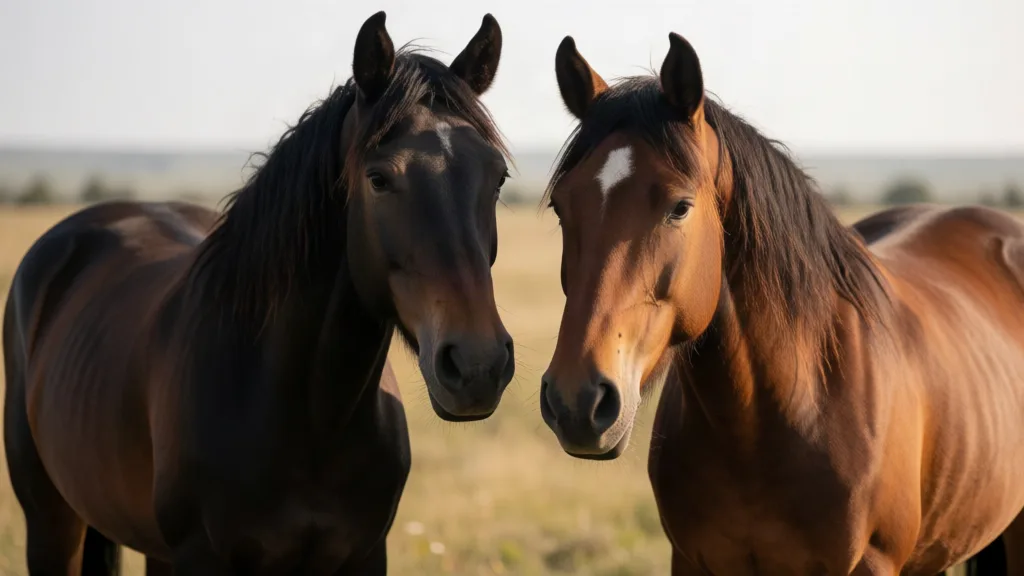
The first mare came to me in a dream three nights before she arrived in the flesh, and in the dream she was made of river water, her mane a current of dark weeds, her hooves striking sparks off stones that weren't there. I woke with my mouth tasting of iron and salt. I was nineteen years old and I had never touched a horse.
My grandmother kept the ledger in the bottom drawer of the sideboard, under the good tablecloth we never used. She wrote in it every evening after the dishes were dried, her pen scratching like a hen's foot in the dirt. Births, deaths, sales, the weather, the price of feed. She'd been keeping it since before I was born. The book had a green cover and the spine was broken in three places and if you opened it to any page you'd find her handwriting getting smaller and smaller as she tried to fit more of the world into less space.
The morning after the dream I asked her what it meant.
She didn't look up from the stove. "Means you slept with your window open."
"It was closed."
"Then it means you ate something that didn't agree with you."
I let it go. You learned to let things go with her. She was a woman who had buried a husband and two sons and a daughter and still got up before dawn to feed the chickens, and she didn't have patience for dreams. What she had patience for was the land. Two hundred acres of it, most of it clay and rock, and she knew every fence post and every drainage ditch and every place where the creek jumped its bank in a hard rain. She'd taught me to read the sky the way other people read books. Red at night, sailor's delight. Red at morning, sailor's warning. She'd say it like a prayer.
We kept cattle then. Sixteen head of Angus, black as the inside of a cave, and they were stupid animals but they were ours. The horses had been gone for years. My grandfather had kept them, back when there was money for that kind of thing, but after he died she sold them off one by one and put the money into the mortgage and never talked about it. There was a photograph on the mantel of a chestnut gelding with a white blaze, and if you asked her about it she'd say, "That was Beau. He was a good horse," and then she'd find something else to do.
I'd never ridden. I'd never wanted to. The cattle were enough work, and horses seemed like a different kind of animal entirely, something that belonged to a different life. But the dream wouldn't leave me. I kept feeling the river water in my hair. I kept hearing the sound of hooves on stone.
On the third day the mares came.
There were seven of them, and they came up the county road at dusk like they'd been walking for a hundred years. No halters. No brand that I could see. The lead mare was gray, the color of woodsmoke, and she walked with her head low and her ears forward, and behind her the others followed in a loose line, and they didn't stop at our gate. They walked right through it. The latch was rusted and the hinge was loose and they pushed it open with their chests like it was nothing.
My grandmother was on the porch with her coffee. She watched them come and she didn't say a word. The mares walked past the barn, past the water trough, past the hay shed, and they stopped in the far pasture where the grass was thick and the creek ran along the fence line. They put their heads down and started grazing like they'd lived there all their lives.
I stood at the fence and counted them. Seven. The gray one looked at me and I felt something turn over in my chest.
"Whose are they?" I said.
My grandmother took a sip of her coffee. "Nobody's."
"They have to belong to somebody."
She shook her head. "No tags. No brands. Nobody's been looking for them. They're nobody's."
We called the sheriff the next morning. He came out and looked at them and said he'd check the lost stock reports, but he didn't seem hopeful. "Horses get dumped out here all the time," he said. "People can't afford them anymore. They just open the trailer door and let them go."
"They're not dumped," I said. "They're too calm. Somebody handled them."
The sheriff looked at me like I was a child. I was nineteen and I looked younger, I knew that. "Miss, I've seen horses that were handled and horses that weren't. These ones don't have a mark on them. No shoes. No saddle marks. They're wild as deer."
But they weren't. I knew they weren't. The gray mare let me walk right up to her. She let me put my hand on her neck. Her coat was warm and rough and she smelled like grass and sweat and something older, something like rain on dry ground. She turned her head and pressed her muzzle into my palm and I felt the breath go out of her, long and slow, like she'd been holding it.
"We can't keep them," my grandmother said that night. "We can't afford them."
"They're not costing us anything. They're eating grass."
"Grass is money."
"Then I'll pay for it. I'll get a job."
She looked at me over her glasses. "You think you're the first person to fall in love with a horse?"
"No," I said. "But I think I'm the first person to fall in love with these."
She didn't answer. She went back to her ledger and wrote something down and closed the book and put it in the drawer. I lay in bed that night and listened to the mares moving in the pasture. I could hear them grazing, the soft rip and tear of grass, the occasional snort, the shift of weight from one hoof to another. I could hear the creek. I could hear my own heart.
The gray mare came back in my dream. This time she wasn't made of water. She was made of fire, and she was running, and behind her the other six ran with her, and they ran through fields I'd never seen, fields that went on forever, and I was running with them. I was barefoot and my hair was loose and I wasn't afraid. I woke up crying and I didn't know why.
In the morning I went out to the pasture and the gray mare was waiting for me at the gate. She looked at me with her dark eyes and I looked at her and I knew, the way you know things in dreams, that she had come here for a reason. That all seven of them had come here for a reason. That whatever was going to happen next had already started, had started before I was born, had started in my grandmother's ledger and in the photograph on the mantel and in the way the creek jumped its bank in a hard rain.
I put my hand on her neck and she leaned into me and I thought, I don't know what you want from me. But I'm going to find out.
Watch this moment
Turn the current scene into a cinematic Live Chapter — what you watch becomes the story's next part.
Disclaimer
This is a work of fiction, assisted by artificial intelligence. Any names or characters, businesses or places, events or incidents, are fictitious. Any resemblance to actual persons, living or dead, or actual events is purely coincidental.
Content Removal Policy
- Users may report content that may be illegal or violates our Standards.
- All reported complaints will be reviewed and resolved within seven business days.
- Review Process: Our team will assess the reported content against our guidelines.
- Appeals: If you disagree with a decision, you may appeal within 14 days of notification.
- Potential outcomes include: content removal, account warning, or no action if no violation is found.
To report content, email us at [email protected]