Share
Go Live
Painted Monsters
·
Published 10/5/2026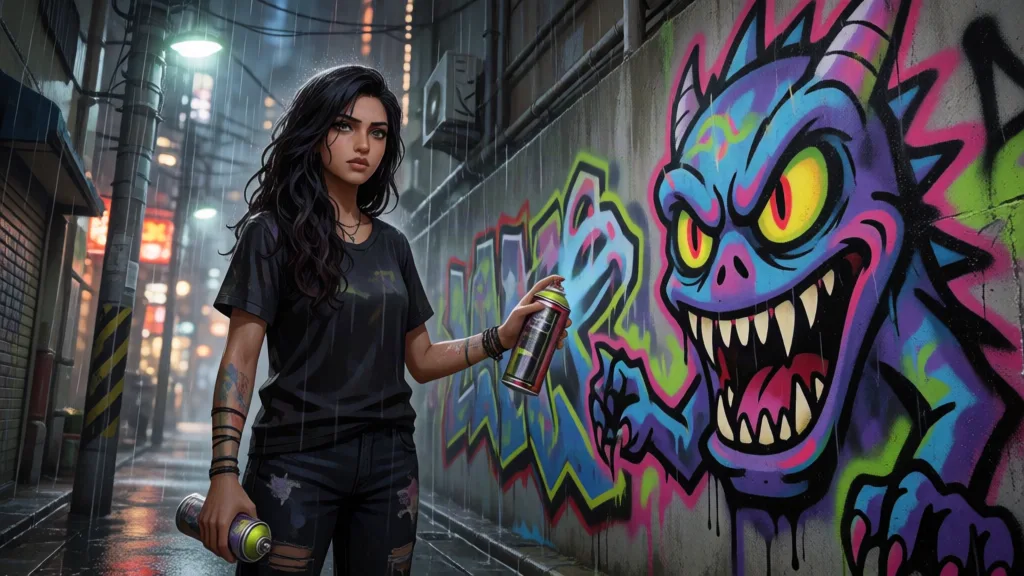
The rain came down like it had a grudge against Tokyo, and I was ankle-deep in it, shaking a can of Montana Black that had maybe two good bursts left. The alley behind the Shibuya love hotel district smelled like wet garbage and old ramen, and the only light came from a flickering vending machine that sold used underwear and canned coffee to men who couldn't look you in the eye. Perfect. That's what I needed. Dark, wet, forgotten.
Nobody paints in this weather unless they're desperate or stupid. I was both.
The wall in front of me was concrete, stained with decades of exhaust and somebody else's half-hearted tag from 2019 that just said *FUK U 2*. Real original. I'd been scouting this spot for three weeks, ever since I found the photograph in my mother's things. The photo showed a woman with my cheekbones and a smile that didn't reach her eyes, standing in front of a torii gate that no longer existed. The gate had burned down in 1995, the same year my mother stopped talking about her childhood. The same year she started locking her bedroom door at night.
I didn't know what I was looking for when I started painting. I just knew that when I held a spray can, the world made sense. The hiss of paint, the smell of solvent, the way a line could curve exactly where I wanted it to. Control. That's what art gave me. Control over something, anything, in a life where I controlled exactly nothing.
My name is Priya. I'm seventeen. I live in a two-bedroom apartment in Adachi with my mother and my grandmother, and I haven't spoken to my father since I was twelve. That's not the interesting part. The interesting part is what happened when I finished the mural.
I'd been working on it for two hours. My fingers were numb, my back ached, and the rain had soaked through my hoodie and into my bones. But the creature on the wall was almost done. It was a thing I'd seen in nightmares since I was a child, a shape that lived in the corner of my eye, always disappearing when I turned to look. Tall. Too tall. Limbs like broken branches, skin the color of old bruises, a mouth that opened in too many directions. I'd never been able to draw it before. Every time I tried, my hand would shake and the image would slip away.
Tonight was different.
Tonight, the image stayed.
I stepped back to look at my work. The creature filled the wall, twelve feet of twisted shadow and hunger. Its eyes were the only part I'd painted in color, a deep, pulsing red that seemed to glow even in the dim light. I hadn't planned that. I'd meant to leave them black. But my hand had moved on its own, reaching for the crimson can without my permission.
The rain hit the wall and the paint didn't run. That should have been my first clue.
I was packing up my bag when I heard it. A sound like wet leather tearing. I froze, one strap of my backpack over my shoulder, and turned slowly.
The creature's hand was moving.
Not moving like paint dripping. Moving like fingers flexing. The concrete buckled outward, cracking in a spiderweb pattern around the creature's wrist. The red eyes blinked. Actually blinked.
I didn't scream. I wanted to. Every nerve in my body was screaming. But my throat had closed up, and all I could do was watch as the thing I'd painted peeled itself off the wall like a sticker, its body unfolding in ways that shouldn't have been possible. Its feet touched the wet asphalt and the puddle beneath them hissed and turned to steam.
The creature looked at me. Its head tilted, joints popping, and that mouth opened in too many directions, revealing teeth that were also wrong, too many, too sharp, arranged in spirals instead of rows.
"You," it said.
Its voice was like gravel in a blender. It had no business speaking. It had no business existing.
I ran.
I ran like I hadn't run since middle school gym class, when I was always picked last and always finished last. But tonight my legs were pistons, my lungs were bellows, and the alley stretched in front of me like a throat. Behind me, I heard the creature moving. Not footsteps. Something worse. A sound like a thousand insects crawling over each other, like bones being ground into powder, like the noise my grandmother made when she prayed to gods I didn't believe in.
I burst out of the alley and onto the main street. Neon signs bled pink and blue into the rain. A few salarymen stumbled past, umbrellas tilted against the wind, and none of them looked at me. None of them saw the thing behind me. I knew they didn't because if they had, they would have screamed too.
I ducked into the first open door I saw. A convenience store, bright and sterile, the kind of place that sold onigiri and porn magazines and little bottles of whiskey to teenagers who thought they were clever. The clerk looked up from his phone. He was young, maybe twenty, with a face that hadn't seen enough of the world to be surprised by anything.
"Customer?" he asked.
I leaned against the counter, gasping. "Just. Give me a minute."
He shrugged and went back to his phone. I turned to look out the window. The street was empty. No creature. No broken concrete. Just rain and neon and the distant rumble of the Yamanote line.
I stayed in that store for an hour. I bought a bottle of water I didn't drink and a pack of gum I didn't chew. The clerk didn't ask questions. That's the thing about Tokyo. You can be bleeding out in the middle of the street and people will step around you. It's not cruelty. It's politeness. It's the belief that everyone deserves their privacy, even when they're falling apart.
At midnight, I walked home.
My mother was still awake when I came in. She was sitting at the kitchen table with a cup of tea that had gone cold, her phone in her hand, her face a mask of worry that I'd seen so many times it had stopped meaning anything.
"You're late," she said.
"I know."
"It's raining."
"I know."
"You could have called."
I could have. I didn't. That was the whole point.
I went to my room and closed the door. My grandmother was asleep in the next room, her breathing a soft rasp through the paper walls. I lay on my bed and stared at the ceiling and tried to convince myself that I'd imagined it. The creature. The voice. The way the concrete had cracked like an eggshell.
I almost succeeded.
Then I heard the scratching.
It came from my sketchbook. The one I kept on my desk, filled with drawings I never showed anyone. I sat up slowly, my heart hammering, and watched as the pages flipped on their own. One by one, like a wind I couldn't feel. They stopped on a drawing I'd done last week. A small thing, barely a doodle. A creature with too many legs and a single eye, the kind of thing you'd find under a rock in a fairy tale.
The eye blinked.
I slammed the sketchbook shut and shoved it in a drawer. Then I sat there, breathing hard, and realized that I had no idea what I was dealing with. But I knew someone who might.
His name was Abdul, and he ran a convenience store in Kabukicho. Not the one I'd hid in tonight. A different one, smaller, older, the kind of place that had been there for fifty years and would be there for fifty more. I'd met him two years ago, when I was fifteen and stupid and trying to buy cigarettes with a fake ID that looked like it had been drawn with crayons. He'd laughed at me. Not meanly. Just laughed, and then he'd given me a melon pan and told me to come back when I was older.
I'd come back anyway. Not for cigarettes. For the quiet. Abdul's store was the only place in the city where I felt like I could breathe. He didn't ask questions. He didn't judge. He just poured me tea from a thermos he kept behind the counter and let me sit in the corner and draw.
He was also the only person I knew who believed in things that didn't exist. Not in a crazy way. In a quiet way. He had a prayer mat rolled up behind the counter and a string of prayer beads hanging from the register, and once, when I'd asked him why he kept them there, he'd said, "Because the world is bigger than what we see."
I needed bigger right now.
I waited until my mother went to bed. Then I climbed out my window and took the train to Shinjuku. The streets were still wet, the neon still bleeding, and the people still didn't look at me. I walked past host clubs and karaoke bars and love hotels with names like Hotel Paradise and Hotel Dream, and I didn't stop until I saw the familiar sign: Abdul's Mart, Open 24 Hours.
The lights were on. Abdul was behind the counter, reading a book. He looked up when I walked in and his expression shifted from surprise to concern in the space of a heartbeat.
"Priya," he said. "It's late."
"I know."
"You look terrible."
"Thanks."
He set down his book. It was a worn copy of something in Urdu, the pages yellowed with age. He'd told me once that he read it every year, that it was the only thing that kept him grounded when the world got too loud.
"What happened?" he asked.
I opened my mouth to tell him. To tell him everything. The mural. The creature. The way the paint had moved on its own. But the words wouldn't come. They stuck in my throat like bones, and all I could do was stand there, dripping on his clean floor, and shake.
Abdul didn't push. He just walked around the counter and took my hand. His palm was warm and dry, and the silver ring on his finger pressed into my skin.
"Come," he said. "Sit."
He led me to the corner where I always sat, the one with the old wooden chair and the stack of manga he let me borrow. He poured me tea from the thermos and sat across from me, waiting.
I took a sip. The tea was bitter and sweet at the same time, the way he always made it.
"I painted something tonight," I said.
"I figured."
"How?"
He smiled. It was a sad smile, the kind that comes from knowing too much. "Because you only come here at midnight when something's wrong. And you only paint at midnight when you're trying to fix it."
I looked down at my hands. They were still shaking. "It came to life, Abdul. The thing I painted. It came off the wall and it spoke to me."
He didn't laugh. He didn't tell me I was crazy. He just nodded, slow and thoughtful, and said, "What did it say?"
"It said 'you.'"
He was quiet for a long moment. Then he reached under the counter and pulled out a small wooden box. It was old, older than the store, older than him, the kind of box that had been passed down through generations. He opened it and took out a piece of paper, folded into a tiny square.
"This was given to me by a man who came through here ten years ago," he said. "He was running from something. Something he'd made. He told me that if I ever met someone who could bring their art to life, I should give them this."
He handed me the paper. I unfolded it with trembling fingers. Inside was a single sentence, written in a language I didn't recognize.
"What does it say?" I asked.
"It says: 'The monster is not the paint. The monster is the painter.'"
I stared at him. "That doesn't help."
"No," he agreed. "It doesn't. But it's true."
I wanted to argue. I wanted to tell him that I wasn't a monster, that I was just a girl who liked to draw, that none of this was my fault. But the words died in my throat because I remembered the creature's eyes. Those red, pulsing eyes. They hadn't looked at me like I was a stranger. They'd looked at me like I was their mother.
"I have to go back," I said.
"Go back where?"
"To the alley. To the mural. I have to finish it."
Abdul's expression didn't change, but his hand tightened around his tea cup. "Why?"
"Because if I don't, it'll keep coming. And I don't think it's the only one."
He was silent for a long time. The store clock ticked. The rain tapped against the windows. Somewhere in the distance, a train rumbled past.
"Then I'm coming with you," he said.
"No."
"Yes."
"Abdul, you don't even know what we're dealing with."
"I know enough." He stood up and walked to the back of the store. When he returned, he was holding a crowbar. "I've been running this shop for six years. I've seen things I can't explain. I've learned that sometimes the only thing you can do is show up."
I wanted to tell him no. I wanted to tell him that this was my mess, my problem, my monster. But I was seventeen and scared and the only person in the world who'd ever looked at me without judgment was standing in front of me with a crowbar and a prayer mat and a quiet determination that made me want to cry.
"Okay," I said. "But if we die, I'm blaming you."
He smiled. "Fair enough."
We left the store at 1:47 AM. The rain had stopped, but the streets were still slick, reflecting the neon like a mirror. We walked in silence, past the love hotels and the karaoke bars, past the convenience store where I'd hidden earlier, past the alley where I'd first seen the creature.
The alley was empty.
The mural was gone.
Not painted over. Not washed away. Gone. The wall was smooth and clean, as if nothing had ever been there. No cracks. No paint. No creature.
"What the hell," I whispered.
Abdul stepped forward, his crowbar raised. He ran his hand over the concrete, his fingers tracing the place where the creature's hand had been.
"It's warm," he said.
I touched the wall. He was right. It was warm, like skin, like something alive. I pulled my hand back and stared at my palm. There was paint on it. Red paint. The same red I'd used for the creature's eyes.
"It's inside," I said.
"What?"
"The mural. It's not gone. It's inside the wall."
Abdul looked at me, then at the wall, then at the crowbar in his hand. "What do we do?"
I didn't answer. Because I didn't know. Because the only thing I knew was that I'd created something, and now it was trapped, and I had no idea how to get it out or if I even wanted to.
I thought about my mother. About the photograph. About the torii gate that had burned down the year she stopped talking about her childhood. I thought about the nightmares I'd had since I was a child, the shape in the corner of my eye, the thing I could never draw until tonight.
And I thought about the words on the paper. *The monster is not the paint. The monster is the painter.*
"Abdul," I said. "I think I need to tell you about my mother."
He looked at me, his dark eyes steady, his crowbar still raised.
"I'm listening," he said.
So I told him. About the photograph. About the torii gate. About the way my mother had locked her door at night, every night, for as long as I could remember. About the things I'd heard through the wall, the whispers, the scratching, the sounds that didn't come from any human throat.
"She was like me," I said. "She could do it too. She could bring things to life. And I think something went wrong."
Abdul was quiet for a long time. Then he lowered the crowbar and said, "We need to find her."
"She won't talk to me. She never talks about the past."
"Then we make her."
I laughed. It was a hollow sound, the kind of laugh that comes when you have nothing else left. "You don't know my mother."
"No," he said. "But I know you. And I know that whatever's in that wall, whatever's been hiding in your family for generations, it's not going to stay quiet forever."
He was right. I could feel it. The wall was warm against my back, and somewhere deep inside, something was moving. Something was waiting. And I had a feeling that the next time it came out, it wouldn't just say *you*.
It would say *mine*.
I looked at Abdul. He looked at me. And in the silence of that empty alley, with the neon bleeding and the city sleeping and the rain starting to fall again, I made a decision.
"I'm going to finish the mural," I said. "But not here. Somewhere else. Somewhere no one will get hurt."
"Where?"
"I don't know yet. But I'm going to find out."
He nodded. "Then I'm coming with you."
I didn't argue this time. I just took his hand and let him lead me out of the alley, away from the warm wall and the creature inside it, away from the life I'd known and into something I didn't understand.
The rain fell harder. The city stretched in front of us like a maze. And somewhere in the dark, something else was waking up.
Watch this moment
Turn the current scene into a cinematic Live Chapter — what you watch becomes the story's next part.
Disclaimer
This is a work of fiction, assisted by artificial intelligence. Any names or characters, businesses or places, events or incidents, are fictitious. Any resemblance to actual persons, living or dead, or actual events is purely coincidental.
Content Removal Policy
- Users may report content that may be illegal or violates our Standards.
- All reported complaints will be reviewed and resolved within seven business days.
- Review Process: Our team will assess the reported content against our guidelines.
- Appeals: If you disagree with a decision, you may appeal within 14 days of notification.
- Potential outcomes include: content removal, account warning, or no action if no violation is found.
To report content, email us at [email protected]