Share
Go Live
Roots of Knowing
·
Published 10/1/2026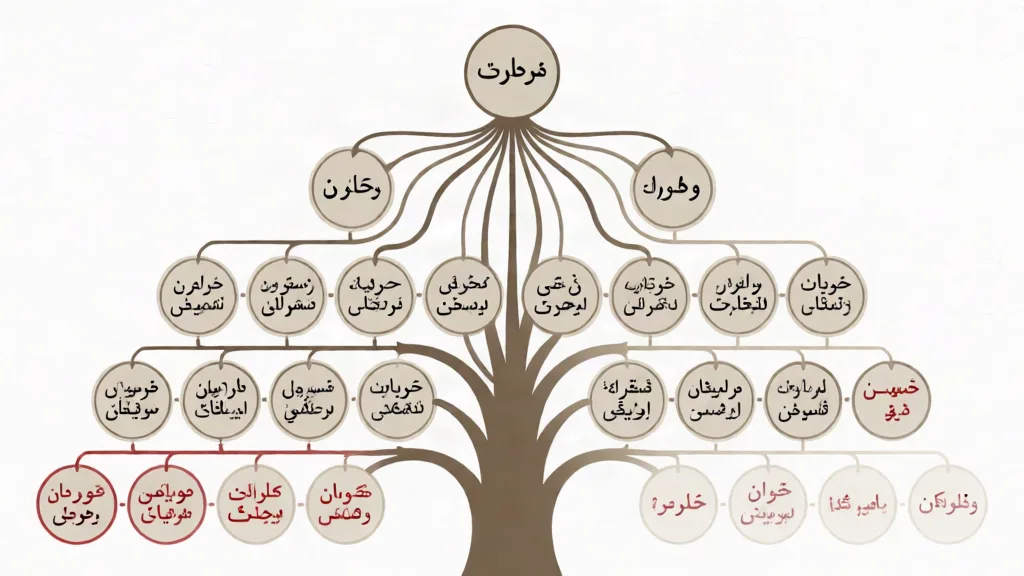
My grandmother's hands were the first thing I learned to read.
Before I knew the alphabet, before I understood that the black marks in books were words and the words were stories, I understood her fingers. How they moved when she talked about the old country. How they stilled when she didn't want to talk about it at all. The way her thumb pressed into her palm when she was calculating something, prices at the market, the weight of saffron, the years since she'd last seen her sister.
She was teaching me to write Farsi before I could write English. This was not a political statement. It was simply what she knew. Every afternoon after school, I'd sit at her kitchen table, the one with the cracked laminate and the permanent smell of cardamom, and she would draw the letters for me. Alef. Be. Pe. The shapes like code, like little houses with doors and windows, each one a container for a sound my throat was still learning to make.
"Again," she'd say, when my alef leaned too far right. "The line must stand straight. Like a spine."
I was seven. I didn't care about spines. I cared about the cookies she kept in the tin on top of the refrigerator, the ones with the walnut halves pressed into the center, and whether my best friend Maya would still want to play with me if I smelled like cardamom.
But I drew the letters anyway. Alef, standing straight. Be, with its single dot below. Pe, with three dots, like a constellation I was learning to navigate.
My grandmother's name was Soraya. She'd been in this country for thirty-one years and still said "this country" like it was a place she was visiting, not a place she lived. She'd come in 1979, when the revolution turned her neighborhood into something unrecognizable, when the university where she taught literature closed its doors to women like her, when her husband, my grandfather, a man I never met, decided they would leave.
He died three years after they arrived. Heart attack. She never remarried. She never went back.
"You have his hands," she told me once, watching me draw. "The same long fingers. Good for holding pens."
I looked at my hands. They seemed ordinary to me. Small and brown, with a scar on my left thumb from a kitchen accident, a crescent-shaped mark that I used to think looked like the moon.
"Were his hands like mine?"
"Exactly." She said it like a fact, not a compliment. "He could have been a calligrapher. But he chose medicine. He said he wanted to fix things that were broken, not make beautiful things that would only fade."
She paused. Her thumb pressed into her palm.
"He was wrong about that. Beautiful things don't fade. They just change shape."
I didn't understand her then. I was seven and the only thing I wanted to fix was the gap between my two front teeth, which I'd been told would close on its own but hadn't yet, and which made me whistle when I said certain words.
But I remembered what she said. I remembered everything she said, even when I didn't understand it, because her voice had a way of settling into me like sediment, layer by layer, until it became part of the ground I stood on.
The kitchen was small. Yellow walls, a window that looked out onto the alley behind our building, where the neighbor's cat, a fat orange tabby named Mister, liked to sit and judge the world. The refrigerator hummed. The clock above the stove ticked. And my grandmother drew letters on the backs of envelopes, on the margins of newspapers, on any scrap of paper she could find, because she believed that words should never be wasted, not even the ones you were just practicing.
"Write your name," she said one afternoon, pushing a fresh envelope toward me.
I wrote it in English first. Sarah. Easy. Five letters, all of them familiar.
"No." She tapped the paper. "Your real name."
I knew what she meant. My real name, the one on my birth certificate, the one she'd chosen for me before I was born. Sahar. It meant dawn. It meant the moment before the sun rises, when the sky is still dark but you can feel the light coming.
I wrote it slowly. Seen. Heh. Alef. Reh. The letters connected, flowing into each other like water finding its path downhill.
"Good," she said. "Now you see? It's not just a name. It's a picture. It's a promise."
I looked at the word I'd written. I tried to see it the way she did, not as letters but as a shape, a form that held meaning the way a bowl holds soup.
"It doesn't look like dawn," I said.
"Not yet. You have to learn to see it."
That was the thing about my grandmother. She was always asking me to see things differently. To look at a word and see a picture. To look at a picture and see a story. To look at a story and see the truth underneath, the thing that was really being said.
She died when I was nineteen.
I was in my second year of college, studying something practical, something my parents approved of, which meant something that could lead to a job. I was good at it. I was good at a lot of things I didn't care about.
The call came on a Tuesday. My mother's voice, thin and careful, the way she sounded when she was trying not to cry. "It's your grandmother. You should come home."
I took the train. Four hours, the landscape sliding past the window, the familiar blur of towns and fields and parking lots. I didn't cry. I didn't feel anything, really, just a kind of numbness, a waiting. I kept thinking about the last time I'd seen her, two months before, when she'd made me tea and asked about my classes and I'd told her about the internship I was applying for, something in finance, something I didn't want but thought I should want.
She'd listened. She'd nodded. And then she'd said, "You know, Sahar, the world has enough people who are good at things they don't care about."
I'd brushed it off. I was nineteen. I knew everything.
When I got to the hospital, she was already gone. My mother met me in the hallway, her eyes red, her hands shaking. She held me for a long time. And then she said, "She left something for you. In her apartment. She wanted you to have it."
The apartment was the same as I remembered. The yellow walls, the ticking clock, the smell of cardamom that would never leave, no matter how many years passed or how many tenants came and went. My mother had a key. We went in together.
On the kitchen table, there was a box. A shoebox, old and worn, with a rubber band around it. My name was written on the top in my grandmother's handwriting. Sahar. In Farsi. The letters connected, flowing into each other like water.
I sat down at the table. The same table. The same cracked laminate. I pulled off the rubber band.
Inside, there were envelopes. Dozens of them. All the scraps of paper she'd ever used to teach me letters, to practice words, to write my name. She'd kept them. Every single one.
I spread them out on the table. Alef. Be. Pe. My name, written over and over in my seven-year-old hand, shaky and uncertain. My name, written in her hand, steady and sure. Words I'd forgotten. Words I'd never known.
And at the bottom of the box, there was a letter. In Farsi. Addressed to me.
I couldn't read it. Not all of it. I'd stopped practicing years ago, when I'd decided that being American was more important than being Persian, when I'd decided that the past was something you could leave behind if you tried hard enough.
But I could read some of it. Enough to understand.
She wrote about the tree.
The tree of words, she called it. The way language grows, branches spreading, roots deepening. She wrote about the words she'd taught me, the ones I'd forgotten, the ones I'd never learned. She wrote about the spaces between words, the silences that held as much meaning as the sounds.
And she wrote about me. About the dawn. About the promise.
I sat at that table for a long time. The clock ticked. The refrigerator hummed. Outside, Mister the cat, older now, fatter, still judging the world from his spot in the alley.
I picked up a pen. I found a blank envelope, one she'd saved for exactly this purpose, for a word that hadn't been written yet.
And I started to draw the letters. Alef, standing straight. Be, with its single dot. Pe, with its three dots, like a constellation.
My hands were shaking. But they were her hands too. The same long fingers. Good for holding pens.
I wrote my name. Sahar. The letters connected, flowing into each other.
And for the first time in years, I tried to see it. Not as letters, but as a shape. Not as a word, but as a promise.
Dawn. The moment before the sun rises.
I had a lot to learn.
Watch this moment
Turn the current scene into a cinematic Live Chapter — what you watch becomes the story's next part.
Disclaimer
This is a work of fiction, assisted by artificial intelligence. Any names or characters, businesses or places, events or incidents, are fictitious. Any resemblance to actual persons, living or dead, or actual events is purely coincidental.
Content Removal Policy
- Users may report content that may be illegal or violates our Standards.
- All reported complaints will be reviewed and resolved within seven business days.
- Review Process: Our team will assess the reported content against our guidelines.
- Appeals: If you disagree with a decision, you may appeal within 14 days of notification.
- Potential outcomes include: content removal, account warning, or no action if no violation is found.
To report content, email us at [email protected]