Share
Go Live
Love in a Girl's School
·
Published 8/15/2026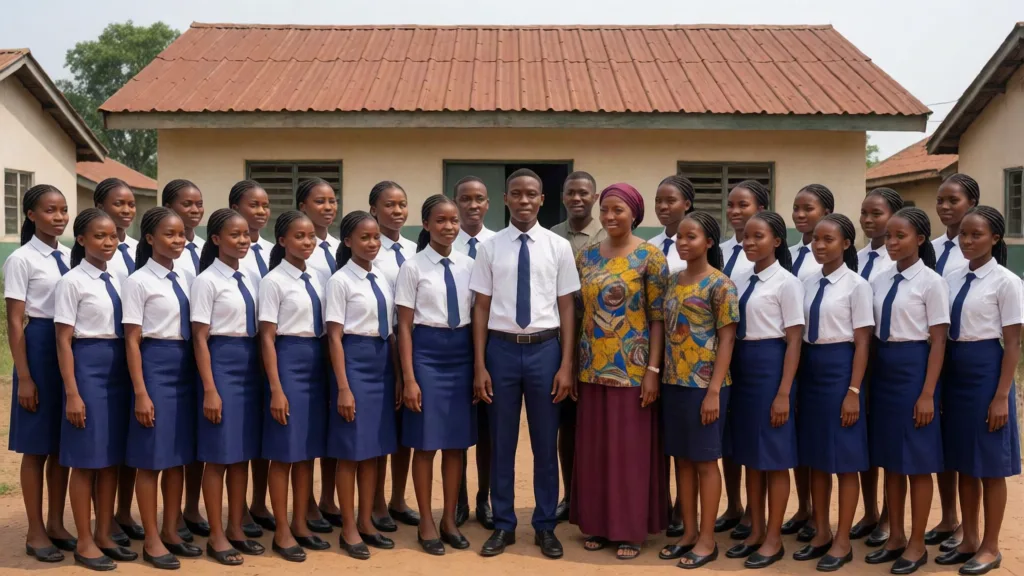
The first bell had already rung by the time I remembered I was the only boy in a school of seven hundred and eighty-three girls.
My mother’s Toyota jerked to a stop at the gate of Maryland Girl’s High School, and she turned to me with the kind of smile that meant she was about to say something I didn’t want to hear. “Emmanuel, be a man today.”
“I’m fifteen, Mummy.”
“Exactly. Be a man.”
She reached over and straightened my collar, her fingers lingering on the knot of my tie like she was checking for a pulse. I sat there in the passenger seat, staring at the pink and white gates ahead of us. Two massive pillars painted like candy canes, topped with a sign that read MARYLAND GIRL’S HIGH SCHOOL in swirling gold letters. The kind of place that looked like it belonged in a magazine. The kind of place that had no business admitting a boy.
“You have your schedule?” she asked.
“Yes.”
“Your water bottle?”
“Yes.”
“Your emergency contact card?”
“Mummy, I have everything.”
She nodded, but her eyes stayed on me. I knew that look. It was the same look she’d worn when my father first told her about the scholarship. The look that said she was trying to decide whether this was a blessing or a curse. The scholarship was real. Full tuition, books, uniform allowance, even transport money. The only catch was the school itself. Maryland Girl’s High had been all-female for thirty-seven years. Then the government started pushing for gender inclusion in STEM programs, and the school needed a male student to keep their federal funding. I was the first. The only.
I was the test case.
My mother checked her phone. “Seven forty-two. You have eight minutes before assembly. Go.”
I grabbed my bag and stepped out. The heat hit me first. September in Lagos was not a season, it was a punishment. The air was wet and thick, like breathing through a warm towel. I walked toward the gate, and the security guard, a man in his fifties with a face like cracked leather, stopped me with one hand.
“You must be the boy.”
“I must be.”
He laughed, a dry sound that turned into a cough. “My name is Alhaji. If you need anything, you come to me. Water, air, escape route. I am here.”
“Thank you, sir.”
“Don’t thank me yet. Go inside. They are waiting for you.”
They were waiting. I felt it the moment I passed through the gate. The compound opened up in front of me, a wide courtyard ringed by three-story buildings painted in that same pink and white. Flower beds lined the walkways. A statue of some woman I didn’t recognize stood in the center, holding a book in one hand and a torch in the other. And everywhere, everywhere, there were girls.
They moved in clusters, in pairs, in long lines that snaked toward the assembly hall. They wore white blouses and pink skirts, their hair in braids and buns and ponytails and styles I didn’t have names for. They carried books and phones and water bottles and the kind of confidence that comes from owning a space completely. And every single one of them stopped talking when they saw me.
It was like someone had pressed a mute button across the entire school. Heads turned. Eyes widened. A girl near the statue dropped her phone, and the sound of it hitting the concrete was loud enough to echo. She didn’t pick it up. She just stared at me, mouth open, like I was a ghost that had wandered into her living room.
I kept walking.
I had a plan. Find the administration block, check in with the principal, get to my first class. That was it. Don’t make eye contact. Don’t stop. Don’t give them anything to talk about. But the silence followed me. It rippled outward from where I walked, spreading through the courtyard like a wave. I could hear whispers starting up behind me, low and quick, the sound of gossip being born.
“Is that him?”
“The boy?”
“He’s taller than I thought.”
“He’s not even fine.”
“Shut up, he’s fine.”
I kept my eyes forward.
The administration block was a two-story building at the far end of the courtyard, and I made it there without incident. Almost. As I reached the door, a girl stepped out of nowhere and blocked my path. She was tall, taller than me by a few inches, with sharp cheekbones and braids that fell to her waist. She wore a red sash across her chest, which I would later learn meant she was a prefect. Her name was Amara, and she looked at me like I had personally offended her ancestors.
“You’re the boy.”
“I’m starting to think that’s my name now.”
She didn’t smile. “You’re late.”
“The bell rang two minutes ago.”
“Assembly starts at seven thirty. You’re supposed to be in line with your class by seven twenty-five. That makes you late.”
I adjusted my bag strap. “I didn’t know.”
“Now you know.” She stepped aside and pointed toward a door on the left. “Principal’s office. She’s waiting for you. And after that, you report to the assembly hall. SS2 Alpha. Front row. Don’t be late again.”
“Yes, ma.”
She narrowed her eyes. “What did you call me?”
“Ma.”
“I’m not your mother. I’m Head Prefect Amara. You will address me as Head Prefect or Amara. Understood?”
“Understood.”
She stared at me for a moment longer, then turned and walked away. Her braids swung behind her like a whip. I watched her go, and I realized something I hadn’t considered before. The girls here weren’t just students. They were an ecosystem. They had hierarchies and rules and systems I didn’t understand yet. And I had just walked into the middle of it.
The principal’s office was cool, air-conditioned to a temperature that felt like a different country. A woman in her fifties sat behind a large wooden desk, her gray hair cut short and neat, her glasses perched on the bridge of her nose. She looked up when I entered and smiled. It was a warm smile, the kind that made you feel like you were welcome, even if you weren’t.
“Emmanuel Agwunobi.”
“Yes, ma.”
“I’m Mrs. Okafor. I’ve been looking forward to meeting you.” She stood and extended her hand. I shook it. Her grip was firm. “I won’t lie to you. This is going to be difficult. You are a pioneer. There is no manual for what you’re about to experience. But I want you to know that my door is always open. If you have a problem, you come to me. If you feel uncomfortable, you come to me. If you need to talk, you come to me. Understood?”
“Yes, ma.”
“Good.” She sat back down and pulled out a file. “Your schedule. You’re in SS2 Alpha, which is our top science class. Chemistry, Biology, Physics, Mathematics, Further Mathematics, English, Literature, Government, and Computer Science. Your teachers have been briefed. Your classmates have been briefed. The entire school has been briefed. You are not a curiosity. You are a student. Act like one, and you will be treated like one.”
“Yes, ma.”
She handed me a printed sheet. “Your first class is Chemistry with Mrs. Adebayo. Room 203. The assembly hall is to your left as you exit. Go.”
I took the sheet and turned to leave. Her voice stopped me at the door.
“Emmanuel.”
“Yes, ma?”
“There are fifty girls in your class. Some of them will be friendly. Some of them will not. Some of them will try to test you. Some of them will try to protect you. Do not mistake one for the other. And do not, under any circumstances, date any of them.”
I felt my face go hot. “I wouldn’t, ma.”
“I’m sure you wouldn’t. But I’m telling you anyway. This school has rules. You break them, and you’re out. No exceptions. Not even for the pioneer.”
She smiled again, but this time it didn’t feel warm. It felt like a warning.
Assembly was loud.
Seven hundred girls standing in rows, their voices rising in a chorus that shook the walls of the hall. I stood at the front with SS2 Alpha, my class, and I felt their eyes on me. All of them. The girls behind me, the girls beside me, the girls on the stage. Even the teachers were looking. A woman in a blue dress near the podium kept glancing in my direction like she was waiting for me to do something spectacularly stupid.
The principal gave a speech about excellence and discipline and the importance of maintaining the school’s standards. She didn’t mention me directly, but she didn’t have to. Every time she said the word “new,” every time she said “change,” every time she said “opportunity,” the entire hall turned to look at me.
I stood still and stared straight ahead.
After assembly, the crowd broke into chaos. Girls scattered in every direction, laughing and shouting and pushing. I tried to follow the flow toward the science block, but I got stuck. A group of girls surrounded me, all of them talking at once.
“What’s your name?”
“Are you really the only boy?”
“Do you have a girlfriend?”
“What’s your phone number?”
“Do you like your girls light-skinned or dark-skinned?”
That last question came from a girl with a round face and braids tied up in a bun. She was grinning, but her eyes were serious. I didn’t know how to answer, so I didn’t.
“I have to get to class.”
“Which class?”
“Chemistry.”
“Mrs. Adebayo’s class? She’s my favorite. I’ll take you.”
The girl with the round face grabbed my arm and pulled me out of the circle. Her name was Zainab, and she walked like she owned the hallway. She talked the whole way, a stream of information that I tried to keep up with.
“You’re in SS2 Alpha, right? That’s the smart class. I’m in SS2 Beta, which is also smart but not as smart. Don’t tell anyone I said that. Mrs. Adebayo is strict but fair. She doesn’t take nonsense. If you don’t do your homework, she will destroy you. Not literally. But emotionally. Also, stay away from the prefects. Especially Amara. She’s a monster. And don’t eat the food from the cafeteria on Fridays. It’s always fish, and the fish is always suspicious.”
“Noted.”
“Also, there’s a rumor that you’re related to someone important. Are you?”
“No.”
“Are you sure? Because someone said your father is a senator.”
“He’s an accountant.”
“Oh.” She sounded disappointed. “Well, that’s still respectable. Accountants make good money.”
We reached Room 203, and she let go of my arm. “Here you go. Good luck. You’ll need it.”
She walked away before I could thank her. I stood at the door, watching her disappear into the crowd, and then I turned and walked inside.
The classroom was already full. Fifty desks arranged in five rows of ten, and every single one of them was occupied. The girls looked up when I entered, and the same silence that had hit the courtyard hit the room. A woman at the front, tall and severe, with glasses that hung on a chain around her neck, looked at me over the top of her book.
“You must be Emmanuel.”
“Yes, ma.”
“I am Mrs. Adebayo. Find a seat. We have work to do.”
I scanned the room. There was one empty desk, at the back, near the window. I walked toward it, feeling the weight of fifty stares on my back. I sat down, pulled out my notebook, and tried to look like I belonged.
The girl beside me leaned over. She had a calm face, the kind of face that didn’t give anything away. Her hair was short, natural, and she wore a single silver earring in her left ear.
“I’m Chioma,” she whispered.
“Emmanuel.”
“I know.” She smiled, just a little. “You’re the only boy in the school. Everyone knows.”
“Right.”
“Don’t worry. It gets easier.”
“Does it?”
“No.” She laughed, quiet and quick. “But you get used to it.”
Mrs. Adebayo started the lesson. Organic chemistry. Hydrocarbons. I tried to focus, but my mind kept drifting. I thought about my sisters, Deborah and Precious, twins, both in SS2 Gamma. They had been excited when I got the scholarship. They had made me promise to visit them during break times. I hadn’t seen them yet. I wondered if they were having as hard a time as I was.
The lesson ended forty minutes later, and the bell rang. I gathered my things, but before I could leave, Mrs. Adebayo called my name.
“Emmanuel, stay back for a moment.”
I waited while the other girls filed out. Chioma gave me a look that said good luck, and then she was gone. The door closed, and I was alone with Mrs. Adebayo.
She sat on the edge of her desk and folded her arms. “How are you finding the school so far?”
“It’s a lot.”
“It will be. You’re a novelty. That will fade. But you need to be careful. There are girls here who will see you as a challenge. Something to conquer. Do not let them.”
“I won’t, ma.”
“Good. Also, I’ve been informed that you have a talent for mathematics. Is that true?”
I blinked. “I’m okay at it.”
“Your entrance exam scores say otherwise. You scored ninety-eight percent. That’s the highest in your class. You’ll be representing this school in the national mathematics competition next term. Start preparing now.”
“Yes, ma.”
“That’s all. You can go.”
I walked out of the classroom and into the hallway, and I almost collided with a girl who was standing right outside the door. She was small, with a sharp face and braids that fell to her shoulders. She held a notebook in her hands, and she was staring at me like I was a puzzle she was trying to solve.
“You’re Emmanuel.”
“Yes.”
“I’m Folake. I’m the editor of the school magazine. I want to interview you.”
“Now?”
“Now.”
She didn’t wait for an answer. She pulled a pen from her hair and flipped open her notebook. “First question. What do you think of Maryland Girl’s High School so far?”
“It’s pink.”
She looked up. “Pink?”
“The buildings. The uniforms. The gates. Everything is pink.”
“That’s not an answer.”
“It’s the only one I have.”
She wrote something down. “Interesting. Second question. Do you think being the only male student gives you an advantage or a disadvantage?”
“Both.”
“Elaborate.”
“Advantage is that everyone knows who I am. Disadvantage is that everyone knows who I am.”
She wrote again. “Third question. Are you single?”
I felt my face go hot. “What kind of interview is this?”
“A thorough one. Are you single?”
“Yes.”
“Noted.” She closed her notebook. “That’s all for now. I’ll find you later for follow-up questions.”
She walked away before I could respond. I stood there, holding my bag, wondering if every day at this school was going to be like this.
The morning passed in a blur of faces and names that I couldn’t keep straight. Biology with Mr. Ogun, a man in his forties who spoke so softly I had to lean forward to hear him. English with Mrs. Eze, who made us read a poem about a woman drowning and then asked me what I thought it meant. I said I didn’t know, and she said that was the wrong answer.
By the time lunch came, I was exhausted.
The cafeteria was a large hall with long tables and a counter at the back where women in white aprons served food. The smell of jollof rice and fried plantain filled the air, and for a moment, I felt almost normal. I joined the line, got my food, and looked for a place to sit.
That’s when I saw them. My sisters.
Deborah and Precious were sitting at a table near the window, surrounded by a group of girls. Deborah saw me first. She waved, and I walked over.
“Emmanuel!” Precious stood up and hugged me. “How are you? How was your morning? Are they treating you well?”
“It’s been a lot.”
“We heard,” Deborah said. “The whole school is talking about you.”
“I know.”
“Sit. Eat. Tell us everything.”
I sat down, and the girls around the table introduced themselves. There was Tolu, Bisi, Funmi, and a girl named Esther who didn’t say much but watched me with curious eyes. They asked questions, but they were gentler than the others. They were my sisters’ friends, so they treated me like family.
I ate my rice and listened to them talk. They talked about boys from other schools, about teachers they hated, about a party happening next weekend that they weren’t sure they could sneak out to. It was normal. It was the kind of conversation I would have heard at any school. And for a few minutes, I forgot that I was different.
Then the prefects came.
Amara walked into the cafeteria with three other girls wearing red sashes. They moved through the room like they were searching for something. When Amara’s eyes landed on me, she stopped.
She walked over to our table and stood in front of me. “Emmanuel. The principal wants to see you.”
“Now?”
“Now.”
I stood up. My sisters exchanged a look. I followed Amara out of the cafeteria, through the hallway, and back to the administration block. She didn’t say a word the whole way.
The principal’s office door was open. Mrs. Okafor was on the phone, and she waved me in without stopping her conversation. I sat down and waited. She hung up a few seconds later and looked at me with an expression I couldn’t read.
“Emmanuel, I just received a call from your father.”
My stomach dropped. “Is everything okay?”
“He’s fine. But he told me something I think you should know.” She paused. “Your father is a senator.”
I stared at her. “No, he’s not. He’s an accountant.”
“He told me himself. Senator Agwunobi. He represents Lagos East Senatorial District. He’s been a senator for the past four years.”
I felt the world tilt. “That’s not true. He works at a bank. He leaves every morning at seven and comes back at six. He wears a tie and carries a briefcase. He’s an accountant.”
Mrs. Okafor looked at me with something like pity. “Emmanuel, your father is a senator. He asked me to tell you himself. He said he wanted you to have a normal life. That’s why he didn’t tell you.”
“He lied to me.”
“He protected you.”
I didn’t know the difference.
She handed me her phone. “He wants to talk to you.”
I took the phone and walked out of the office. I stood in the hallway, staring at the screen. The call was already connected. I raised it to my ear.
“Dad?”
“Emmanuel.”
“You’re a senator?”
A long pause. “Yes.”
“Why didn’t you tell me?”
“Because I wanted you to be normal. I wanted you to have friends who liked you for you, not for who your father is. I wanted you to earn your place in that school, not have it handed to you because of my name.”
“You lied to me for four years.”
“I did. And I’m sorry. But I need you to understand something. The scholarship you got? It’s real. You earned it. Your mother and I didn’t pull any strings. You got in because you’re smart. That part is true.”
“What else is a lie?”
“Nothing. Everything else is true. I’m an accountant too. I have a degree in accounting. I worked at a bank for ten years before I went into politics. I didn’t lie about who I am. I just didn’t tell you everything.”
I leaned against the wall and closed my eyes. “I don’t know how to feel about this.”
“You don’t have to know right now. Just know that I love you. And I’m proud of you. And I’m sorry I didn’t tell you sooner.”
“I have to go.”
“Emmanuel.”
“I have to go, Dad.”
I hung up.
I stood in the hallway for a long time. The bell rang for afternoon classes, and I heard the sound of footsteps and voices as students moved through the building. But I didn’t move. I stood there, holding the phone, trying to process what I had just learned.
My father was a senator.
My father had lied to me for four years.
And I had no idea what else was real.
The afternoon classes passed in a haze. I don’t remember what was taught. I don’t remember what I wrote. I just remember sitting at my desk, staring at the board, while my mind spun in circles.
When the final bell rang, I packed my bag and walked out. The courtyard was crowded with girls heading to the gate, but I didn’t follow them. I walked to the back of the school, past the science block, past the library, to a bench under a mango tree near the fence. I sat down and put my head in my hands.
I heard footsteps. I looked up.
Chioma was standing there, holding two bottles of water. She sat down beside me and handed me one.
“You look like you’ve had a day.”
“You have no idea.”
“Try me.”
I didn’t know why I told her. Maybe because she was the first person who hadn’t asked me a question. Maybe because she had offered me water before she offered me words. I told her about my father. About the lie. About the senator. About the four years of my life that I suddenly didn’t trust.
She listened. She didn’t interrupt. When I finished, she was quiet for a long moment.
“My mother lied to me too,” she said finally.
“About what?”
“About my father. She told me he died when I was two. I found out last year that he’s alive. He lives in Canada. He has a new family. He didn’t even know I existed.”
“I’m sorry.”
“It’s not your fault.” She took a sip of water. “The thing about lies is that they don’t change the truth. They just delay it. And when the truth finally comes out, it hurts more because you spent so long believing something else.”
I looked at her. “How did you get through it?”
“I didn’t. I’m still getting through it. Every day. But I stopped being angry. Anger doesn’t help. It just makes you tired.”
We sat in silence as the sun began to set. The mango tree cast a long shadow across the grass. Somewhere in the distance, I heard girls laughing.
“Do you want to know something funny?” I said.
“What?”
“I spent the whole day being afraid of this school. Of the girls. Of the teachers. Of being different. And now I realize that the thing I should have been afraid of was my own house.”
Chioma smiled. “That’s not funny. That’s tragic.”
“I know. But it’s also funny. In a sad way.”
“That’s the Nigerian way.”
I laughed. It was the first time I had laughed all day.
My phone buzzed. A text from my mother. *Where are you?*
I typed back. *Coming.*
I stood up. Chioma stood with me.
“Same time tomorrow?” she asked.
“Same time tomorrow.”
I walked toward the gate, past the pink buildings and the flower beds and the statue of the woman with the torch. Alhaji was at his post, and he nodded at me as I passed.
“First day done.”
“First day done.”
“How was it?”
“I don’t know yet.”
He laughed. “That’s the right answer. Come back tomorrow. It will make more sense.”
I didn’t believe him. But I walked out the gate anyway, into the Lagos evening, into the heat and the noise and the truth I was still trying to understand.
My father was a senator.
And I was the only boy in a school of seven hundred and eighty-three girls.
Tomorrow, I would have to figure out what that meant.
Watch this moment
Turn the current scene into a cinematic Live Chapter — what you watch becomes the story's next part.
Disclaimer
This is a work of fiction, assisted by artificial intelligence. Any names or characters, businesses or places, events or incidents, are fictitious. Any resemblance to actual persons, living or dead, or actual events is purely coincidental.
Content Removal Policy
- Users may report content that may be illegal or violates our Standards.
- All reported complaints will be reviewed and resolved within seven business days.
- Review Process: Our team will assess the reported content against our guidelines.
- Appeals: If you disagree with a decision, you may appeal within 14 days of notification.
- Potential outcomes include: content removal, account warning, or no action if no violation is found.
To report content, email us at [email protected]