Share
Go Live
Feral Hearts
·
Published 9/27/2026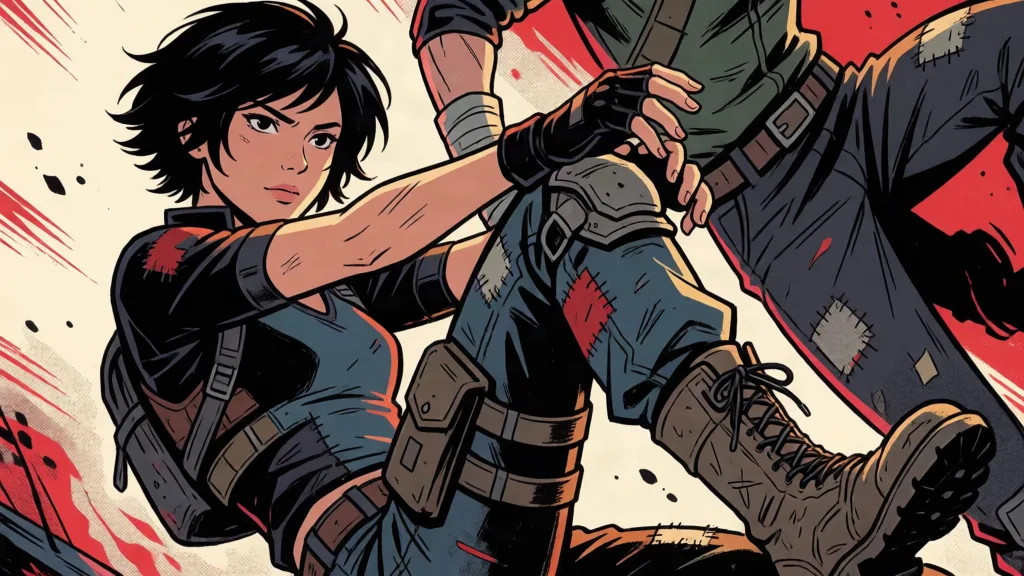
The bullet came from the east, which meant the shooter was either an amateur or an optimist. I was betting on amateur. Optimists didn’t last long in the ruins of Saint Louis, not unless they had a death wish or a very good reason to be firing at a lone scavenger picking through the carcass of a collapsed parking garage.
I dropped behind a chunk of concrete the size of a small car, my knees hitting the rubble-strewn ground with a jarring thud that rattled my teeth. Dust puffed up around me, dry and chalky, tasting like the end of the world. I’d been having a decent morning until then. Found a sealed maintenance closet on the third sub-level that hadn’t been cracked open since the bombs fell. The hinges had screamed when I forced them, but inside was a treasure trove: copper wire, a box of unopened MREs, and a first-aid kit that still had its seal. That was a week’s worth of trade at the market. Maybe two if I played my cards right with Old Man Hemlock, who was always desperate for antibiotics.
Now I was pinned down by some idiot with more ammo than sense.
Another shot rang out, wild and high. It sparked off a rebar rod jutting from a broken slab, sending a shower of orange sparks into the gray afternoon air. Definitely an amateur. A professional would have flanked me by now, or at least aimed lower.
I risked a glance over my makeshift cover. The garage was a skeletal thing, its roof long gone, the upper levels sheared off by the blast wave that had flattened most of downtown. From my position, I could see the street below, a canyon of rubble and rusted-out cars, and beyond that, the skeletal remains of the Arch, its stainless steel surface now a dull, pitted gray against the perpetual overcast. The river was a brown ribbon in the distance, sluggish and choked with debris. Nothing moved on the street. No birds. No dogs. Just the wind, which always sounded like a sigh, and the occasional creak of metal giving way somewhere in the distance.
Then I saw him. A flash of movement behind a rusted delivery truck about fifty yards away. He was crouched low, trying to use the truck’s engine block for cover. His silhouette was thin, wiry. He was holding a rifle, a bolt-action piece that looked older than I was, and he was struggling to work the bolt. It was jammed. He was panicking.
I could have killed him. My own rifle, a battered M4 I’d scavenged from a National Guard armory two years back, was already shouldered. My finger was on the trigger. One squeeze and the problem would be solved. That was the rule of the wasteland. You shoot first, you don’t ask questions, and you definitely don’t feel bad about it. I’d done it before. I’d do it again.
But something made me hesitate. Maybe it was the way he was fumbling with the bolt, his movements jerky and desperate. He wasn’t a raider. Raiders moved with a swagger, a brutal confidence. They didn’t hide behind trucks and panic when their weapons jammed. This was someone who was scared. Someone who was probably just trying to protect something.
Or someone who was just a really, really bad shot.
I eased my finger off the trigger. “Hey!” I yelled, my voice echoing in the concrete canyon. “You want to stop wasting bullets? You’re not even close.”
The fumbling behind the truck stopped. A moment of silence. Then a voice, young and reedy, called back, “I’m warning you! I’m armed!”
“Yeah, I noticed. You’re also a terrible shot. What are you, twelve?”
“I’m twenty-two!” The voice cracked on the “two.” Definitely a kid. Or a very defensive adult with a puberty problem.
“Okay, twenty-two,” I said, keeping my rifle trained on the truck. “What do you want? Because if you’re trying to rob me, you’re doing a piss-poor job of it.”
Another pause. The wind whistled through the empty window frames of the garage, a mournful sound. “I saw you go into the garage,” he called back. “I thought you might… I thought you might have found something.”
“And that gives you the right to shoot at me?”
“I didn’t shoot *at* you. I shot *near* you. To… to scare you off.”
I almost laughed. Almost. “Scare me off? Kid, I’ve been shot at by people who actually knew how to aim. Your little warning shots are just annoying.”
Silence. I could almost hear him thinking, trying to figure out his next move. He was probably weighing his options. Run? Keep shooting? Try to talk his way out of it? He didn’t seem like the type to have a plan.
“Look,” I said, making a decision. A stupid one, probably. The kind of decision that got people killed. But I was curious. And curiosity was a luxury I rarely indulged. “I’m going to stand up. If you shoot me, I’ll kill you. If you don’t, we can talk. Deal?”
“How do I know you won’t shoot me?”
“You don’t. But I haven’t so far, have I? I could have put a bullet in your head five minutes ago. I didn’t.”
Another long pause. Then, “Okay. Deal.”
I stood up slowly, my rifle still at my shoulder, my eyes fixed on the truck. The kid rose from behind it just as slowly, his hands raised, the ancient rifle dangling from its strap. He was thin, almost gaunt, with a mop of dirty blond hair that fell into his eyes. His clothes were a patchwork of scavenged fabrics, and his face was pale, smudged with dirt. He looked like he hadn’t eaten a decent meal in weeks.
He also looked familiar.
I stared at him, trying to place the face. The sharp chin, the wide, nervous eyes. The way he held himself, like he was expecting a blow. I knew that posture. I’d seen it before, a long time ago, in a different life.
“Leo?” I said, the name escaping my lips before I could stop it.
The kid’s eyes went wide. His mouth fell open. “Mia?”
The world tilted. The rubble-strewn garage, the gray sky, the distant Arch, it all seemed to blur at the edges. Leo. Leo, who I hadn’t seen since we were kids, since before the bombs, since before everything went to hell. Leo, who used to live two doors down from me in the old neighborhood, who used to build model airplanes in his garage and let me help him paint them. Leo, who was the closest thing I ever had to a best friend.
He looked like a ghost. A ghost of the boy I remembered, stretched thin and worn down by years of survival.
“What the hell are you doing here?” I asked, my voice coming out harsher than I intended. The rifle was still up, still pointed at his chest. I couldn’t seem to lower it.
“I… I live here,” he stammered. “I mean, not here, not in the garage. But in the city. I’ve been… I’ve been looking for you.”
“Looking for me?” The words didn’t make sense. “Why?”
He swallowed hard. His Adam’s apple bobbed in his thin throat. “I need your help, Mia. I didn’t know who else to turn to.”
I finally lowered the rifle. My arms felt heavy, like they were made of lead. The adrenaline was fading, leaving behind a bone-deep weariness. I hadn’t slept well in days. Hadn’t eaten since yesterday morning. And now this. A ghost from the past, standing in the ruins of the present, asking for help.
“You’ve got a funny way of asking for help,” I said. “Shooting at someone is generally considered bad manners.”
He flushed, a dull red creeping up his pale neck. “I’m sorry. I panicked. I saw you and I… I didn’t know if it was really you. I’ve been following you for two days.”
“Two days?” I felt a chill that had nothing to do with the cold. “You’ve been following me?”
He nodded, looking miserable. “I saw you at the market yesterday. I recognized your walk. You still walk like you’re ready to run.”
That was a strange thing to remember. A strange thing to notice. I shifted my weight, suddenly self-conscious. “You should have just said something.”
“I was scared. I didn’t know how you’d react. It’s been a long time.”
“Twelve years,” I said. The number hung in the air between us, heavy and impossible. Twelve years since the sirens had wailed and the sky had turned to fire. Twelve years since I’d last seen his face, a frightened ten-year-old being pulled away by his mother, heading for the evacuation buses. I’d stayed behind with my father, who had refused to leave. He’d said the city was his home, and he’d die in it. He had. Two weeks later, of a heart attack, not the bombs. The irony wasn’t lost on me.
“You look…” Leo started, then stopped, as if he couldn’t find the right words.
“Like hell?” I offered. “Yeah, I know. You don’t look so great yourself.”
He gave a weak smile. “I’ve had a rough few weeks.”
I gestured with my rifle toward the maintenance closet I’d cracked open. “I’ve got some food. It’s not much, but you look like you could use it.”
His eyes widened. “You’d share with me? After I shot at you?”
“I’m still deciding whether to shoot you back. Consider it a stay of execution.”
I led him over to the closet, my boots crunching on the broken glass and concrete. The MREs were still there, a stack of olive-drab pouches that promised calories and a vague approximation of flavor. I pulled one out, tore it open, and handed him the entree. Beef stew. It looked like cat food, but it smelled like heaven.
He took it with trembling hands. “Thank you.”
“Don’t thank me yet. You’re going to tell me why you were looking for me. And it better be good.”
He sat down on a chunk of concrete, his back against the wall, and began to eat. He ate like a starving man, shoveling the stew into his mouth with his fingers, not even bothering with the plastic spoon that came with the pouch. I watched him, my own hunger momentarily forgotten. He was a mess. His clothes were held together with duct tape and hope. His boots had holes in them. His hands were covered in cuts and calluses.
But there was something else. A flicker of the old Leo, the kid who used to laugh at my terrible jokes and share his lunch with me when I forgot mine. He’d always been kind. Too kind for this world. I was surprised he’d survived this long.
When he’d finished, he wiped his mouth with the back of his hand and looked at me. “I need you to help me find someone.”
“Who?”
“My sister. Lily.”
The name hit me like a punch to the gut. Lily. She’d been five when the bombs fell. A tiny thing with pigtails and a gap-toothed smile. She used to follow us around like a puppy, always wanting to be included. I’d taught her how to skip stones in the creek behind our houses. I’d given her a ladybug I’d found on a leaf, and she’d named it Spot.
“She’s alive?” I asked, my voice barely a whisper.
“I don’t know,” Leo said, his eyes filling with tears. “She was taken. Three weeks ago. By a group of raiders. They call themselves the Reapers.”
The name was familiar. The Reapers were a nasty bunch, even by wasteland standards. They operated out of the old industrial district on the north side, dealing in slaves and salvage. They were known for their brutality, their love of fire, and their habit of leaving a trail of bodies wherever they went.
“Why would they take her?” I asked. “What do they want with a kid?”
“She’s not a kid anymore,” Leo said. “She’s seventeen. And she’s… she’s smart. Really smart. She can fix things. Electronics, mostly. Radios, generators. They must have found out. They must have wanted her skills.”
I nodded slowly. That made sense. The Reapers were always looking for useful people. They’d take anyone who could give them an edge. A girl who could fix a radio was worth more than a dozen slaves.
“How do you know she’s still alive?”
“I don’t,” he admitted. “But I have to try. She’s all I have left. Our mother died two years ago. Infection. A cut on her foot that went bad. I promised her I’d take care of Lily. I promised.”
His voice broke on the last word. He looked away, his shoulders shaking. I felt a pang of something I hadn’t felt in a long time. Sympathy. It was a dangerous emotion, one I’d tried to stamp out of myself years ago. But it was there, a stubborn ember in the cold ash of my heart.
“The Reapers’ base is a fortress,” I said, my voice flat. “I’ve seen it. It’s in an old factory, surrounded by walls, with guards on the roof. You can’t just walk in there.”
“I know,” he said. “That’s why I need you. You know the city. You know how to get around. You know how to… how to fight.”
I laughed, a short, bitter sound. “I know how to survive. That’s not the same thing as fighting.”
“It’s close enough.”
I shook my head. “You’re asking me to risk my life for a girl I haven’t seen in twelve years. A girl who might already be dead. That’s a lot to ask from someone you just shot at.”
He flinched. “I know. I’m sorry. I didn’t know what else to do. I’ve been on my own for so long. I tried to find help, but no one wants to go up against the Reapers. They’re too scared. But you… you were always brave, Mia. Even when we were kids. You were never afraid of anything.”
“I was afraid of everything,” I said. “I just hid it better than most.”
He looked at me, his eyes pleading. “Please. I’ll do anything. I’ll pay you. I don’t have much, but I have some things. Some salvage. A working watch. Some jewelry my mother left.”
“I don’t want your jewelry,” I said, though the mention of a working watch was tempting. A watch was a valuable trade item. But this wasn’t about trade. This was about something else. Something I didn’t want to name.
I thought about my father. About the way he’d refused to leave the city, about the way he’d died alone in our living room while I was out scavenging for food. I’d come home to find him slumped in his chair, a book open on his lap, his face peaceful. He’d looked like he was sleeping. I’d tried to wake him, shaking his shoulder, calling his name. But he was gone. I’d sat with him for hours, holding his cold hand, until the sun went down and the rats started to come out. Then I’d buried him in the backyard, under the oak tree where he used to read. I’d marked the grave with a piece of scrap metal, a simple cross. It was the best I could do.
I’d been alone ever since. Twelve years of solitude, of watching my back, of trusting no one. It was a hard way to live, but it was safe. Safe in a way that nothing else was. Letting someone in, that was the real danger. That was how you got hurt.
But Leo was here. Leo, who I’d thought was dead. Leo, who needed my help. And despite everything, despite the years of isolation and the walls I’d built around myself, I couldn’t just turn him away.
“I’ll help you,” I said, the words feeling like they belonged to someone else. “But on one condition.”
He looked up, hope flickering in his eyes. “Anything.”
“You do what I say, when I say it. No arguments. No heroics. If I tell you to run, you run. If I tell you to hide, you hide. If I tell you to shoot, you shoot. Got it?”
He nodded eagerly. “Got it.”
“And you stop following me. If you want to talk to me, you walk up and say hello like a normal person. No more stalking.”
He had the grace to look embarrassed. “Okay.”
I sighed, already regretting my decision. This was going to be a disaster. I could feel it in my bones, a dull ache that had nothing to do with the cold. But there was also a flicker of something else. Something that felt dangerously like hope.
“We can’t stay here,” I said, gathering up the MREs and stuffing them into my pack. “It’s not safe. We need to find a place to hole up for the night.”
“Where do you usually stay?”
“Depends. I move around a lot. There’s an old subway station a few blocks from here. The tunnels are mostly collapsed, but there’s a maintenance room that’s still intact. It’s hidden, and it’s defensible.”
He stood up, brushing the dust off his pants. “Lead the way.”
We left the garage, stepping out into the gray afternoon. The wind had picked up, carrying the smell of rust and decay. The street was a graveyard of cars, their windows shattered, their tires long gone. Weeds pushed up through the cracks in the asphalt, pale and spindly, struggling for light in the perpetual gloom.
I kept my rifle ready, my eyes scanning the buildings on either side. This part of the city was mostly abandoned, but you never knew who might be lurking in the shadows. The Reapers had patrols, and there were other gangs, other scavengers, other desperate people who would kill you for a can of beans.
Leo walked beside me, his ancient rifle clutched in his hands. He was nervous, his eyes darting from one dark window to the next. He wasn’t cut out for this life. He was too soft, too trusting. I wondered how he’d managed to survive for so long.
“So,” I said, breaking the silence, “what have you been doing all these years?”
He shrugged. “This and that. We moved around a lot after the bombs. My mom, Lily, and me. We stayed in refugee camps for a while, then we found a place in the suburbs. An old house that was still mostly intact. We lived there for a few years. It was… it was almost normal.”
“What happened?”
“The Reapers happened. They came through about a year ago, looking for recruits. They took some people, killed others. We hid in the basement, but they found us. They took Lily. My mom tried to stop them, and they… they hurt her. She never really recovered.”
His voice was flat, emotionless. He was telling the story like it had happened to someone else. I recognized the tone. It was the same one I used when I talked about my father. It was a way of protecting yourself, of keeping the pain at a distance.
“I’m sorry,” I said, and I meant it.
He nodded, not looking at me. “After that, I just… I just drifted. I couldn’t stay in the house. Too many memories. I’ve been moving from place to place, trying to find a way to get Lily back. I heard about you from a trader at the market. He said there was a woman named Mia who lived in the ruins, who knew the city better than anyone. He said you were tough. A survivor.”
“He was right,” I said.
“He also said you were dangerous.”
“He was right about that, too.”
We walked in silence for a while, the only sound the crunch of our boots on the broken pavement. The subway entrance was a dark maw in the side of a collapsed building, the stairs leading down into absolute blackness. I pulled a flashlight from my belt, clicked it on, and started down.
The tunnel was damp and cold, the air thick with the smell of mold and stagnant water. The walls were covered in graffiti, most of it faded and illegible. A few of the lights were still working, flickering weakly, casting pools of sickly yellow light on the ground. The tracks were mostly buried under rubble, but a narrow path had been cleared along the side.
Leo followed close behind me, his footsteps echoing in the silence. “It’s creepy down here,” he said.
“It’s safe,” I said. “That’s what matters.”
The maintenance room was at the end of a long corridor, behind a heavy steel door that I’d reinforced with scrap metal. It was a small space, maybe ten feet by ten feet, with a cot in one corner, a small table, and a makeshift stove made from a metal bucket. There was a stack of books in the corner, their pages yellowed and brittle. A few candles sat on the table, half-melted.
“Home sweet home,” I said, closing the door behind us and sliding the bolt into place.
Leo looked around, his eyes wide. “You live here?”
“When I’m not out scavenging. It’s not much, but it’s mine.”
He sat down on the floor, his back against the wall, and let out a long breath. “This is the safest I’ve felt in weeks.”
I lit a candle, the flame flickering to life and casting dancing shadows on the walls. I sat down on the cot, facing him. “Tell me about the Reapers. Everything you know.”
He talked for an hour. He told me about their base, the old factory on the north side, surrounded by walls of scrap metal and barbed wire. He told me about their leader, a man named Kael, who was rumored to be a former soldier, a man who had embraced the chaos of the new world and carved out his own kingdom of violence. He told me about the patrols, the guards, the dogs they kept. He told me about the other prisoners, the ones he’d seen being led into the factory, their hands bound, their faces blank with terror.
“They keep the prisoners in the basement,” he said. “At least, that’s what I’ve heard. There’s a network of tunnels under the factory, old steam tunnels from before the war. They use them for storage, for holding people. It’s a maze down there.”
I listened, my mind working, piecing together a plan. It was a long shot, a really long shot. But it was the only shot we had.
“We can’t go in through the front,” I said. “Too many guards. But there might be another way.”
“What do you mean?”
“The steam tunnels. You said they run under the factory. Where do they come out?”
He thought for a moment. “I don’t know. I never got that close. But I heard some of the prisoners talking. They said there was an old access point in the sewers, about half a mile from the factory. It was sealed off, but they thought it might still be passable.”
“The sewers,” I said, grimacing. “Great. My favorite place.”
“I’m sorry,” he said. “I know it’s dangerous.”
“Everything’s dangerous. That’s not the point. The point is whether it’s possible.”
“Is it?”
I looked at him, at his thin face, his desperate eyes. He was counting on me. A boy I’d known a lifetime ago, who had somehow found his way back into my life. I didn’t know if I could save his sister. I didn’t know if I could save myself. But I knew I had to try.
“It’s possible,” I said. “But we’re going to need help.”
“What kind of help?”
“The kind that comes with guns and a death wish. I know some people. They’re not exactly friendly, but they owe me a favor.”
“Who?”
“A man named Silas. He runs a crew of scavengers out of the old brewery on the south side. They’re not raiders, but they’re not saints either. They do what they have to do to survive. I saved his daughter’s life a couple of years ago. He said he’d repay the debt whenever I asked.”
“Do you think he’ll help?”
“I don’t know. Silas is a pragmatic man. He doesn’t do anything unless there’s something in it for him. But he hates the Reapers. They’ve been encroaching on his territory, taking his people. He might see this as an opportunity.”
Leo nodded slowly. “When do we go?”
“Tomorrow. We’ll rest tonight, then head south at first light. It’s a long walk, and we’ll need to be careful. The Reapers have patrols all over the city.”
He looked at me, his expression unreadable. “Thank you, Mia. For helping me. I know you didn’t have to.”
“No,” I said. “I didn’t.”
I blew out the candle, plunging the room into darkness. I lay down on the cot, my back to the wall, my rifle within reach. Leo curled up on the floor, using his pack as a pillow. The silence was heavy, broken only by the distant drip of water and the occasional rumble of the earth settling.
I couldn’t sleep. My mind was racing, turning over the events of the day. Leo. After all these years. It felt like a dream, a strange, impossible dream. I remembered the boy he’d been. The way he’d laughed, the way he’d looked at me with those trusting eyes. He’d been my only friend, the only person who hadn’t treated me like a freak because I liked to climb trees and catch frogs instead of playing with dolls. We’d spent hours together, exploring the woods behind our houses, building forts, making up stories about the adventures we’d have when we grew up.
We’d promised to always be friends. We’d promised to always find each other, no matter what.
And now, here he was. A man, or close enough. Worn down by the world, but still fighting. Still hoping.
I thought about the way he’d looked at me when he’d said my name. The shock, the recognition, the flicker of something else. Something that might have been relief. Or maybe something more.
I pushed the thought away. This wasn’t the time for sentiment. This was about survival. About saving a girl who was probably already dead. About repaying a debt I didn’t even know I owed.
But as I lay there in the darkness, listening to Leo’s soft breathing, I couldn’t help but feel that something had shifted. The walls I’d built around myself, the walls that had kept me safe for so long, had a crack in them. A small one, barely visible. But it was there.
And I didn’t know if I wanted to patch it up or let it grow.
The next morning, we left at dawn. The sky was a pale gray, the sun hidden behind a thick layer of clouds. The air was cold and damp, carrying the smell of rain. We moved quickly, keeping to the shadows, avoiding the main streets. I led Leo through a labyrinth of back alleys and collapsed buildings, my rifle ready, my senses on high alert.
We saw no one. The city was quiet, almost peaceful. But I knew better than to trust the silence. Danger was always lurking, just out of sight.
We reached the brewery by midday. It was a massive complex of red brick buildings, their windows shattered, their roofs sagging. A high wall of scrap metal surrounded the perimeter, topped with coils of razor wire. Guards patrolled the wall, their rifles slung over their shoulders. They looked bored, but I knew they were watching.
I stopped a hundred yards from the gate, pulling Leo behind a rusted-out bus. “Stay here,” I said. “I’ll go talk to them.”
“What if they shoot you?”
“They won’t. They know me.”
I stepped out from behind the bus, my hands raised, my rifle slung over my shoulder. I walked slowly toward the gate, my eyes on the guards. One of them, a woman with a shaved head and a scar across her cheek, raised her rifle.
“That’s far enough,” she called. “State your business.”
“I’m here to see Silas,” I said. “Tell him Mia is here. He’ll want to talk to me.”
The woman stared at me for a long moment, then nodded to one of the other guards. He disappeared behind the wall. A few minutes later, the gate creaked open, and a man stepped out.
Silas was a big man, broad-shouldered, with a thick beard and a bald head. He wore a leather vest over a stained t-shirt, and a machete hung from his belt. He looked like a biker who’d survived the apocalypse and decided to keep the aesthetic.
“Mia,” he said, his voice a low rumble. “I was wondering when you’d show up.”
“Silas,” I said. “You’re looking well.”
He laughed, a harsh sound. “Liar. I look like shit. But I’m still breathing, which is more than most can say.” He glanced behind me, at the bus where Leo was hiding. “Who’s your friend?”
“A friend. We need to talk. Privately.”
He studied me for a moment, his eyes narrowing. Then he nodded. “Come inside. We’ll talk in my office.”
I waved for Leo to join me. He emerged from behind the bus, looking nervous, and walked over to us. Silas raised an eyebrow but said nothing. He led us through the gate, across a courtyard filled with scavenged vehicles and stacks of supplies, and into the main building.
His office was on the second floor, a large room with a desk, a few chairs, and a map of the city on the wall. The map was covered in markings, red circles and blue lines, a testament to the complex web of alliances and territories that made up the wasteland.
Silas sat down behind his desk, gesturing for us to take the chairs opposite him. “So,” he said, leaning back. “What brings you here? I assume it’s not a social call.”
“I need your help,” I said. “There’s a girl. She’s being held by the Reapers. We’re going to get her out.”
Silas’s expression didn’t change. “The Reapers. You’re talking about going up against Kael and his crew. That’s suicide.”
“Maybe. But I have a plan.”
“A plan,” he repeated. “And what does this plan involve?”
I told him. The steam tunnels, the sewer access, the need for a distraction. He listened without interrupting, his face impassive. When I finished, he was silent for a long moment.
“You’re asking me to risk my people for a girl I don’t know,” he said finally. “Why should I?”
“Because you owe me. I saved your daughter’s life. You said you’d repay the debt.”
“That was two years ago. Things have changed.”
“Not that much. You’re still a man of your word, aren’t you?”
He scowled. “Don’t try to guilt me, Mia. It won’t work.”
“I’m not trying to guilt you. I’m trying to appeal to your self-interest. The Reapers are a threat to everyone. They’ve been expanding, taking over territory, pushing into your part of the city. You know it’s only a matter of time before they come for you. Helping us is a chance to strike back, to weaken them.”
He was quiet, thinking. I could see the wheels turning in his head. He was a pragmatic man, but he was also a survivor. He knew the Reapers were a problem. He just needed a reason to act.
“What’s in it for me?” he asked.
“The satisfaction of doing the right thing?”
He snorted. “Try again.”
“Salvage rights. The factory is full of old machinery, electronics, tools. The Reapers have been hoarding it for years. If we take them down, it’s all yours.”
His eyes flickered with interest. “All of it?”
“We only want the girl. Everything else is yours.”
He leaned forward, his elbows on the desk. “And how do you plan to take them down? You said yourself, it’s a fortress.”
“That’s where you come in. We need a distraction. Something to draw the guards away from the main gate. A fire, maybe. Or an explosion. Something big.”
He nodded slowly. “I might be able to arrange that. But it won’t be cheap.”
“I told you, the salvage is yours.”
“I’m not talking about the salvage. I’m talking about my people. If I send them in there, some of them might not come back. I need more than just salvage.”
I knew what he was asking. He wanted a guarantee. Something to ensure that his investment would pay off. I thought for a moment, then said, “I’ll owe you. A favor, to be called in whenever you want.”
He raised an eyebrow. “A favor from Mia the scavenger. That’s a valuable thing.”
“It is.”
He was silent for a long moment, then nodded. “Alright. I’ll help you. But I’m not sending my people into the factory. We’ll provide the distraction, nothing more. You and your friend are on your own once you’re inside.”
“Understood.”
He stood up, extending his hand. “Deal.”
I shook it. His grip was firm, his palm calloused. “Deal.”
We spent the rest of the day planning. Silas’s crew would stage an attack on the Reapers’ eastern perimeter at midnight, drawing the guards away from the main gate. That would give us a window of maybe twenty minutes to get inside. After that, we were on our own.
Leo and I would enter through the sewer access point, a rusted grate in an alley half a mile from the factory. From there, we’d navigate the steam tunnels, find the holding area, and get Lily out. It was a simple plan. Simple plans were the ones that got you killed.
But it was the only plan we had.
As the sun set and the city fell into darkness, we prepared. I checked my rifle, loaded my spare magazines, and sharpened my knife. Leo did the same, his movements clumsy but determined. He was scared. I could see it in his eyes. But he was also resolved. He was going to save his sister, or die trying.
I understood that. I’d felt the same way when my father died. I’d wanted to burn the world down, to make someone pay for the injustice of it all. But there was no one to blame. The world had ended, and we were just the leftovers.
We left the brewery at eleven, slipping out through a back gate. The night was dark, the moon hidden behind a thick layer of clouds. The streets were empty, silent. We moved quickly, our footsteps muffled by the rubble.
The sewer access point was exactly where Leo said it would be. A rusted grate in the ground, half-hidden by a pile of debris. I pried it open with my knife, the metal groaning in protest. The smell that rose from the darkness was indescribable. Rot, decay, and something else. Something alive.
“After you,” I said.
Leo swallowed hard, then climbed down the ladder. I followed, pulling the grate closed behind us. The darkness was absolute. I clicked on my flashlight, the beam cutting through the gloom.
The tunnel was narrow, the walls covered in slime. The water at our feet was black and foul, rippling with things I didn’t want to think about. We walked in silence, our breathing loud in the confined space.
After what felt like hours, we reached a junction. The tunnel split into three directions. I pulled out the map Silas had given me, a crude sketch on a piece of paper.
“Left,” I said. “That should take us under the factory.”
We turned left, the tunnel sloping downward. The air grew warmer, more humid. The smell changed, becoming something industrial. Oil, grease, and the faint, acrid tang of gunpowder.
Then we heard it. Voices. Low, murmuring. And the sound of footsteps. Someone was coming.
I grabbed Leo’s arm, pulling him into a side alcove. We pressed ourselves against the wall, barely breathing. A group of men walked past, their flashlights cutting through the darkness. They were laughing, joking about something. Reapers. They didn’t see us.
We waited until the sound of their footsteps faded, then continued on. The tunnel opened up into a larger chamber, a vast underground space filled with pipes and machinery. This was the steam tunnel, the heart of the old factory’s power system.
And there, in the corner, was a cage.
It was made of chain-link fence, reinforced with steel bars. Inside, huddled on the floor, were a dozen people. Women, children, a few men. They were dirty, emaciated, their eyes hollow with despair.
And one of them was Lily.
I recognized her immediately. She had the same blond hair as Leo, the same sharp chin. But her face was thinner, harder. She looked up as our flashlight swept over the cage, her eyes widening.
“Leo?” she whispered.
Leo ran to the cage, his hands gripping the chain-link. “Lily! Oh god, Lily!”
She stumbled to her feet, reaching through the fence to touch his face. “You came. You actually came.”
“I told you I would. I promised.”
I watched them for a moment, a strange ache in my chest. Then I turned away, scanning the chamber for guards. There were none. The distraction must have worked. Silas had come through.
“We need to move,” I said. “Now.”
I examined the lock on the cage. It was a heavy padlock, but the chain-link was old, rusted. I pulled out my bolt cutters and went to work. The metal snapped after a few seconds, and the door swung open.
The prisoners poured out, their faces a mix of relief and terror. Lily ran to Leo, throwing her arms around him. He held her tight, his shoulders shaking with silent sobs.
“We have to go,” I said, my voice urgent. “The guards will be back soon.”
We led the prisoners back through the tunnels, moving as fast as we could. The journey back was a blur. The darkness, the smell, the fear. I kept expecting to hear shouts, gunfire, the sound of pursuit. But there was nothing. Silas’s distraction had worked better than I’d hoped.
We emerged from the sewer grate into the cold night air. The prisoners scattered, disappearing into the ruins, heading for whatever safety they could find. Lily stayed with us, her hand clasped in Leo’s.
“What now?” Leo asked.
“We get out of the city,” I said. “Find a place to hide. The Reapers will be looking for us.”
“Will they come after us?”
“Maybe. But we’ll be ready.”
We walked through the night, heading south, away from the factory, away from the danger. The sky began to lighten, the first hints of dawn painting the clouds with pink and gold. It was beautiful. I hadn’t noticed beauty in a long time.
We found an abandoned house on the outskirts of the city, a small bungalow with a collapsed roof and a overgrown yard. It wasn’t much, but it was shelter. We barricaded the doors and windows, then collapsed on the floor, exhausted.
Leo and Lily fell asleep almost immediately, curled up together like puppies. I sat by the window, my rifle across my knees, watching the sun rise.
I thought about the day before. The bullet from the east. The boy with the jammed rifle. The ghost from my past. It all felt like a dream. But it wasn’t. It was real. Leo was real. Lily was real. And for the first time in twelve years, I wasn’t alone.
I didn’t know what the future held. The Reapers would be angry. They’d come looking for revenge. And Silas would want his favor. The world was still a dangerous place, still full of people who would kill you for a can of beans.
But as I watched the sun rise over the ruined city, I felt something I hadn’t felt in a long time. Hope. It was a fragile thing, easily broken. But it was there.
And I was going to hold onto it for as long as I could.
Leo stirred in his sleep, murmuring something I couldn’t understand. I looked at him, at his peaceful face, and felt the crack in my walls widen. He was here. After all these years, he was here.
I didn’t know what that meant. I didn’t know if it was a good thing or a bad thing. But I knew I wasn’t going to push him away.
Not yet.
Maybe not ever.
The sun climbed higher, burning off the morning mist. The city was waking up, the sounds of the wasteland beginning anew. Somewhere in the distance, a dog barked. A gunshot rang out. Life went on.
I checked my rifle, loaded a fresh magazine, and settled in to wait. The Reapers would come. They always did. But this time, I wouldn’t be alone.
This time, I had something to fight for.
I glanced at Leo one more time, then turned my eyes back to the window. The world was still out there, still dangerous, still full of pain. But for the first time in a long time, I felt like I was part of it again.
And that was enough.
Watch this moment
Turn the current scene into a cinematic Live Chapter — what you watch becomes the story's next part.
Disclaimer
This is a work of fiction, assisted by artificial intelligence. Any names or characters, businesses or places, events or incidents, are fictitious. Any resemblance to actual persons, living or dead, or actual events is purely coincidental.
Content Removal Policy
- Users may report content that may be illegal or violates our Standards.
- All reported complaints will be reviewed and resolved within seven business days.
- Review Process: Our team will assess the reported content against our guidelines.
- Appeals: If you disagree with a decision, you may appeal within 14 days of notification.
- Potential outcomes include: content removal, account warning, or no action if no violation is found.
To report content, email us at [email protected]