Share
Go Live
Ghost Train Pulse
·
Published 10/4/2026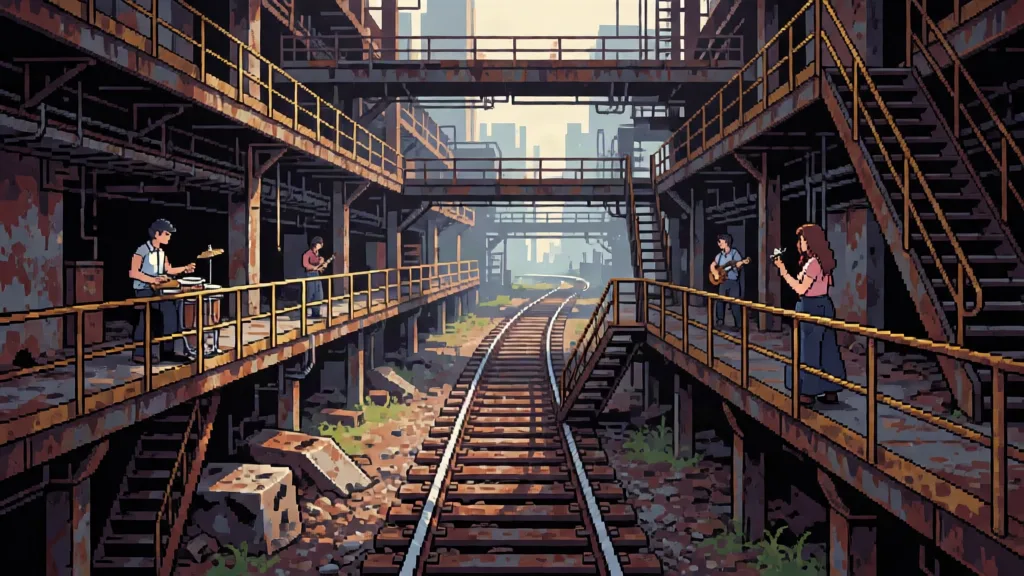
The first thing I feel is the bass.
It comes up through the soles of my boots, through the concrete floor of the old Packard plant, through the bones of my feet and into my shins. A low, rolling thrum that has no business being here at 3:14 in the morning. The plant's been dead for thirty years. No power. No machinery. Just rust and pigeons and the occasional squatter who doesn't know any better.
But the bass doesn't care about any of that.
I press my palm flat against the nearest support column, a fat I-beam slick with condensation. The vibration crawls up my arm, into my shoulder, settles behind my sternum like a second heartbeat. It's not random. It's not wind. It's a rhythm. A pattern. A message I've been decoding for six weeks now, ever since I started sleeping in the old maintenance office because my apartment got condemned and my sister stopped answering her phone.
3:15.
The rhythm shifts. Accelerates. A syncopated stutter that feels like panic. I know this feeling. I've felt it in my own chest a thousand times. The moment before a crash. The half-second of free fall before impact.
I grab my bag, sling it over my shoulder, and start moving.
The catwalks stretch above me like the ribs of some enormous dead animal. I know them by touch, by the way my weight makes them sing. Every step I take sends a shiver through the metal, a note in a song only I can hear. The deaf thing, people always assume it means silence. They don't get it. I've never heard a sound in my life, not the way they mean. But I feel everything. The world is a drum, and I've been playing it since I was four years old, when my mother put a pair of sticks in my hands and said, "This is how you talk."
She wasn't wrong.
I climb the ladder to the second-level catwalk, my fingers finding the rungs without looking. The vibration here is different. Sharper. Urgent. It's coming from the east, from the old rail spur that runs along the edge of the property, the one that hasn't seen a train since 1987. But tonight, at 3:16, something is coming down those tracks. Something that doesn't exist. Something that derails every single night in a scream of twisting metal and shattering glass, and every single night I feel it happen, and every single night I'm too late to stop it.
Not tonight.
I run.
The catwalk groans under my boots, a deep, resonant note that I feel in my teeth. I've learned to trust the groans. They tell me where the metal is weak, where the rust has eaten through, where a wrong step will send me plummeting thirty feet onto the factory floor. I dodge left, skip over a gap, land hard on the balls of my feet. The impact travels up through my knees, into my hips, and I feel it like a downbeat. A count-in. The song is starting.
3:16 and thirty seconds.
The east catwalk is a straight shot to the rail spur, but it's also the most decayed. I can feel it swaying as I run, a pendulum motion that grows with every step. The rhythm of the ghost train is building now, a frantic, off-kilter waltz that makes my stomach clench. Something's wrong. More wrong than usual. The pattern is different tonight. Heavier. There's a drag on the left side, a hesitation in the rhythm that I've never felt before.
The train is going to derail earlier. Before it reaches the curve.
I push harder.
My lungs burn. My calves scream. I'm not an athlete. I'm a percussionist who hasn't played a real gig in eight months, who's been living on canned soup and the kindness of a security guard who lets me sleep in the plant because he feels sorry for me. But I'm fast when I need to be. And right now, I need to be.
The catwalk ends at a rusted door that opens onto the old loading dock. I hit it with my shoulder, and it gives way with a shriek of protest. The night air hits my face, cold and wet, carrying the smell of the river and diesel fuel and something else, something electrical, like the air before a thunderstorm.
The rail spur is twenty feet below me. I can see it in the dim glow of the distant streetlights, two parallel lines of rusted steel disappearing into the dark. And there, at the edge of my vision, something is moving. Something that shouldn't be there. A shape. A shadow. A train that isn't a train.
I drop to my knees on the loading dock and press both palms flat against the concrete.
The vibration is overwhelming. It's not just a rhythm anymore. It's a full-body assault, a bass line so deep and so powerful that it rattles my fillings, makes my eyes water, turns my spine into a tuning fork. I close my eyes and let it wash over me. Let it tell me its story.
The train is heavy. Heavier than it should be. There's something in the cargo, something that shifts and slides with every turn of the wheels. The left side is dragging because the load is unbalanced. The engineer is trying to compensate, but he's fighting a losing battle. The curve is coming up too fast, and the brakes are failing, and there's a sound underneath it all, a high, keening note that I feel in my sinuses, the sound of metal about to give way.
I don't know how I know these things. I just do. The same way I know that the note A is 440 vibrations per second, or that a snare drum sounds like a gunshot, or that my mother's heartbeat had a slight arrhythmia that I could feel through her chest when she held me. The world is a symphony of vibrations, and I've spent my whole life learning to read the score.
But this score is written in a language I don't fully understand. And the composer is a ghost.
3:17.
The train hits the curve.
I feel it before I see it. The rhythm stutters, skips, collapses into chaos. A grinding, shrieking cacophony of vibrations that tears through my body like a seizure. I'm on my feet without thinking, running along the loading dock, my eyes scanning the darkness for something I can use. A lever. A switch. Anything that might change the track.
There's nothing. Just rust and weeds and the distant glow of the city.
The train derails.
I feel it in my bones. The moment of impact. The way the wheels leave the rails. The way the cargo shifts, slides, crashes through the side of the car. The way the engine screams, a sound I can't hear but can feel, a vibration so intense that it knocks me off my feet.
I hit the concrete hard. My bag flies open. My sticks scatter across the loading dock, clattering away into the dark. I lie there for a moment, gasping, my body still vibrating with the aftershock of the disaster. The ghost train is gone. The rhythm has faded. All that's left is the ordinary hum of the city, the distant thrum of the freeway, the pulse of my own blood in my ears.
I should get up. I should go back inside. I should try to sleep.
But I don't.
I lie on the cold concrete and stare up at the sky, and I think about the train. About the cargo that shifted. About the high, keening note that I felt in my sinuses. About the fact that tonight, for the first time in six weeks, the train derailed before it reached the curve.
Something is changing. Something is different.
And I'm the only one who can feel it.
---
The security guard's name is Marcus. He's sixty-three years old, built like a refrigerator, and he's been working the night shift at the Packard plant for eleven years. He doesn't ask why I sleep here. He doesn't ask why I'm always awake at 3 AM, wandering the catwalks like a ghost. He just nods when he sees me, hands me a cup of coffee from the thermos he keeps in the guard shack, and goes back to his crossword puzzle.
"You look like hell," he says tonight, when I stumble into the shack at 4:30, soaking wet from the rain that started while I was lying on the loading dock.
"Feel like it too."
I take the coffee. It's terrible, bitter and burnt, but it's warm, and warmth is something I've learned not to take for granted. I wrap my hands around the cup and let the vibration of the liquid travel up through my palms. It's a steady, comforting rhythm. Nothing like the ghost train.
"Bad night?" Marcus doesn't look up from his puzzle.
"Something like that."
"You find what you're looking for?"
I don't answer. I don't know how to explain that I'm not looking for anything. That I'm listening. That the plant is trying to tell me something, and I'm the only one who can hear it.
Marcus doesn't push. He's good like that. He just slides a granola bar across the desk and goes back to his crossword. I eat it slowly, watching the rain streak down the window, and I think about the train.
It's not real. I know that. There hasn't been a train on that spur since before I was born. The tracks are rusted, overgrown, disconnected from the main line. There's no engine, no cargo, no engineer. There's nothing there but ghosts.
But the vibration is real. The rhythm is real. And tonight, something changed.
I finish my coffee and stand up. "I'm going to walk the perimeter."
Marcus grunts. "Take a flashlight. And don't fall through any more catwalks."
"I'll try."
The rain has stopped by the time I step outside. The air smells clean, washed, and the sky above the factory is a deep, bruised purple, the color of a fresh bruise. I pull my hood up and start walking.
The perimeter of the plant is a mile and a half of chain-link fence, broken concrete, and dead grass. I've walked it a hundred times, mapping the vibrations, learning the rhythms of the place. The hum of the transformer on the north side. The rattle of the loose fence panel on the east. The deep, resonant thrum of the foundation settling, shifting, sinking into the soft Detroit earth.
But tonight, there's something new.
I feel it before I see it. A vibration in the ground, faint but persistent, like a heartbeat under the concrete. It's coming from the rail spur. From the exact spot where the ghost train derailed.
I follow it.
The spur is a dead end, a quarter-mile of track that runs from the main line to the loading dock and then just stops. The rails are rusted, the ties are rotting, and the whole thing is slowly being swallowed by weeds and wild grass. But tonight, the weeds are flattened. The grass is torn. And there, in the middle of the track, something is lying on the ground.
I approach slowly, my heart pounding in my throat. The vibration is stronger here, a low, insistent pulse that I feel in my knees, my hips, my chest. It's not the ghost train. It's something else. Something smaller. Something real.
I kneel down and reach out.
My fingers touch cold metal. A shape. A curve. A piece of something that shouldn't be here.
I pick it up and hold it to the light.
It's a bell. A small, brass bell, the kind you'd hang on a cat's collar or a child's toy. It's dented, tarnished, and there's something engraved on the side. I can't read it in the dark, but I can feel it. The letters are raised, sharp, deliberate.
I slip the bell into my pocket and stand up. The vibration is fading now, the rhythm slowing, settling back into the ordinary hum of the city. But I can still feel it. A faint, persistent pulse, like a second heartbeat.
I don't know what it means. I don't know why it's here. But I know one thing for certain.
The ghost train isn't just a ghost. It's a message. And someone, somewhere, is trying to tell me something.
---
I don't sleep.
I lie on the cot in the maintenance office, staring at the ceiling, the bell clutched in my hand. The vibration has faded to almost nothing, but I can still feel it, a tiny, insistent pulse that matches the rhythm of my own heart. I bring the bell to my ear, not to hear it, but to feel it. The metal is cold against my skin, and the vibration is faint, but it's there. A hum. A whisper. A voice.
I close my eyes and try to remember.
The ghost train has been derailing every night for six weeks. I know this because I've felt it every night for six weeks. The same rhythm, the same pattern, the same catastrophic collapse at 3:17 AM. But tonight was different. Tonight, the train derailed early. Tonight, the cargo shifted. Tonight, there was a sound I'd never felt before, a high, keening note that I still feel in my sinuses when I think about it.
And now there's a bell.
I sit up and turn on the flashlight I keep by the cot. The beam is weak, yellow, flickering, but it's enough. I hold the bell up to the light and read the engraving.
*For Lila, with love.*
Lila.
The name doesn't mean anything to me. I don't know anyone named Lila. I don't know anyone who would leave a bell on a dead train track in the middle of the night. But the vibration is real. The bell is real. And the feeling in my gut, the one that tells me this is important, that this is the beginning of something, is real too.
I put the bell in my pocket and stand up.
The maintenance office is a small room, ten feet by ten feet, with a desk, a chair, a filing cabinet, and a cot. It used to be the office of the plant's foreman, back when the plant was alive, back when it was full of noise and heat and the rhythm of thousands of machines working in unison. Now it's just a room. A place to sleep. A place to hide.
But tonight, it feels like something more. Tonight, it feels like the start of something.
I walk to the window and look out at the rail spur. The sky is starting to lighten, the purple fading to gray, and I can see the tracks clearly now, the rusted rails, the rotting ties, the flattened weeds where I found the bell. There's nothing else there. No train. No cargo. No ghost.
But I can still feel it. The vibration. The rhythm. The message.
I don't know what it means. I don't know who Lila is, or why her bell was on the track, or what the ghost train is trying to tell me. But I know one thing for certain.
I'm not going to stop until I find out.
---
The next night, I'm ready.
I've spent the day doing research. The Detroit Public Library has archives, old newspapers, microfilm. I spent hours scrolling through grainy images, looking for anything about the rail spur, the Packard plant, a train derailment. I found a few articles, nothing major. A minor accident in 1957, a worker killed in 1962, a fire in 1974. Nothing about a ghost train. Nothing about a girl named Lila.
But I did find something else. A name. A man named Elias Thorn, who owned the rail spur in the 1920s. He was a wealthy industrialist, a railroad magnate, a man who built his fortune on steel and sweat and the backs of thousands of workers. He died in 1929, just before the crash, and his fortune disappeared. The rail spur was abandoned, forgotten, left to rust.
I don't know if it's connected. I don't know if any of it is connected. But it's a start.
Tonight, I'm on the catwalk by 3:00 AM. The air is cold, clear, the sky full of stars. I can feel the vibration building, the rhythm starting, the ghost train approaching. It's the same as always. The same pattern. The same syncopated stutter. The same sense of impending disaster.
But this time, I'm not going to run. This time, I'm going to listen.
I sit down on the catwalk and press my palms flat against the metal. The vibration travels up my arms, into my chest, into my bones. I close my eyes and let it wash over me. Let it tell me its story.
The train is heavy. The cargo is shifting. The brakes are failing. The engineer is trying. The curve is coming. The metal is screaming.
But underneath it all, there's something else. A thread. A pattern. A rhythm that doesn't belong.
I focus on it. The thread. The pattern. The rhythm. It's faint, almost lost in the chaos, but it's there. A steady pulse. A heartbeat. A voice.
And then I feel it.
The bell.
It's vibrating in my pocket, a tiny, insistent hum that matches the rhythm of the ghost train. It's not random. It's not coincidence. The bell is part of this. The bell is the key.
I pull it out and hold it in my palm. The vibration is stronger now, a steady pulse that I feel in my teeth, my sinuses, my fingertips. It's not just a bell. It's a tuning fork. A receiver. A way to hear the ghost train.
And then, for the first time in my life, I hear something.
Not with my ears. I've never heard anything with my ears. But with my body. With my bones. With my blood.
A voice. A woman's voice. Faint, distant, but clear.
*Help me.*
I gasp. The bell falls from my hand, clatters on the catwalk, rolls to the edge. I lunge for it, catch it just before it falls. My heart is pounding. My hands are shaking. I press the bell to my chest and close my eyes.
*Help me.*
The voice is louder now. Closer. I can feel it in my chest, a vibration that's not a rhythm but a word. A plea. A prayer.
*Help me.*
I don't know who she is. I don't know what she wants. But I know one thing for certain.
I'm going to help her.
---
The ghost train derails at 3:17.
I feel it happen. The same rhythm, the same pattern, the same catastrophic collapse. But this time, I'm not lying on the loading dock, helpless. This time, I'm on the catwalk, the bell in my hand, the voice in my chest.
*Help me.*
The train is gone. The rhythm is fading. But the voice is still there. Faint, distant, but persistent. A thread. A pattern. A rhythm that doesn't belong.
I stand up and look out at the rail spur. The sky is lightening, the stars fading, and I can see the tracks clearly now. They're empty. There's nothing there. No train. No cargo. No ghost.
But I can still feel it. The vibration. The rhythm. The voice.
*Help me.*
I put the bell in my pocket and start walking. I don't know where I'm going. I don't know what I'm looking for. But I know one thing for certain.
I'm not going to stop until I find her.
---
The sun is rising by the time I reach the end of the rail spur.
The tracks end at a rusted gate, padlocked and chained, with a sign that reads *PRIVATE PROPERTY. NO TRESPASSING.* Beyond the gate, there's a building. A small, brick building, maybe a hundred years old, with a slate roof and dark windows. It looks abandoned. It looks forgotten. But I can feel it. The vibration. The rhythm. The voice.
*Help me.*
I climb the fence. It's easy, even with my bag and my sticks and the bell in my pocket. I drop to the other side and walk toward the building. The grass is overgrown, waist-high, and the air smells like rust and old wood and something else, something sweet, like flowers. Like lilies.
The door is unlocked. I push it open and step inside.
The room is small, dusty, filled with old furniture and stacks of paper. There's a desk, a chair, a filing cabinet. A window, covered in grime, lets in a weak, gray light. And there, in the corner, there's a piano.
An old upright piano, covered in dust, its keys yellowed and chipped. I walk toward it, my heart pounding, the bell vibrating in my pocket. I reach out and press a key.
The note is flat, discordant, but the vibration is strong. It travels up my arm, into my chest, into my bones. And with it comes the voice.
*Help me.*
I close my eyes and listen. Not with my ears. With my body. With my blood. With my bones.
And I hear her.
A woman. A girl. A voice that's been trapped here for a hundred years. A voice that's been trying to tell me something. A voice that's been waiting for someone like me.
Someone who can hear.
I open my eyes and look at the piano. There's a photograph on the music stand, faded and cracked. A young woman, maybe eighteen, with dark hair and dark eyes and a smile that doesn't reach her eyes. She's standing next to a man, tall and stern, with a mustache and a suit. On the back of the photograph, in faded ink, there's a name.
*Lila Thorn. 1927.*
I pick up the photograph and hold it to the light. The woman's eyes are dark, sad, and there's something in them, something that looks like fear. Something that looks like a plea.
*Help me.*
I put the photograph in my pocket, next to the bell. The vibration is stronger now, a steady pulse that I feel in my teeth, my sinuses, my fingertips. It's not just a rhythm. It's a message. A story. A life.
And I'm the only one who can hear it.
I sit down at the piano and press my palms flat against the keys. The vibration travels up my arms, into my chest, into my bones. I close my eyes and let it wash over me. Let it tell me its story.
The train is coming. The cargo is shifting. The brakes are failing. The engineer is trying. The curve is coming. The metal is screaming.
And underneath it all, there's a voice. A woman's voice. A girl's voice. A voice that's been trapped here for a hundred years.
*Help me.*
I open my eyes and look at the photograph. Lila Thorn. 1927. A girl who died on a train. A girl who's been trying to tell me something. A girl who's been waiting for someone like me.
Someone who can hear.
I don't know what happened to her. I don't know why she's here. But I know one thing for certain.
I'm going to find out.
And I'm going to help her.
Even if it kills me.
Watch this moment
Turn the current scene into a cinematic Live Chapter — what you watch becomes the story's next part.
Disclaimer
This is a work of fiction, assisted by artificial intelligence. Any names or characters, businesses or places, events or incidents, are fictitious. Any resemblance to actual persons, living or dead, or actual events is purely coincidental.
Content Removal Policy
- Users may report content that may be illegal or violates our Standards.
- All reported complaints will be reviewed and resolved within seven business days.
- Review Process: Our team will assess the reported content against our guidelines.
- Appeals: If you disagree with a decision, you may appeal within 14 days of notification.
- Potential outcomes include: content removal, account warning, or no action if no violation is found.
To report content, email us at [email protected]