Share
Go Live
Steel Requiem
·
Published 9/28/2026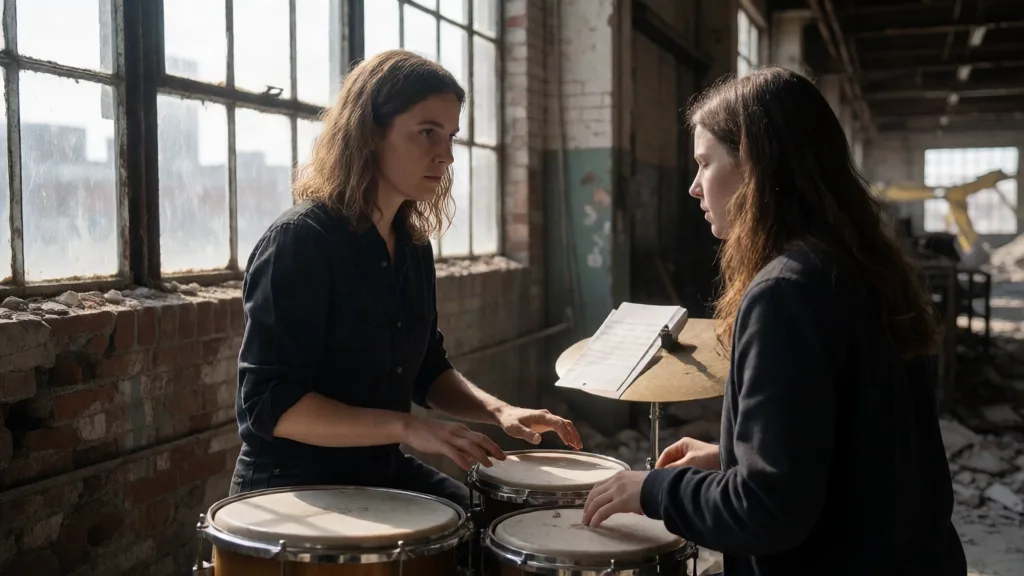
The first thing I ever heard was a lie.
Not a lie I was told. A lie I told myself. I was four years old, standing in the doorway of my father's garage on the east side of Detroit, and I felt something move through the soles of my feet. A rumble. A pulse. The air compressor kicking on, maybe, or a truck passing on Gratiot. But I told myself it was music. I told myself I could hear it.
I couldn't hear anything. I'd been deaf since birth. But the vibration traveled up through my bones and settled somewhere behind my sternum, and I decided right then that the world was speaking to me in a language nobody else could learn.
My father didn't know what to do with me. He was a big man with big hands and a small vocabulary, and when the doctors told him his daughter would never hear a word he said, he just nodded and took me home and bought me a drum. Not a toy drum. A real snare drum, used, from a pawn shop on Michigan Avenue. He set it in front of me on the kitchen floor and put my hands on the skin.
"Feel it," he said. I couldn't hear him, but I could read his lips. I could feel the words in the floorboards when he stomped his foot.
I hit the drum. The vibration shot up my arms and into my chest and I laughed, loud and wrong, the way deaf kids laugh before they learn to modulate. My father laughed too. He put his hand on the drum and I hit it again, and he felt it, and for a second we were in the same room, speaking the same language.
That was the first secret I ever kept. That the world had a heartbeat, and I was the only one who knew how to listen.
I'm thirty-two now. My father's been dead for six years. The drum is gone, sold along with everything else when the bank took the house. But I still feel things. I feel everything. The subway rattling under the street. The bass from a car stereo three blocks away. The particular thrum of a city that's been dying for so long nobody remembers what it looked like when it was alive.
Detroit doesn't have a heartbeat anymore. It has a death rattle. And I've been listening to it for so long I forgot there was a difference.
Until I found the factory.
It was a Tuesday in October, the kind of gray afternoon that makes you forget the sun ever existed. I was walking home from a gig that hadn't paid, a session with a blues band that needed a percussionist who could "feel the groove" but didn't want to pay for the privilege. I'd made twelve dollars in tips and spent eight of it on a sandwich. The other four were in my pocket, clinking against my keys.
I took the long way home. Not because I wanted to, but because the bus didn't come, and the bus never came, and I'd learned a long time ago that waiting for things in this city was a fool's game.
The factory was on the corner of Holbrook and Townsend, a hulking brick corpse of a building that had been dead since before I was born. The windows were boarded up, the roof was caved in on one side, and the chain-link fence around the perimeter had been cut so many times it looked like lace. A demolition notice was stapled to a telephone pole out front, the paper yellowed and curling at the edges. I'd walked past it a hundred times and never looked twice.
But that day, I felt something.
It started in my feet. A low hum, so deep it was almost below the threshold of sensation. I stopped walking. I put my hand on the fence. The metal was cold, but underneath the cold there was something else. A vibration. Rhythmic. Steady. Like a heart.
I stood there for a long time, my fingers wrapped around the chain-link, trying to figure out if I was imagining it. The city was full of vibrations. The ground shook all the time. Trucks, trains, the slow collapse of infrastructure that nobody bothered to fix. This was different. This was deliberate.
The gate was open. Not just cut, but open, the chain hanging loose and the hinges rusted but functional. I pushed it aside and walked into the yard.
The factory had a name once. The letters were still visible on the facade, faded white paint on red brick. MOTOR CITY STAMPING. The "M" had fallen off and the "G" was hanging by a thread, but I could fill in the blanks. My grandfather had worked in a place like this. My father too, before the plants closed and he bought the garage and pretended he'd always wanted to be his own boss.
The main door was steel, heavy, warped at the bottom where someone had tried to pry it open. It gave way when I leaned into it, scraping against the concrete floor with a sound I couldn't hear but could feel in my teeth.
Inside, the air was thick. Dust and rust and something else, something sweet and rotten, like fruit left too long in a bowl. The light came through gaps in the roof, thin shafts that cut through the darkness and illuminated nothing. I stood in the doorway and let my eyes adjust.
The factory floor stretched out in front of me, a cathedral of dead machinery. Assembly lines, stamping presses, conveyor belts, all of it frozen in place, covered in a layer of rust so thick it looked like velvet. The machines were huge. Twice my height, three times my width, their gears and pistons locked in positions they'd held for decades.
I walked forward. My footsteps sent small clouds of dust into the air. The vibration was stronger here. It came up through the concrete floor and into my legs, my hips, my spine. It wasn't just a hum anymore. It was a rhythm. A pattern. Something almost like a song.
I put my hand on the nearest machine. A stamping press, its die still open, its metal skin cold and rough. The vibration traveled up my arm and into my chest, and I closed my eyes and listened.
It wasn't random. It wasn't the building settling or the wind moving through the cracks. It was a beat. A steady, four-four beat, like a metronome set to a tempo I couldn't quite place. I counted the pulses. One, two, three, four. One, two, three, four. Over and over, relentless, patient.
I opened my eyes. The factory was still. The machines were still. But the floor was moving. Not visibly. Not in any way I could see. But I could feel it. The concrete was vibrating, and the vibration was coming from somewhere below.
I knelt down and put my palm flat against the floor. The beat was stronger here. It traveled up through my hand and into my wrist and I felt it in my teeth, in my sinuses, in the hollow space behind my eyes. It was warm. Alive.
I stayed like that for a long time. Long enough that the light through the roof shifted and the shadows changed. Long enough that my knees ached and my back screamed and I didn't care. I'd been deaf my whole life. I'd learned to read vibrations the way other people learned to read books. And this vibration was saying something.
I just didn't know what yet.
The demolition notice said the building was scheduled for implosion in sixty days. I found that out later, when I went back to the telephone pole and read the whole thing. Sixty days. That was it. Sixty days until the wrecking ball came and turned this place into rubble.
I went back the next day. And the day after that. And the day after that.
I told myself I was just curious. I told myself I was killing time between gigs, between shifts at the diner, between the long empty hours of a life that hadn't turned out the way I'd planned. I told myself a lot of things.
But the truth was simpler. The truth was that the factory was the first thing in years that had made me feel like I wasn't alone.
I started bringing my sticks. Not to play, not at first. Just to have something in my hands. I'd walk through the factory floor and tap the machines, listening with my palms, feeling for the rhythm. It was always there. The same beat, the same tempo, the same patient pulse. But it changed depending on where I stood. Near the stamping press, it was heavier, more insistent. Near the conveyor belts, it was lighter, almost playful. Near the far wall, where a row of smaller machines sat in silence, it was barely there at all, a whisper of a whisper.
I started to map it. In my head, at first, then on paper. I drew the factory floor on a piece of notebook paper and marked the places where the vibration was strongest. I connected the dots and the lines formed a pattern. A spiral. A spiral that started at the center of the factory and wound outward, toward the walls, toward the exits, toward the world outside.
I didn't know what it meant. But I knew it was important.
The first time I played, I didn't mean to.
I was standing near the stamping press, my sticks in my hands, and the vibration was so strong it felt like a current running through my body. I lifted my right stick and brought it down on the metal surface of the press.
The sound I couldn't hear. But the vibration that came back was enormous. It shot up my arm and into my shoulder and I felt it in my chest, in my stomach, in the soles of my feet. The machine shuddered. Not much. Just a tremor, a shiver, like a horse shaking off a fly. But it was enough.
I hit it again. Harder this time. The vibration doubled. The machine groaned, a sound I felt in my bones, and somewhere deep inside it, something shifted. A gear turned. A piston moved. The rust cracked and fell away in flakes.
I stepped back. My heart was pounding. The machine was still. The factory was still. But the rhythm had changed. It was faster now. More urgent. Like it was waiting for something.
I hit the press again. And again. And again.
Each time, the machine responded. Each time, the vibration grew. I wasn't just feeling the rhythm anymore. I was playing it. I was adding to it, building on it, turning the factory's heartbeat into something more. Something that sounded, in the only way I could hear, like music.
I played until my arms ached and my hands bled. I played until the light through the roof turned orange and then gray and then black. I played until I couldn't play anymore, and then I collapsed against the machine and pressed my forehead to the cold metal and felt it humming under my skin.
The factory had been waiting for me. I didn't know how I knew that. I just knew.
I wasn't alone in the factory.
I found that out on the fifth day, when I walked in and saw a figure standing at the far end of the assembly line. A man. Tall, thin, wearing a canvas jacket that had seen better decades. He was facing away from me, his hands in his pockets, his head tilted like he was listening to something.
I froze. My first instinct was to run. My second instinct was to fight. I'd been on my own long enough to know that strangers in abandoned buildings were rarely good news.
But he turned around before I could decide. And when he saw me, he didn't look surprised. He looked relieved.
"You're the one making all the noise," he said.
I couldn't hear him, but I could read his lips. I'd gotten good at it over the years. Not perfect, but good enough.
"I'm not making noise," I said. My voice was rough. I hadn't spoken to anyone in days. "I'm making music."
He smiled. It was a strange smile, crooked and sad, like he'd forgotten how to do it properly. "Same thing, in this place."
He walked toward me. Slow, deliberate, his footsteps sending small clouds of dust into the air. He stopped a few feet away and held out his hand.
"Dorian," he said.
I looked at his hand. Long fingers, calloused, stained with something dark. Grease, maybe. Or paint. Or blood.
"Vera," I said. I didn't take his hand.
He didn't seem offended. He just nodded and put his hand back in his pocket. "You've been coming here for a while," he said. "I've seen you. Through the windows. You don't look like you're here to strip copper."
"I'm not."
"Then what are you here for?"
I didn't have an answer. Not one I could put into words. I just looked at him, at his thin face and his tired eyes and the way he stood like he was ready to run at any moment.
"I heard it," I said finally. "The rhythm. The beat. Whatever it is."
His eyes widened. Just a little. Just enough. "You can hear it?"
"Feel it," I said. "I'm deaf. I feel vibrations."
He was quiet for a long time. The factory hummed around us, the same steady beat, the same patient pulse. I could feel it in my feet, in my legs, in the space between my ribs.
"I've been coming here for three years," he said. "I've never met anyone else who could feel it."
"What is it?"
He shook his head. "I don't know. But it's alive. And it's been getting stronger."
He looked at the stamping press behind me. At the rust flakes on the floor, the fresh marks where my sticks had hit the metal.
"You've been playing it," he said. It wasn't a question.
"Yes."
"How?"
I shrugged. "I just hit things. And it responds."
He laughed. A short, sharp sound I felt in my chest. "That's not how it works. I've tried. I've hit every machine in this place. Nothing happens."
"Maybe you're not hitting it right."
"Maybe." He looked at me, and there was something in his eyes I couldn't read. Curiosity, maybe. Or hope. Or something darker. "Or maybe it's been waiting for you."
We stood there in the dark, the factory breathing around us, and I felt something shift. Not in the building. In me. A door opening. A window cracking. A secret I hadn't known I was keeping, finally let out.
"I'm coming back tomorrow," I said.
"I know," he said. "I'll be here."
He was.
Dorian was there every day after that. Sometimes he'd be waiting when I arrived, sitting on a crate near the entrance, his breath fogging in the cold. Sometimes he'd appear later, materializing out of the shadows like he'd been there all along. He never told me where he lived. He never told me what he did when he wasn't in the factory. He just showed up, day after day, and watched me play.
I didn't mind. It was nice, having someone there. Nice to feel another presence in the vast emptiness of the factory floor. Nice to look up from my sticks and see him leaning against a machine, his arms crossed, his eyes closed, feeling the vibration the same way I did.
We talked. Not a lot. Not at first. But enough. I told him about my father, about the drum, about the years I'd spent trying to find a place in a world that didn't know what to do with me. He told me about the factory, about the years he'd spent exploring it, about the way the rhythm had drawn him in and refused to let go.
"It's like it knows us," he said one day. We were sitting on the floor near the stamping press, our backs against the cold metal, our breath mingling in the dusty air. "Like it's been waiting for someone who can understand it."
"Understand what?"
He didn't answer. He just looked at me, and I felt something pass between us. Something I didn't have a name for.
I kissed him that night. Or he kissed me. I'm not sure which. One minute we were sitting there, talking about nothing, and the next his mouth was on mine and his hands were in my hair and the factory was humming around us, louder than I'd ever felt it, a roar of approval, a symphony of yes.
We didn't talk about it after. We didn't talk about much of anything. We just kept meeting, day after day, and the rhythm kept growing, and I kept playing, and somewhere in the middle of it all I realized I was happy.
That scared me more than anything else.
I'd been happy before. Once. A long time ago, when I was a kid and my father was alive and the world made sense. But happiness had always been a temporary thing, a break between storms, and I'd learned not to trust it. I'd learned to wait for the other shoe to drop.
The other shoe dropped on a Thursday.
I was at the diner, working the morning shift, slinging coffee and trying not to think about the factory. I'd been there since six, and my feet hurt and my back ached and I was counting the minutes until I could leave. The diner was busy, full of the usual crowd, old men nursing their coffees, truckers passing through, a couple of college kids who looked like they'd been up all night.
The TV was on. It was always on, muted, the closed captions scrolling across the bottom of the screen. I didn't usually pay attention. But something caught my eye. A headline. A picture.
The factory. My factory. The one on Holbrook and Townsend, the one with the dead machines and the living heartbeat, the one where I'd spent every free hour for the past three weeks.
The caption said: "Historic factory to be demolished in 30 days."
I dropped the coffee pot. It shattered on the floor, hot liquid splashing across my shoes, and everyone in the diner turned to look at me. But I didn't care. I was staring at the TV, at the picture of the factory, at the wrecking ball already parked outside.
Thirty days. Not sixty. Thirty.
I don't remember leaving the diner. I don't remember the walk to the factory. I just remember arriving, breathless and shaking, and finding Dorian already there.
"You saw," he said.
I nodded. I couldn't speak.
He walked toward me and took my hands. His fingers were cold. His eyes were wild.
"We have thirty days," he said. "Thirty days to finish it."
"Finish what?"
"The symphony." He squeezed my hands. "You've been building it. Every day, every time you play. It's almost there. I can feel it."
I pulled away. "I don't know what you're talking about."
"You do." He stepped closer. "You've felt it. The rhythm. The way it responds to you. It's not just noise. It's a song. A song that's been waiting to be played for fifty years."
"And what happens when it's finished?"
He didn't answer. He just looked at me, and I saw something in his eyes that I hadn't seen before. Something hungry. Something desperate.
"I don't know," he said finally. "But I know we have to try."
I should have walked away. I should have gone home and forgotten about the factory and the rhythm and the man with the hungry eyes. I should have let the wrecking ball do its job.
But I didn't.
I stayed.
And that's when the real secret began.
Watch this moment
Turn the current scene into a cinematic Live Chapter — what you watch becomes the story's next part.
Disclaimer
This is a work of fiction, assisted by artificial intelligence. Any names or characters, businesses or places, events or incidents, are fictitious. Any resemblance to actual persons, living or dead, or actual events is purely coincidental.
Content Removal Policy
- Users may report content that may be illegal or violates our Standards.
- All reported complaints will be reviewed and resolved within seven business days.
- Review Process: Our team will assess the reported content against our guidelines.
- Appeals: If you disagree with a decision, you may appeal within 14 days of notification.
- Potential outcomes include: content removal, account warning, or no action if no violation is found.
To report content, email us at [email protected]