Share
Go Live
The Good Boy
·
Published 10/5/2026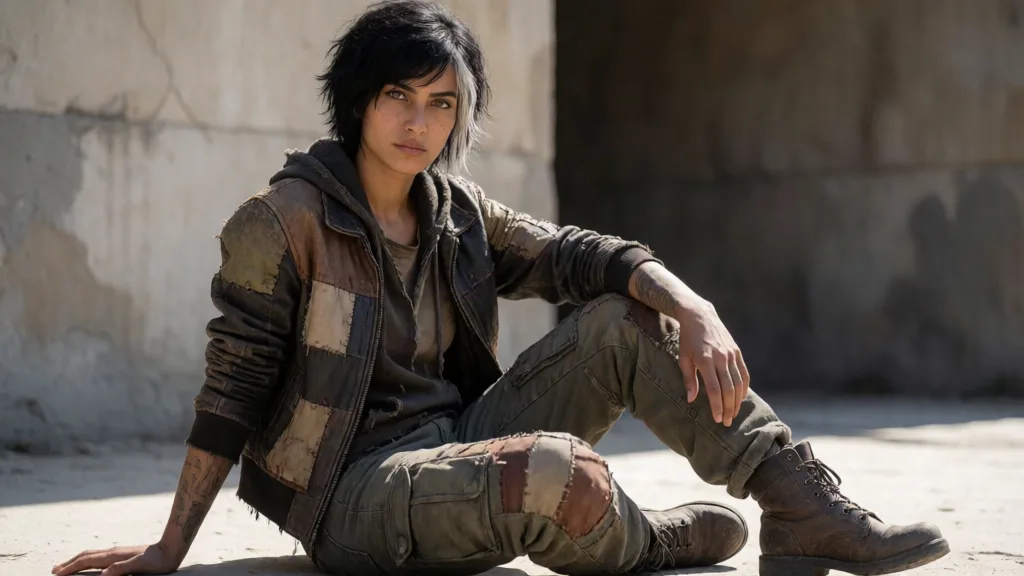
The dog found me before the sun did.
I was three days into a bad trade, the kind you take because the alternative is watching your water reserves drop below the red line you've scratched into the wall of whatever hole you're calling home that month. The buyer was a nervous man with soft hands and a voice that cracked every third word. He wanted pre-Collapse pharmaceuticals, the kind that came in blister packs with names you couldn't pronounce. I had them. I also had a bad feeling that had been sitting in my gut since I'd climbed through his window two hours before dawn.
We met in the shell of an old parking garage, level three, where the concrete ceiling had crumbled enough to let in thin gray light. He was early. That was the first wrong thing.
"You brought it?" he asked. His hands were doing that thing nervous people do, twisting together like they were trying to wring water from themselves.
I held up the bag. Small, brown, unremarkable. "You brought payment?"
He nodded too fast. Reached into his coat. And that's when I heard it. Not him. Something else. A low sound, half growl, half whine, coming from the shadows near the stairwell.
The buyer's face went white. "You said you came alone."
"I did."
The dog stepped into the light.
It was big. Not the kind of big you see in old photographs of pets, golden retrievers and Labs with soft eyes and wagging tails. This was the kind of big that made you understand why ancient humans had feared wolves. Its coat was a mess of gray and brown, ribs visible through matted fur, one ear torn nearly in half. But its eyes were what got me. Dark. Steady. Watching me like it knew something I didn't.
"Get it away," the buyer hissed.
"I don't know it."
"You're lying."
I wasn't. I'd never seen this dog before in my life. But I knew dogs like it. Ferals. Scavengers. Survivors. The kind that had adapted to the new world better than most humans. They ran in packs usually. This one was alone. That was strange.
The dog sat down. Just sat there, in the middle of the parking garage, tongue lolling out like we were old friends meeting for coffee.
The buyer was shaking now. "The deal's off. I'm not dying for pills."
He bolted. Stupid move. The stairwell was dark and full of rubble, and I heard him trip halfway down, the sound of his body hitting concrete echoing up like a drum. Then silence. Then the sound of him scrambling away, his footsteps fading into the gray morning.
I should have been angry. Three days of work, gone. But I was too busy staring at the dog.
"Alright," I said. "What do you want?"
The dog tilted its head. Then it stood, turned, and walked toward the stairwell. It stopped at the edge, looked back at me. Waited.
I've done a lot of stupid things in my life. Trusted the wrong people. Taken the wrong jobs. Walked into rooms I knew were traps because the alternative was starving. But following a strange dog into a dark stairwell at dawn? That was new.
I followed.
---
The dog led me through the ruins like it had a map in its head. Down through the parking garage, out a side entrance I hadn't noticed, across a field of broken asphalt where weeds pushed up through cracks like they were trying to reclaim the world one green blade at a time. The sun was rising now, painting the sky in colors that didn't have names anymore. Orange. Pink. A kind of purple that made my chest ache if I looked at it too long.
We walked for an hour. Maybe more. The dog stayed twenty feet ahead, never looking back, never slowing. It knew exactly where it was going.
I knew this part of the city. Had scavenged here before. The buildings were older, pre-Collapse, their bones still standing but their flesh stripped away. Windows gone. Doors gone. Anything valuable gone. What was left was concrete and steel and the ghosts of whatever had happened here.
The dog stopped in front of a building I didn't recognize. Small. Two stories. Red brick, or what had been red brick before the weather had its way with it. The windows were boarded up with plywood that looked newer than everything else. Someone had been here recently.
The dog sat down in front of the door. Looked at me. Then looked at the door. Then back at me.
"No," I said. "Whatever this is, no."
The dog whined. Low. Insistent.
"I'm not going in there."
The dog stood. Walked to the door. Scratched at it with one paw. The sound was loud in the quiet morning, nails on wood, a rhythm that felt almost deliberate. Like knocking.
I stood there for a long time. The sun kept rising. The city kept being dead. And the dog kept waiting.
"Fine," I said. "But if this is a trap, I'm blaming you."
The door wasn't locked. It swung open at my touch, revealing a dark interior that smelled like dust and something else. Something alive. I stepped inside.
---
The boy was in the corner.
He was maybe twelve. Thirteen. Hard to tell with kids these days. Malnutrition stunted everyone, made them look younger than they were, or older, depending on how you squinted. He was curled up on a mattress that had seen better decades, a thin blanket pulled up to his chin. His face was pale. Too pale. And his breathing was wrong. Too fast. Too shallow.
The dog walked over to him. Lay down beside the mattress. Put its head on the boy's chest.
"Hey," I said. Soft. "Hey, kid."
His eyes opened. Brown. Fever-bright. They found me, focused, then lost focus again.
"You're not her," he said. His voice was a rasp, like he'd been crying or coughing or both.
"Not who?"
He didn't answer. His eyes closed. The dog whined.
I should have left. This wasn't my problem. Kids got sick. Kids died. That was the world. You couldn't save everyone, and if you tried, you'd end up dead yourself. I'd learned that lesson the hard way, the kind of hard that leaves scars you can't see.
But the dog was looking at me. Those dark eyes, steady and knowing. And the boy was breathing wrong. And I was standing in a stranger's house with a bag of pills that weren't going to do anyone any good now.
I knelt beside the mattress. Put my hand on the boy's forehead. Hot. Too hot. Infection, probably. Or fever from something else. I'd seen it before. The kind of sick that came from drinking bad water or eating bad food or just being unlucky in a world that didn't care about luck.
"Okay," I said. To the dog. To the boy. To myself. "Okay."
---
His name was Eli.
He told me that two hours later, after I'd managed to get some water into him and found a stash of old antibiotics in a cabinet that someone had tried to hide behind a loose board. The pills were expired, but expired was better than nothing. I crushed one into the water and made him drink it. He gagged. Swallowed. Kept it down.
The dog watched the whole time. Never moved from its spot beside the mattress. Never took its eyes off me.
"You're not her," Eli said again. His voice was stronger now. Not by much, but enough.
"Who's her?"
He didn't answer. Just looked at the dog. The dog looked back.
"She left," he said finally. "She said she'd come back."
"How long ago?"
He shrugged. A small movement, barely visible under the blanket. "Before."
Before could mean a lot of things. Before the fever. Before the hunger. Before the world ended, though he was too young for that. Before was a word that carried weight in this world. It meant something had changed. Something had been lost.
"Where are your parents?"
Another shrug. "Gone."
I didn't ask for details. I knew the story. Everyone knew the story. The Collapse had taken millions. The years after had taken millions more. Kids like Eli were everywhere, orphans of a world that had stopped caring about orphans.
Except someone had been caring for him. The boarded windows. The hidden antibiotics. The mattress, which was cleaner than it should have been. Someone had been here. Someone had left.
"Was it her?" I asked. "The one who left?"
He nodded. His eyes were getting heavy again. The fever was pulling him under.
"Did she say where she was going?"
"To find something." His voice was fading. "Something that would make him better."
Him. The dog. I looked at it. It looked at me.
"What's wrong with him?"
But Eli was already asleep. His breathing had evened out, still too fast but less ragged. The dog hadn't moved. Its eyes were still on me, patient, waiting.
I sat back on my heels. Took a breath. Looked around the room for the first time.
It was small. One room, really, with a curtain dividing the space into two halves. The half where Eli slept had the mattress, a small table with a candle stub, a plastic jug of water that was almost empty. The other half had a camp stove, some cans of food, a backpack that had been left open, its contents spilling out. Clothes. A hairbrush. A small mirror with a crack running through it.
And on the wall, above the camp stove, a map.
I stood up. Walked over. The map was hand-drawn, not printed, the lines shaky but careful. It showed the city, or what was left of it, with certain buildings marked in red ink. X's. Circles. Arrows pointing in directions that didn't make sense unless you knew what they meant.
One of the X's was circled three times. It was in the old industrial district, the part of the city that had been abandoned even before the Collapse. No one went there. Nothing was there.
Except something was. Something that the woman who left had gone to find.
I looked at the dog. It hadn't moved. Its eyes were still on me, dark and knowing.
"You want me to go there," I said.
The dog didn't react. But I felt it anyway. The weight of its attention. The pressure of its need.
"I don't do this," I said. "I don't help people. I don't get involved."
The dog blinked. Slowly. Deliberately.
"I'm serious. I have my own problems. I have my own life."
The dog put its head back down on Eli's chest. Closed its eyes. And somehow, that was worse than the staring.
---
I stayed.
Not because I wanted to. Not because I owed anything to this kid or this dog or the woman who'd left them behind. I stayed because Eli's fever spiked again that night, and I knew if I left, he'd die. Simple as that. I'd seen it before. The fever would climb, and he'd start shaking, and then he'd stop, and that would be it. No one would find him. No one would care. The dog would stay by his body until it starved.
I couldn't let that happen. Not because I was good. I wasn't. I'd done things that would make most people's stomachs turn. But there was a line somewhere, and leaving a kid to die alone was on the wrong side of it.
So I stayed. I fed him water and antibiotics. I found more food in the backpack, protein bars and canned beans and a bag of dried fruit that was more leather than fruit. I ate some. Fed some to Eli when he was awake enough to chew. The dog ate scraps. It never begged. Never whined for food. Just waited until I put something down, then ate it like it was doing me a favor.
On the second day, Eli was lucid enough to talk.
"She was nice," he said. He was propped up against the wall, the blanket around his shoulders. The dog was in his lap, or as much of it as could fit. "She found me in the market. I was trying to steal bread."
"Did you get it?"
"No. She caught me." He smiled. It was a small smile, fragile, like it might break if he used it too much. "She didn't turn me in. She bought me bread instead. Then she brought me here."
"Why?"
He shrugged. "She said I reminded her of someone."
"Who?"
"She didn't say."
I looked at the map on the wall. The circled X. The arrows. "What was she looking for?"
"Medicine. For Boy."
"Boy?"
"The dog." Eli scratched behind Boy's ear. The dog leaned into it, eyes half-closed. "That's what she called him. She said he was a good boy."
"What's wrong with him?"
Eli's face changed. The smile faded. "He's sick. He's been sick for a long time. She said there was something in the old city. Something that could help him."
"What kind of something?"
"I don't know. She didn't tell me. She said it was better if I didn't know."
That was smart. Knowledge was dangerous in this world. The wrong knowledge could get you killed. But it also meant she was hiding something. Something important enough to leave a sick kid and a sick dog behind.
"Did she say when she'd be back?"
"Soon." His voice was small. "She said soon."
Soon. I'd heard that word before. It was the kind of word people used when they didn't want to say never.
---
On the third day, I went through her things.
I know. It was wrong. But I needed to know what I was dealing with. Who she was. Why she'd left. And whether she was coming back at all.
Her backpack was a mess. Clothes, mostly. Practical stuff. A knife that was better than mine. A water filter that was worth more than everything I owned. And at the bottom, wrapped in a piece of cloth, a small notebook.
I opened it.
The handwriting was cramped. Careful. The kind of handwriting you develop when you're trying to fit as much as possible into as little space as possible. There were notes about the city, about the buildings marked on the map. There were lists of supplies, of routes, of people she'd met and whether they could be trusted. And there were pages, whole pages, about Boy.
He's not like the others, she'd written. He understands things. He knows things. I don't know how, but he does.
I looked at the dog. It was watching me. Of course it was.
I found him in the ruins, she'd written. He was hurt. Dying. I thought he was just a dog. But he's not. He's something else.
Something else. What did that mean?
I kept reading.
There's a place in the old city. A lab. Pre-Collapse. I've heard stories about it. About what they were doing there. About the animals.
My stomach tightened. The old city. The lab. I knew about the labs. Everyone did. The corporations had done things before the Collapse. Things that were supposed to save the world but ended up breaking it instead. And after the Collapse, the labs had been abandoned. Left to rot. But some of them still had power. Still had secrets.
I'd worked in one once. A long time ago. Before I'd learned to survive on my own. I'd been a lab assistant, back when I was young enough to believe that the corporations were trying to help. I'd seen things there that I still had nightmares about. Things that had made me run.
I closed the notebook. Looked at Boy.
He was still watching me. Those dark eyes, steady and knowing.
"What are you?" I asked.
He didn't answer. He was a dog. Dogs didn't answer.
But I felt it anyway. The weight of his attention. The pressure of his need. And something else. Something that felt almost like recognition.
---
Eli was better on the fourth day.
Not well. Not healed. But better. His fever had broken. He could sit up on his own. He could eat solid food without gagging. He was still weak, still pale, but he was alive. That was something.
"You're going to leave," he said. It wasn't a question.
I was packing my bag. The pills I'd brought for the trade were gone, used up on Eli. My water was low. My food was lower. I needed to go back to the market, find another job, figure out how to survive the next week.
"Yeah," I said. "I am."
He nodded. Didn't argue. Didn't beg. Just looked at me with those brown eyes that were too old for his face.
"Will you come back?"
I didn't answer. Because I didn't know. Because coming back meant getting involved. Meant caring. Meant opening a door I'd spent years keeping closed.
Boy stood up. Walked over to me. Sat down in front of my bag.
"Move," I said.
He didn't move.
"I'm serious. Move."
He didn't move.
I looked at Eli. He was smiling again. That fragile smile.
"He likes you," he said.
"I don't like him."
"You do."
I didn't. I didn't like anyone. That was the rule. The only rule that mattered. People let you down. People left. People died. And if you let yourself care, you'd end up broken. I'd been broken before. I'd spent years putting myself back together. I wasn't going to let a dog and a kid undo all that work.
But Boy was still sitting there. Still watching me. And I could feel the weight of the notebook in my pocket. The words she'd written. The place she'd gone. The thing she was looking for.
"What did she mean?" I asked. "Something else. What did she mean?"
Eli's smile faded. He looked at Boy. Boy looked at him.
"She said he was special," Eli said. "She said he could find things. Things that were lost."
"Find things how?"
"I don't know. She didn't explain. She just said he was special."
I looked at Boy. He looked at me. And I felt it again. That sensation of being seen. Of being known. Of being weighed and measured and found wanting.
"I'm not her," I said. To the dog. To the kid. To myself. "I'm not going to save you."
Boy stood up. Walked to the door. Looked back at me.
And I knew. Even before I made the decision. Even before I said yes. I knew I was going to follow him.
---
The old city was two days' walk.
I left Eli with enough food and water to last a week. I told him I'd be back. I didn't promise. Promises were for people who could keep them. But I told him I'd try.
He nodded. Didn't say anything. Just watched me go with those too-old eyes.
Boy walked ahead. Always ahead. Never looking back. He knew where he was going. He'd been there before. With her.
The old city was a graveyard. That's the only way I can describe it. The buildings were taller here, pre-Collapse towers that had once scraped the sky. Now they were hollow. Broken. Their windows were empty eyes, staring down at the streets below. The streets themselves were cracked, vines pushing up through the asphalt like the earth was trying to swallow what was left.
No one came here. That was the rule. The old city was dangerous. Not because of the buildings, though they could collapse at any moment. Not because of the gangs, though they sometimes used the ruins as hideouts. But because of what was left behind. The experiments. The failures. The things that had been created in the labs and then abandoned when the world ended.
I'd heard stories. Everyone had. Creatures that weren't quite animals. People who weren't quite people. Things that had been changed, twisted, made into something new. The corporations had been trying to save the world. Instead, they'd made monsters.
Boy walked through it all like he belonged here. Like he'd been here before. Maybe he had. Maybe he'd been born here, in one of the labs, in a cage or a tank or whatever they'd used to create him.
He stopped in front of a building. It was smaller than the others, lower, more intact. A sign above the door was rusted, barely readable. But I could make out the words.
BIOSCIENCES DIVISION.
My heart stopped.
I knew this place. I'd worked here. Before the Collapse. Before I'd run. This was where I'd been a lab assistant. This was where I'd seen the things that still haunted my dreams. This was where I'd learned to be afraid.
Boy looked at me. Those dark eyes, steady and knowing.
"You brought me here on purpose," I said.
He didn't react. He was a dog. Dogs didn't react.
But I knew. Somehow, I knew. He'd been waiting for me. He'd found me in that parking garage because he'd been looking for me. Because he needed someone who knew this place. Someone who understood what was inside.
"I can't go in there," I said.
Boy walked to the door. Scratched at it. The same rhythm as before. The same sound. Like knocking.
"I can't."
He looked back at me. And for a moment, just a moment, I saw something in his eyes. Something that wasn't quite animal. Something that was almost human.
Please.
I didn't hear the word. But I felt it. In my chest. In my bones. In the part of me I'd thought was dead.
"Okay," I said. "Okay."
I pushed open the door.
The dark swallowed me whole.
Watch this moment
Turn the current scene into a cinematic Live Chapter — what you watch becomes the story's next part.
Disclaimer
This is a work of fiction, assisted by artificial intelligence. Any names or characters, businesses or places, events or incidents, are fictitious. Any resemblance to actual persons, living or dead, or actual events is purely coincidental.
Content Removal Policy
- Users may report content that may be illegal or violates our Standards.
- All reported complaints will be reviewed and resolved within seven business days.
- Review Process: Our team will assess the reported content against our guidelines.
- Appeals: If you disagree with a decision, you may appeal within 14 days of notification.
- Potential outcomes include: content removal, account warning, or no action if no violation is found.
To report content, email us at [email protected]