Share
Go Live
The Breeding Convoy
·
Published 8/17/2026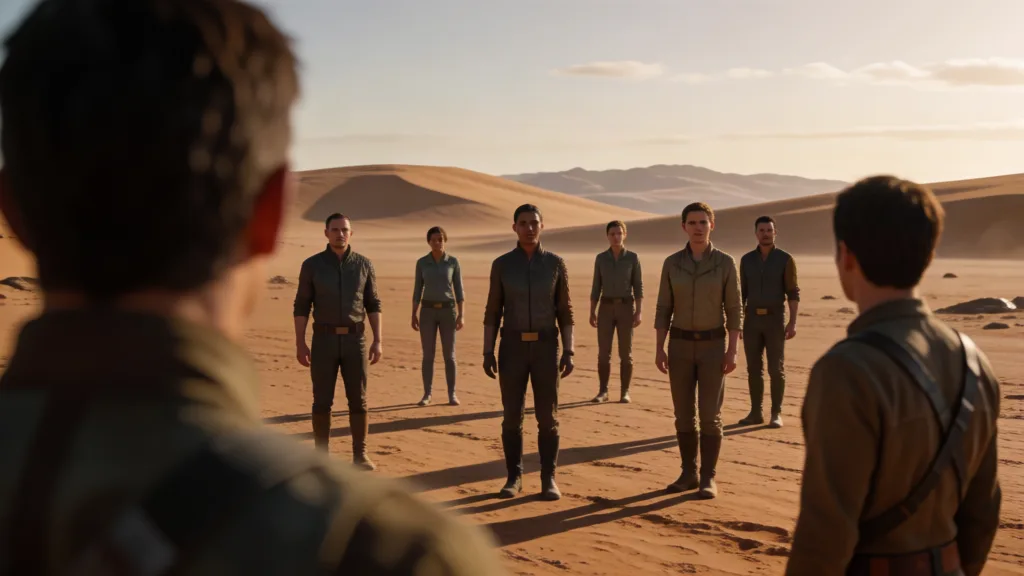
The first siren went off at oh-four-hundred. I was already awake. Sleep came in scraps these days, more like a bad habit than a rest, and the siren just finished the job. I swung my legs over the cot and sat there in the dark, listening. The second siren came a minute later. That was the one that meant business.
By the time I got my boots on and hit the corridor, half the outpost was already moving. Lights flickered on in the barracks. Someone’s dog was barking. A kid was crying somewhere down the hall, that thin, ragged sound that meant the parents were already gone. We had two hundred and seven people in New Haven, counting the infants. We’d lost three adults to the fever last month and one child to a snake bite. The colony registry was a ledger of small griefs.
I pushed through the main doors and the cold hit me like a wall. This continent didn’t believe in gentle mornings. The air was sharp, metallic, full of the smell of wet stone and something else, something green and rotten that never quite burned off. The sky was the color of a bruise. Lights from the watchtower cut yellow cones through the dark, and I could see people already gathered at the perimeter fence.
Maya was there. She was always there first, standing at the gate with her arms crossed, her breath pluming. She ran the logistics board. She was thirty-two, which made her one of the old ones, and she had a face that looked like it had been carved from the same rock they built the outpost from. She didn’t turn when I walked up.
“They’re early,” she said.
“How early?”
“Two hours. Look.”
She pointed past the fence, past the cleared ground where we’d planted the first crops, past the treeline where the forest started. The road they’d cut through the jungle was a dark scar. And on it, moving slow, was a line of lights. Not headlights. Torches. The convoy was coming on foot.
I’d known this day was coming for six months. We’d all known. The council had voted on it, debated it, prayed over it. The message from the Home Office had been clear: we were not meeting production quotas. We were not expanding fast enough. We were not breeding. The colony needed a labor force, and the mainland had a surplus. Five hundred demihumans, they said. Distant cousins. The old bloodlines. The ones who’d lost the war and then lost the peace, pushed into reservations, pushed into camps, pushed onto ships. Now they were being pushed to us.
I’d voted against it. So had Maya. So had about forty others. But the majority had their reasons. We needed hands. We needed bodies. We needed someone to do the work that was killing our people at a rate we couldn’t sustain. The fever took the strong ones first. The soil was wrong. The water was wrong. Everything on this continent wanted to kill us, and we were losing.
So they were coming. Five hundred of them. To work. To breed. To dilute their bloodlines until there was nothing left but a footnote in the colonial records.
The convoy took another hour to reach us. I watched them come. We all did. The fence was lined with people, some still in their nightclothes, some holding coffee cups that steamed in the cold. The children were kept inside. Someone had decided that was better. I wasn’t sure it was.
They walked in chains. Not the heavy iron kind you see in old pictures. These were lighter, plastic and alloy, cuffs on wrists and ankles linked by a central chain that ran down the line. They moved like a single creature, a long dark worm of bodies shuffling forward. The guards walked on either side, twelve of them in colonial uniforms, rifles slung, faces blank. The torches were carried by the demihumans in the front. They were the only light.
I’d seen pictures. I’d read the reports. But pictures don’t prepare you for the smell, the sound, the sheer weight of so many bodies in motion. They were short, most of them. Not dwarfish, just compact, built for a different kind of gravity. Their skin was gray, not the gray of sickness but the gray of stone, of river silt, of things that had never seen the sun. Their eyes were large and dark, set deep in their faces, and they didn’t blink enough. The women had hair that grew in patches, not like a disease but like a pattern I couldn’t read. The men were bald. The children, and there were children, looked like smaller versions of the adults, already worn, already quiet.
The lead guard stopped at the gate. He was a big man, red-faced, with the kind of mustache that seemed to belong to an earlier century. He looked at Maya, then at me, then at the crowd behind us.
“Colony New Haven?” he said.
“That’s right,” Maya said.
“Delivery for you. Five hundred and three. Three died on the crossing. We left them in the sea.”
No one said anything. The wind picked up, carrying the smell of the convoy toward us. It was a smell I still can’t name. Unwashed bodies, yes. Fear, yes. But something else. Something old. Something that didn’t belong in this century or on this continent.
“Where do you want them?” the guard said.
Maya looked at me. I was the liaison. That was my official title. Liaison to the Demihuman Population. I’d taken the job because no one else wanted it, and because I thought maybe I could do some good. I wasn’t sure anymore.
“The holding pens,” I said. “Past the agri-domes. We’ve got shelters set up.”
The guard nodded. He turned and shouted something in a language I didn’t understand. The convoy started moving again, shuffling through the gate, past the fence, into the colony. The people of New Haven watched. Some of them crossed themselves. Some of them just stared.
I walked alongside the line. I wanted to see their faces. I wanted to know what we were doing. The first few rows were men, their eyes fixed straight ahead, their mouths set in lines that could have been resignation or hatred or nothing at all. Then came the women. They carried the children, or held their hands, or pulled them along. One woman had a baby strapped to her chest with a cloth. The baby was awake. It was looking at me with those big dark eyes, and I had to look away.
I counted the children. I didn’t mean to, but I did. Forty-seven. Maybe fifty. They looked healthy enough, thin but not starving, scared but not crying. They’d learned not to cry. That was the worst part. The children had already learned.
The holding pens were at the edge of the settlement, near the river. We’d built them fast, pre-fab walls and wire fencing, a row of barracks that were really just sheds with cots. The guards herded the demihumans inside and closed the gates. Then they came to the admin building to sign the papers.
I sat in the back of the room while Maya handled the transfer. The guard captain, his name was Reeves, sat across from her, chewing on something, tobacco maybe, and spitting into a cup.
“They’re healthy enough,” he said. “The ones that survived. The breeding stock is good. We kept the best specimens for you.”
“Specimens,” I said.
Reeves looked at me. “That’s what they are. That’s what the contract says. Genetic material. Labor units. You can call them whatever you want, but the paperwork calls them units.”
“And the children?”
“They grow up. They work. They breed. That’s the point, isn’t it? You’re not supposed to keep them separate. You’re supposed to integrate them. Mix the bloodlines. In a generation or two, there won’t be any demihumans left. Just humans with a bit of gray in their skin and big eyes. That’s the plan.”
I’d read the plan. I’d read it a dozen times. The language was clinical. “Genetic assimilation.” “Cultural absorption.” “Phased population integration.” It was the kind of language that made genocide sound like a management problem.
“You’ve got a problem with it?” Reeves said.
“I’ve got a problem with calling people specimens.”
He shrugged. “They’re not people. Not legally. They’re protected persons. That’s the term. Protected persons under colonial administration. They have rights, technically. They can’t be killed without cause. They can’t be tortured. But they’re not citizens. They don’t vote. They don’t own property. They don’t choose where they go or what they do. That’s the law.”
“The law is wrong.”
“The law is what keeps this colony alive. You want to go back to doing everything by hand? You want to watch more of your people die of exhaustion and fever? Because that’s the alternative. You don’t get to have a colony on a continent like this without labor. And your people don’t want to do it. So here they are.”
He had a point. I hated him for it, but he had a point. We’d tried. We’d really tried. The first year, everyone worked. Everyone pulled their weight. But the fever took the strong ones, and the soil took the rest, and the ones who survived were too tired to build anything. We were dying. Not fast, but steady. A few people a month. A child. A farmer. A carpenter. The colony registry was a ledger of small griefs, and it was getting longer.
So they sent us the demihumans. And we took them.
Maya signed the papers. Reeves left. The convoy guards went back to their trucks and drove away, and we were alone with five hundred strangers.
I didn’t sleep that night. I walked to the holding pens and stood outside the fence, watching. The demihumans had been given food, a thin stew and bread, and they ate in silence. The children ate fastest, like they knew the food might disappear. The adults rationed theirs, breaking the bread into pieces, saving some for later.
One of the women saw me standing there. She walked to the fence and stopped a few feet away. She was older, maybe forty, with gray streaks in her patchy hair and a scar running from her temple to her jaw. She looked at me for a long time. Then she spoke.
“What happens now?”
Her voice was rough, like she didn’t use it much. The accent was strange, the vowels flattened, the consonants hard. But the words were clear.
“You work,” I said. “You live here. You’ll be assigned to farms, to construction, to the kitchens. The children will go to school.”
“School,” she said. Like she was tasting the word.
“They’ll learn our language. Our history. Our ways.”
“And their own?”
I didn’t answer.
She nodded. She’d known. They all knew. That was the worst part. They knew what was coming, and they’d come anyway, because the alternative was worse. The reservations were dying. The camps were dying. The mainland didn’t want them. No one wanted them. We were the last stop.
“My name is Elara,” she said.
“I’m Daniel.”
“Daniel.” She said it carefully, like she was memorizing it. “You are the one who speaks for us?”
“I’m the liaison. I’m supposed to help. To make things easier.”
“Easier,” she said. Another word she was tasting. “Nothing is easier. But some things are less hard.”
She turned and walked back to the others. I watched her go. The children had finished eating. Some of them were playing, a quiet game in the dirt, drawing lines with sticks. They looked like children anywhere. They looked like children who didn’t know yet that they were being erased.
The next morning, the work began.
I’d drawn up a schedule. I’d spent weeks on it, trying to be fair, trying to keep families together, trying to spread the labor so no one was worked to death. The council had approved it, mostly. There were arguments about which demihumans would go to which farms, about who got the strongest workers, about how many hours they could work before they needed rest. The council members had names for them now. Not “units.” Not “protected persons.” They said “the grays” and “the short ones” and worse. I didn’t correct them. I didn’t have the strength.
The first day was chaos. The demihumans didn’t understand our tools. Our language was a wall. Our methods were foreign. They tried. God, they tried. But a plow that took a human an hour to learn took them a day. A harvest that should have taken three hours took eight. The farmers shouted. The demihumans flinched. By evening, everyone was exhausted and nothing was done.
I walked the fields that night. The moon was up, a sliver of light that barely touched the ground. I found Elara sitting by the river, her feet in the water, her hands in her lap.
“It will get better,” I said.
“Will it?”
“You’ll learn. We’ll learn. It’s just the first day.”
“It is the first day of a thousand days,” she said. “And at the end of them, there will be no more of us. Just children who look like humans but remember nothing. Just blood that is thin and pale. Just a story that no one tells.”
I sat down next to her. The river was cold, but I put my feet in anyway.
“I voted against this,” I said.
“That does not help me.”
“No. It doesn’t.”
She was quiet for a long time. The water moved past us, dark and fast. Somewhere in the forest, an animal called out, a sound like a child crying.
“Tell me about your world,” she said.
“What do you want to know?”
“Everything. Before we came. What did you build? What did you love? What did you lose?”
I told her. I told her about the city I grew up in, the one with the bridges and the rain and the markets that smelled of bread and fish. I told her about my mother, who died when I was twenty, and my father, who died before I was born, and my sister, who stayed behind when I came to the colony. I told her about the fever that took my best friend in the second year, and the child I’d helped deliver who died three days later, and the garden I’d planted that never grew.
She listened. She didn’t interrupt. When I was done, she said, “You have lost much.”
“Everyone has.”
“Yes. But you are allowed to keep what you build. You are allowed to pass it on. We are not.”
I didn’t have an answer for that. I still don’t.
The weeks passed. The rhythm settled. The demihumans learned the tools. The farmers learned to speak slower, to show instead of tell. The children went to school, where they sat in rows and recited the colonial charter and learned to write their names in our alphabet. The colony registry added five hundred new names. The ledger of small griefs got longer.
But something else happened too. Something I didn’t expect.
They started to talk to me. Not all of them. Most of them still looked at me like I was a guard, a jailer, a threat. But some of them came to me with questions, with complaints, with stories. Elara was one. A man named Kael was another. He was young, maybe twenty, with a scarred hand and a quick smile that didn’t reach his eyes. He’d been a hunter on the reservation. He knew the forest better than anyone in the colony. He started going out with the hunting parties, showing them where the game was, how to track, how to set traps. The hunters came back with full bags for the first time in months.
“You’re good at this,” I told him one evening.
“I am good at staying alive,” he said. “That is what we are. Survivors. We have been surviving for a long time.”
“Longer than us.”
“Much longer. We were here before you. Before your ships. Before your colonies. We were here when this continent was young and the air was clean and the rivers ran clear. You came and you took it. And now you are taking us.”
“I didn’t take anything.”
“You are here. You eat the food we grow. You live in the houses we build. You take our children to your schools. You are taking everything. Even if you do not hold the knife, you are the one who eats the meat.”
I wanted to argue. I wanted to tell him I was different, that I was trying, that I wasn’t like the others. But I’d learned something in my years on this continent. The truth doesn’t care about your intentions. The truth is what you do. And what I was doing was standing by while a people were erased.
Three months in, the first demihuman child was born in New Haven.
The mother was a woman named Sera. She was young, nineteen, and she’d come to us pregnant, though no one had told us. The father was a human, one of the guards on the convoy. That was the story she told, anyway. She didn’t say it with anger. She said it like it was a fact, like rain or nightfall.
The baby was a girl. She had gray skin and dark eyes and a tuft of black hair. She looked like any demihuman baby. But she was half human. That was the point. That was the plan.
I held her once. She was warm and small and she gripped my finger with a strength that surprised me. She looked at me with those eyes, and I saw nothing in them but baby. Just a baby. Just a life.
“What will you name her?” I asked Sera.
“Hope,” she said. “That is the word you use. Hope.”
“It’s a good name.”
“It is a lie. But it is a beautiful lie.”
The colony celebrated the birth. The council called it a milestone. The Home Office sent a message of congratulations. They said it was proof that integration was working, that the plan was succeeding, that the future was bright.
I walked home that night and I sat in my room and I didn’t move for a long time. The walls were thin. I could hear the demihumans in the holding pens, their voices low, their songs strange. They sang at night. I’d never asked what the songs meant. I was afraid to know.
The next morning, I found Elara at the river again. She was washing clothes, her hands red from the cold water.
“You look tired,” she said.
“I didn’t sleep.”
“Neither did we. The baby cried all night.”
“How did you know it was a baby?”
She looked at me. “We know. We always know. Every birth is a death. Every child is a grave.”
“That’s a terrible thing to say.”
“It is a terrible thing to be true.”
I sat down. The river was higher than usual. The rains had come early.
“I want to help,” I said. “I want to do something. I don’t know what.”
“You cannot help us,” she said. “You can only choose not to hurt us. That is not help. That is the absence of harm. It is not the same.”
“Then what do I do?”
“You ask the wrong question. The question is not what you do. The question is what you are willing to lose. You have a colony. You have a life. You have a place in this world. Are you willing to lose it?”
I didn’t answer. I couldn’t.
She stood up, wrung out the clothes, and walked back to the pens. I stayed by the river until the sun was high and the heat burned off the cold and the day was just another day.
That was three weeks ago. The baby is still alive. The colony is still running. The work goes on. The children go to school. The demihumans sing at night.
And I am still here, standing at the fence, watching them.
I don’t know what I’m going to do. I don’t know if there’s anything to do. The plan is working. The bloodlines are mixing. In a generation, there will be no more demihumans. Just humans with gray skin and big eyes, who remember nothing, who tell no stories, who are us.
But tonight, the songs are louder than usual. And Elara is standing at the fence, looking at me, her eyes dark and unblinking.
She’s holding something. A piece of paper. She presses it against the wire.
I walk over. The paper has writing on it. Not our alphabet. Theirs. Symbols I’ve never seen, curves and lines that look like roots, like rivers, like veins.
“What is this?” I say.
“A story,” she says. “Our story. The one they want us to forget.”
“Why are you showing me?”
“Because you asked. Because you are the only one who did.”
She walks away. I stand there, holding the paper, the symbols strange and beautiful in the moonlight.
I don’t know what it says. I don’t know if I can learn to read it. I don’t know if it matters.
But I’m going to try.
Because the ledger of small griefs is long enough. And I don’t want to add another name.
Watch this moment
Turn the current scene into a cinematic Live Chapter — what you watch becomes the story's next part.
Disclaimer
This is a work of fiction, assisted by artificial intelligence. Any names or characters, businesses or places, events or incidents, are fictitious. Any resemblance to actual persons, living or dead, or actual events is purely coincidental.
Content Removal Policy
- Users may report content that may be illegal or violates our Standards.
- All reported complaints will be reviewed and resolved within seven business days.
- Review Process: Our team will assess the reported content against our guidelines.
- Appeals: If you disagree with a decision, you may appeal within 14 days of notification.
- Potential outcomes include: content removal, account warning, or no action if no violation is found.
To report content, email us at [email protected]