Share
Go Live
Rhythm of Ruin
·
Published 11/2/2026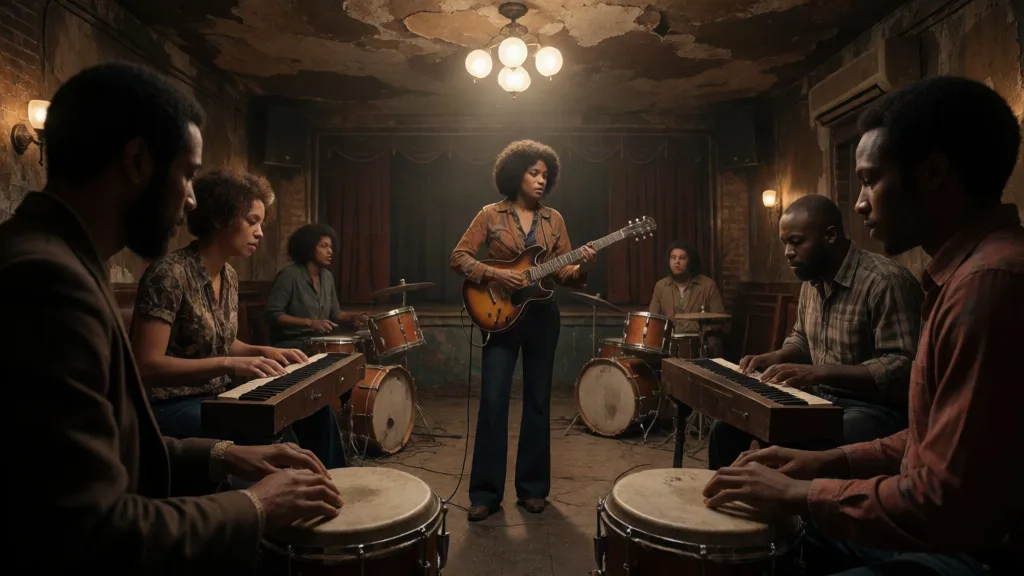
The bass drum hit me in the sternum before I ever heard a note.
That's how it's always been. Music lives in my bones first, a thrumming in the marrow, a pressure against my ribs like a second heartbeat. The doctors told my mother it was a gift, this sensitivity, this way I have of feeling what others only hear. My mother, who sang in the choir at Greater New Mount Moriah every Sunday, who could hold a note long enough to make the rafters sweat, she just nodded and said, "She got it from me."
She didn't. But I loved her for saying it.
The club was called The Blue Lantern, and it had been dead for seven years by the time I found it. Dead in the way that buildings in Detroit were dead in 1976, which is to say not quite, never quite, because the city itself refused to die no matter how many times they pulled the plug. The sign was still there, blue paint peeling like a sunburn, the lantern shape barely visible under rust and pigeon shit. Wood boards covered the windows. The door was chained, but the chain had rusted through in one link, and someone had pulled it apart, leaving a gap just wide enough for a skinny seventeen-year-old with more curiosity than sense.
That was me. Vesta Jones. Named for the Roman goddess of the hearth, which my father thought was funny because I couldn't hear the fire crackle. He left when I was six. I don't remember his laugh, but I remember the vibration of it, the way it shook the kitchen table when he told jokes at breakfast. That's the thing about being deaf in a hearing world. You don't lose the memory of sound. You just translate it into something else.
I'd been walking past The Blue Lantern for three weeks, ever since Mama and I moved into the apartment on Kercheval. The building was two blocks from our place, wedged between a burned-out laundromat and a church that had been converted into a numbers running operation. I knew about the numbers because the men who ran it stood outside smoking cigarettes and talking in low voices, and I could feel the rumble of their conversations through the sidewalk. Everything in Detroit rumbled. The buses, the factories, the arguments that spilled out of bars at closing time. The city was a body that never stopped twitching.
But The Blue Lantern was different. It was quiet. Not the absence of sound, which I understood better than anyone, but a kind of held breath. A waiting. Every time I walked past, I felt it, a faint pulse in the concrete, like something underneath was trying to get out.
I told myself it was the subway. Detroit didn't have a subway, but I was new to the neighborhood and I didn't know that yet. I told myself it was the pipes, the rats, the ghost of some old furnace still burning. I told myself a lot of things.
Then I found the chain.
---
The gap in the door was narrow. I had to turn sideways, suck in my stomach, feel the rough wood scrape against my hip through the thin cotton of my dress. The dress was yellow, my favorite, the one I'd bought at Hudson's with money from my summer job at the car wash. I'd worn it because I wanted to feel pretty, which was a stupid reason to dress up for an abandoned building, but I was seventeen and stupid was my default setting.
Inside, the dark was total. I stood still and let my eyes adjust, which took longer than I expected. The boards over the windows didn't let in much light, just thin slivers that cut through the dust like knives. The air was thick, musty, sweet with rot and something else, something I couldn't name. I breathed it in and felt it settle in my lungs, heavy and warm.
The floor was sticky. I didn't want to think about what made it sticky. My sandals made soft sounds against the wood, little squelches that I couldn't hear but could feel through my soles. I moved forward slowly, one hand out in front of me, the other clutching the strap of my purse. The purse was fake leather, red, a hand-me-down from Mama. Inside was a switchblade I'd never used and a pack of Wrigley's and a photograph of a boy named Curtis who didn't know I existed.
The main room of the club was long and narrow, with a bar on one side and a stage at the far end. I could make out the shapes of tables, chairs stacked against the wall, a piano that had been gutted, its keys scattered across the floor like teeth. The stage was small, barely big enough for a trio, and the microphone stand was still there, bent at the neck like a question mark.
I stood in front of the stage and closed my eyes.
This is what I do. This is what I've always done. I close my eyes and I let the world come in through my skin. The vibrations tell me everything. The building was settling, old bones shifting in the heat. The wind outside pushed against the walls, a low steady pressure. Somewhere a rat was scratching, a tiny tickle against the floorboards. And underneath all of it, something else. Something deeper.
A rhythm.
I felt it in my feet first, a pulse that came up through the soles of my sandals and traveled up my legs, into my hips, into my spine. It was slow, slower than a heartbeat, maybe forty beats per minute. But it was steady. It was deliberate. It was music.
I opened my eyes and looked around. The club was empty. I was alone. But the rhythm continued, a throb that seemed to come from everywhere and nowhere, a bass line played on instruments I couldn't see.
I followed it.
The stairs to the basement were behind the stage, hidden by a curtain that had rotted into lace. I pulled it aside and found the steps, narrow and steep, disappearing into a darkness that felt thicker than the dark upstairs. The rhythm was stronger here. It pushed against my chest, my stomach, my throat. I could feel it in my teeth.
I should have turned back. Any sensible girl would have turned back. But I was not sensible. I was Vesta Jones, and I had spent my whole life chasing vibrations, and this was the strongest I'd ever felt.
I went down.
---
The basement was a single room, low-ceilinged and damp. Water stains spread across the walls like maps of countries that didn't exist. The floor was concrete, cracked and uneven, and in the center of the room was a circle.
I saw it first as a shadow, a darker patch on the concrete. But as my eyes adjusted, I saw that it wasn't a shadow. It was a drawing. Chalk, maybe, or paint, faded but still visible. A circle, maybe six feet across, with symbols inside it. Stars. Crosses. Words in a language I didn't recognize.
And in the center of the circle, a drum.
It was a conga, tall and narrow, the wood dark with age. The skin was torn, a long gash that ran from the center to the edge. It should have been silent. A drum with a torn head makes no sound.
But I felt it. The rhythm. It was coming from the drum.
I stood at the edge of the circle and stared. The vibrations were so strong now that they blurred my vision, made the walls seem to breathe. I could feel them in my fillings, in the metal pins they'd put in my ankle when I broke it falling out of a tree when I was nine. My whole body was a tuning fork, and the drum was the note.
I don't know how long I stood there. Time did something strange in that basement, folded in on itself, became a loop. The rhythm didn't change, didn't speed up or slow down. It just was. A constant, a pulse, a promise.
And then it stopped.
The silence that followed was worse than any silence I'd ever known. It was a vacuum, a void, a hole in the world. I gasped, actually gasped, and the sound of my own breath was loud in my ears, which is a figure of speech, because I couldn't hear my breath, but I felt it, the rush of air, the expansion of my lungs.
I stepped into the circle.
The drum was cold. Colder than it should have been, colder than the damp air around it. I touched the torn skin and felt nothing. No vibration. No rhythm. Just the rough texture of the hide, the sharp edge of the tear.
I picked it up. It was heavier than it looked, maybe twenty pounds, the wood smooth and dark. I held it against my chest and felt my own heartbeat, fast and shallow, a rabbit's heart, a frightened heart.
And then I felt something else.
A warmth. Spreading from the drum into my hands, my arms, my chest. A heat that wasn't physical, wasn't temperature, but something else. Something like recognition. Like the drum knew me. Like it had been waiting.
I heard a voice. Not with my ears, which was impossible, but with my bones. A voice that was also a vibration, a frequency, a message.
*Play me.*
I dropped the drum.
It hit the concrete with a hollow thud that I felt through my feet. The sound echoed, or maybe it didn't, maybe it was just the vibration bouncing off the walls, but it felt like an echo, felt like the drum was calling out, trying to find me again.
I ran. Up the stairs, through the curtain, across the sticky floor, out the gap in the door, into the street. The sun was setting, the sky a bruise of purple and orange, and the heat of the day was still rising off the asphalt. I stood on the sidewalk and breathed, deep gulps of air that tasted like exhaust and fried food and something sweet, maybe honeysuckle, maybe just the city.
My hands were shaking. I looked down at them and saw that they were clean. No dust, no chalk, no residue from the drum. Just my hands, brown and small, the nails bitten down to the quick.
I walked home.
---
Mama was in the kitchen when I got there, stirring a pot of greens and humming a hymn. She couldn't carry a tune, not really, but she hummed anyway, and the vibration of it filled the apartment, a low buzz that I'd known my whole life. She turned when I came in, her face soft with welcome, and I felt the familiar rush of love that always came when I saw her. Mama was small and round and fierce, a woman who had raised me alone after my father left, who had worked double shifts at the hospital laundry, who had never once made me feel like a burden, even though I knew I was.
"You're late," she said. Her lips moved in a way I knew, the shape of the words. I read lips the way other people read books, automatically, without thinking. "Where you been?"
"Walking," I said. My voice is strange, I know. Deaf voice, they call it, flat and careful, the words shaped by memory instead of sound. I've worked hard to make it understandable, to make it mine. "Just walking."
She looked at me for a long moment. Mama had a way of seeing through me, of knowing when I was lying, of knowing when something was wrong. But she didn't push. She never pushed. She just turned back to the stove and said, "Wash up. Dinner's almost ready."
I went to my room and closed the door. My room was small, barely big enough for a bed and a dresser, but it was mine. I'd painted the walls yellow, the same yellow as my dress, because yellow was the color of sunshine and I wanted to feel like I lived in the sun. On the dresser was my record player, a portable one I'd bought at a garage sale, and a stack of albums. Stevie Wonder. Aretha. Marvin Gaye. The Supremes. Music I couldn't hear but could feel, music that made my bones sing.
I sat on the bed and put my hands on my knees. They were still shaking. I could still feel the rhythm, a ghost of it, a memory. It was in my blood now, I thought. It was part of me.
I didn't sleep that night. I lay in bed and stared at the ceiling and felt the city breathe around me. The buses, the cars, the arguments, the laughter. The vibrations of a million lives, all of them separate, all of them connected. And underneath them all, faint but unmistakable, the rhythm. The beat. The pulse.
It was still there. It was always there.
---
The next day was Sunday. Church day. Mama woke me at seven with a hand on my shoulder, gentle but firm. I got dressed in my good dress, the blue one with the white collar, and we walked to Greater New Mount Moriah together. The church was six blocks away, a big stone building with a steeple that pointed at the sky like a finger. Inside, the pews were already filling up, the congregation in their Sunday best, hats and suits and dresses that shone in the stained light from the windows.
I sat next to Mama and let the service wash over me. The organ, the choir, the preacher's voice rising and falling like a wave. I couldn't hear the words, but I felt them. The vibration of the organ was a deep, resonant hum that filled my chest. The choir's voices were a chorus of frequencies, each one distinct, each one part of the whole. And the preacher, Reverend Watkins, his voice was a drum, a beat that drove the congregation forward, that made them nod and sway and call out.
I closed my eyes and let it take me. This was my music, the music I'd grown up with, the music that had shaped me. It was different from the rhythm in the basement, but it was also the same. Both were about something bigger than sound. Both were about connection, about being part of something, about feeling the world move through you.
After the service, Mama stayed to talk to the other women, and I slipped outside. The sun was high and hot, and the sidewalk was crowded with people in their church clothes, shaking hands and exchanging news. I stood at the edge of the crowd and watched them, feeling the vibrations of their voices, the rumble of their laughter, the sharp tick of their heels on the concrete.
That's when I saw Curtis.
He was standing with a group of boys near the corner, laughing at something, his head thrown back. Curtis was eighteen, tall and lean, with skin the color of dark honey and a smile that made my stomach flip. He worked at the record store on Woodward, and I'd been going there for weeks, pretending to browse, pretending not to stare. I'd never spoken to him. I'd never even been close enough to feel his voice.
But I felt it now. Across the crowd, across the noise, I felt it. A vibration that was different from the others, that cut through the chaos like a knife. It was warm, and it was steady, and it was him.
He turned, as if he'd felt me watching. Our eyes met. He smiled.
I looked away.
My heart was pounding. I could feel it in my throat, in my wrists, in the tips of my fingers. I wanted to go to him. I wanted to say something, anything, to make him see me. But I was frozen. I was always frozen. I was Vesta Jones, the deaf girl, the weird girl, the girl who felt too much and said too little.
Mama came out of the church and took my arm. "Ready to go home?"
I nodded. I didn't look back at Curtis. I couldn't.
But I felt him watching me as I walked away. I felt it in my spine, in my shoulders, in the back of my neck. A warmth. A recognition. The same warmth I'd felt from the drum.
---
The week passed slowly. I went to work at the car wash, spraying down cars and drying them with towels that smelled like soap and gasoline. I came home and helped Mama with dinner. I lay in bed at night and felt the rhythm, faint but persistent, calling to me from two blocks away.
I didn't go back to The Blue Lantern. I told myself I was scared, which was true, but it was more than that. I was afraid of what I'd find. I was afraid of what I'd feel. I was afraid that the drum would speak to me again, and that this time, I wouldn't be able to walk away.
But the rhythm didn't leave me. It was there when I woke up, a pulse in the floorboards. It was there when I walked to work, a throb in the sidewalk. It was there when I sat in church, a counterpoint to the organ. It was there when I saw Curtis at the record store, a heat in my chest that had nothing to do with him and everything to do with him.
I started to feel like I was losing my mind. I started to feel like the rhythm was changing me, reshaping me, turning me into something I didn't recognize. I started to feel like I was a drum myself, hollow and waiting, and someone was playing me.
On Thursday, I went back.
---
The gap in the door was still there. The chain was still broken. I slipped inside and stood in the dark, letting my eyes adjust. The club was the same as before, the tables, the chairs, the gutted piano. But the rhythm was stronger now. It was a pressure in the air, a weight on my skin. It was pulling me toward the stage, toward the stairs, toward the basement.
I went down.
The drum was still in the circle. It was exactly where I'd left it, lying on its side, the torn skin facing up. I knelt beside it and touched the wood. It was warm. Warmer than it should have been.
I picked it up and held it against my chest. The rhythm was coming from inside it, a vibration so strong that it made my teeth ache. I closed my eyes and let it fill me. I let it take me.
And then I heard the voice again.
*Play me.*
I opened my eyes. The basement was empty. I was alone. But the voice was real. It was as real as the drum in my hands, as real as the rhythm in my bones.
I didn't have sticks. I didn't need them. I turned the drum over and used my hands, my palms, my fingers. I hit the skin and felt the vibration travel up my arms, into my shoulders, into my chest. I hit it again, and again, and again. I found the rhythm, the one that had been calling to me, and I played it.
The sound was terrible. The torn skin made a flat, dead noise, a thud instead of a tone. But the vibration was beautiful. It was a frequency that I'd never felt before, a resonance that seemed to open something inside me, a door that had been locked my whole life.
I played until my hands were raw. I played until the rhythm was all there was, until I was the rhythm, until the drum and I were the same thing.
And then I felt something else.
A presence. Someone else in the basement. Someone watching me.
I stopped. I turned.
Curtis was standing at the bottom of the stairs.
---
He was wearing a white t-shirt and jeans, and his arms were crossed over his chest, and his face was a mask of something I couldn't read. Surprise? Fear? Wonder? I couldn't tell. I couldn't feel his vibration, not from this distance, not over the rhythm of the drum.
"What are you doing here?" I said. My voice was loud, too loud, the way it gets when I'm scared.
He didn't answer. He just stood there, staring at me, staring at the drum.
"How did you find this place?" I said.
He took a step forward. Then another. He was close enough now that I could feel him, the warmth of his body, the vibration of his breath. He was scared. I could feel it, a tightness in his chest, a tremble in his hands.
"I followed you," he said.
His voice was low, a rumble that I felt in my stomach. I'd never felt his voice before. It was different from what I'd imagined. It was softer. It was sadder.
"Why?" I said.
He didn't answer. He just looked at the drum, at the circle, at the symbols on the floor. His face was pale, paler than I'd ever seen it.
"Do you know what this is?" he said.
"No," I said. Which was a lie. I knew something. I just didn't know what.
He knelt beside me and touched the drum. His fingers brushed against mine, and I felt a spark, a jolt, a vibration that was different from the rhythm. It was him. It was his frequency. It was the thing I'd felt at church, the thing I'd been feeling for weeks, the thing I'd been too scared to name.
"This is bad," he said. "This is very bad."
"What do you mean?"
He looked at me. His eyes were dark, darker than I'd thought, and they were full of something I couldn't name. Fear. Sorrow. Love.
"You don't know what you've found," he said. "You don't know what this thing does."
"Then tell me."
He shook his head. "I can't. Not here. Not now."
"Then when?"
He stood up. He looked at the drum, at the circle, at me. And then he turned and walked up the stairs, and I was alone again.
---
I didn't follow him. I sat in the basement for a long time, holding the drum, feeling the rhythm pulse through me. I thought about what he'd said. I thought about the way he'd looked at me. I thought about the warmth of his fingers on mine.
I thought about the fact that he'd followed me. He'd been watching me. He'd known where I was going, and he'd followed.
Why?
I didn't have an answer. I didn't have anything except the drum and the rhythm and the feeling that my life had just changed, that I'd crossed a line I couldn't uncross, that I was part of something now, something bigger than myself.
I went home.
Mama was asleep. I crept into my room and lay on my bed and stared at the ceiling. The rhythm was still there, a pulse in the dark, a beat that was mine now, that I'd claimed. I closed my eyes and let it take me.
I dreamed of Curtis. I dreamed of his hands on my skin, his voice in my ear, his body against mine. I dreamed of the drum, of playing it, of the vibration that connected us. I dreamed of the city, of Detroit, of the riots that had happened when I was a child, the fires and the guns and the tanks in the streets. I dreamed of a rhythm that was also a warning, a beat that was also a prophecy.
I woke up with a start. The rhythm was louder now. It was urgent. It was afraid.
I sat up and looked at the window. The sky was still dark, but there was a glow on the horizon, an orange flicker that wasn't the sun.
Fire.
I ran to the window and looked out. The street was empty, but the sky was full of smoke. Somewhere, a few blocks away, something was burning.
And the rhythm was pounding in my chest, a drumbeat that was also a heartbeat, a warning, a call.
*Play me.*
I didn't know what it meant. I didn't know what was happening. But I knew one thing.
I had to go back.
---
The fire was at the laundromat next to The Blue Lantern. The one that had been burned out for years, the one that was just a shell. But now it was burning again, flames licking out of the empty windows, smoke pouring into the sky. The fire trucks were already there, their lights flashing, their hoses spraying water that turned to steam before it hit the flames.
I stood on the corner and watched. The heat was intense, a pressure on my skin, a vibration that was different from the rhythm. It was chaos, destruction, anger. It was the city's rage made visible.
And underneath it, the rhythm. The beat. The pulse.
*Play me.*
I turned and looked at The Blue Lantern. The door was still open, the gap still there. The building was dark, but I could feel it calling to me, pulling me toward it.
I went inside.
The club was different now. The air was thick with smoke, and the walls were hot to the touch. But the rhythm was stronger than ever, a force that pushed me forward, that guided me to the stage, to the stairs, to the basement.
The drum was waiting for me.
I picked it up and held it against my chest. The rhythm was a roar now, a demand, a command.
*Play me.*
I played.
I played the rhythm that had been calling to me, the beat that was also a warning. I played the fire, the anger, the fear. I played the city, the people, the pain. I played until my hands were bleeding, until my arms were numb, until I couldn't play anymore.
And then I felt it.
A shift. A change. The rhythm was different now. It was slower, softer. It was a lullaby, a comfort, a promise.
The fire was out.
I don't know how I knew. I just knew. The flames had died, the smoke had cleared, the city had gone back to sleep. And the rhythm was quiet now, a whisper, a heartbeat, a memory.
I sat in the basement and held the drum and cried. I cried for the city, for the people, for myself. I cried because I didn't understand what was happening, because I was scared, because I was alone.
And then I felt a hand on my shoulder.
I turned. Curtis was there.
---
He was standing behind me, his face smudged with soot, his eyes red from the smoke. He looked at me, at the drum, at the circle. And then he spoke.
"You stopped it," he said.
His voice was a rumble, a vibration that I felt in my bones. I shook my head.
"I don't know what I did," I said.
"You played," he said. "You played the rhythm. You changed it."
"I don't understand."
He knelt beside me. He took my hands, the ones that were bleeding, the ones that were raw. He held them gently, like they were something precious.
"The rhythm," he said. "It's not just music. It's a prophecy. It's a warning. It's the city's heartbeat, and it's been getting faster, louder, angrier. It's been building to something. Something bad."
"The riots," I said.
He nodded. "The riots. The ones that happened before. The ones that are going to happen again. The rhythm knows. It feels it coming. And it's been trying to find someone who can hear it, someone who can play it, someone who can change it."
"Me," I said.
"You," he said.
I looked at the drum. I looked at the circle. I looked at Curtis.
"Why me?" I said.
He didn't answer. He just looked at me, his eyes full of something I couldn't name. And then he leaned forward and kissed me.
His lips were soft, softer than I'd imagined. His vibration was warm, warmer than I'd felt. He tasted like smoke and sweat and something sweet, something that was just him. I closed my eyes and let him kiss me, let him hold me, let him be the thing that grounded me in a world that was spinning out of control.
When he pulled back, he was smiling. A sad smile, a knowing smile.
"You're the only one who can feel it," he said. "You're the only one who can play it. You're the only one who can stop it."
"Stop what?"
"The riots," he said. "The violence. The destruction. You can change the rhythm. You can change the future."
I looked at him. I looked at the drum. I looked at my hands, the ones that were bleeding, the ones that had played the rhythm.
"I don't know if I can," I said.
"You can," he said. "I'll help you."
He kissed me again, and this time I kissed him back. I kissed him with everything I had, with all the fear and the hope and the love that I'd been holding inside. I kissed him until I couldn't breathe, until I couldn't think, until there was nothing in the world but him and me and the rhythm.
And then I felt it.
A new vibration. A new beat. A rhythm that was different from the one I'd been playing, a rhythm that was ours. It was slow and steady and warm, a pulse that connected us, that made us one.
I pulled back and looked at him.
"What's happening?" I said.
He smiled. "You're changing it," he said. "You're changing the rhythm. You're changing the future."
I looked at the drum. The torn skin was still torn, but it was different now. It was glowing, a faint light that pulsed in time with the rhythm. The symbols on the floor were glowing too, a soft blue light that filled the basement.
"I don't understand," I said.
"You don't have to understand," he said. "You just have to play."
He took my hands and placed them on the drum. The vibration was different now. It was softer, gentler. It was a question, not a command.
*Play me.*
I played.
I played the new rhythm, the one that was ours. I played the hope, the love, the future. I played until the glow faded, until the symbols dimmed, until the drum was just a drum again.
And when I stopped, Curtis was gone.
---
I looked for him. I searched the basement, the club, the street. But he was nowhere. He had vanished, like smoke, like a dream, like a vibration that had faded into silence.
I went home. Mama was awake, sitting at the kitchen table with a cup of coffee. She looked up when I came in, her face tight with worry.
"Where you been?" she said. "I was worried."
"I'm sorry," I said. "I was... walking."
She looked at me for a long moment. She looked at my hands, the ones that were still bleeding, the ones that were still raw. She looked at my face, the one that was smudged with soot and tears.
"What happened to you?" she said.
I didn't answer. I couldn't. I just walked to my room and closed the door and lay on my bed and stared at the ceiling.
The rhythm was still there. But it was different now. It was softer, gentler. It was a heartbeat, a lullaby, a promise.
And underneath it, another rhythm. A new one. A beat that was Curtis, that was me, that was us.
I closed my eyes and let it take me. I let it fill me. I let it become me.
I didn't know what was going to happen. I didn't know what the rhythm meant, or what I was supposed to do, or how I was supposed to stop the riots that were coming. I didn't know anything.
But I knew one thing.
I was Vesta Jones. I was a drummer. And I was going to play.
---
The next morning, I woke up to the sound of silence. Not the absence of sound, but the presence of it. The rhythm was gone. The pulse that had been calling to me for weeks, that had been pounding in my chest, that had been the background music of my life, it was gone.
I sat up and looked around. My room was the same. Yellow walls, record player, stack of albums. But something was different. Something was missing.
I got dressed and went to the kitchen. Mama was there, making breakfast, humming a hymn. She turned when I came in and smiled.
"You sleep okay?" she said.
I nodded. I didn't trust myself to speak.
I ate breakfast. I went to work. I came home. I did all the things I was supposed to do, the things that normal people did, the things that I'd done before the rhythm had found me. But it was different now. It was hollow. It was empty.
I missed it. I missed the pulse. I missed the vibration. I missed the feeling that I was part of something, that I was connected to something bigger than myself.
I missed Curtis.
I went to the record store on Wednesday. He wasn't there. I asked the man behind the counter, a fat white guy with a beard, if he knew where Curtis was.
"Curtis?" he said. "Curtis who?"
"The guy who works here," I said. "Tall, dark skin, about eighteen."
The man shook his head. "Ain't nobody named Curtis work here," he said. "Ain't never been."
I stared at him. I felt the floor shift under my feet.
"What do you mean?" I said. "He's been here for months. I've seen him."
The man shrugged. "You must be thinking of someone else," he said. "I've owned this store for fifteen years. I know everyone who's ever worked here. There ain't no Curtis."
I left the store. I walked home. I felt like I was dreaming, like the world had tilted, like nothing was real.
Curtis wasn't real. He couldn't be. He was a ghost, a vision, a vibration that had taken human form.
But he'd kissed me. He'd held me. He'd told me I could change the future.
I went to The Blue Lantern. The door was still open, the gap still there. I went inside, through the club, down the stairs, into the basement.
The drum was gone.
The circle was still there, the symbols still visible on the concrete. But the drum was gone. There was nothing in the center of the circle but empty space.
I stood there for a long time. I felt the silence. I felt the absence. I felt the hole in the world where the rhythm had been.
And then I felt something else.
A vibration. Faint, but there. A pulse. A beat.
It was coming from me.
I put my hand on my chest and felt my heart. It was beating, steady and strong. And underneath it, another beat. A rhythm that was mine. A rhythm that I'd created. A rhythm that would never leave me.
I smiled. I couldn't help it. I smiled.
I was Vesta Jones. I was a drummer. And I was going to play.
---
The riots came three weeks later. I felt them before they happened, felt the rhythm building, felt the city's anger rising like a tide. I went to the basement every night and played the drum, the one I'd found in my dreams, the one that appeared when I needed it, the one that was always waiting for me. I played the new rhythm, the one that was hope, the one that was love, the one that was peace.
It didn't stop the riots. Nothing could stop the riots. But it changed them. It made them shorter, less violent. It made them a protest instead of a war. It made them a cry for justice instead of a scream of rage.
I don't know if it was me. I don't know if the rhythm did anything. But I like to think it did. I like to think that I made a difference. I like to think that Curtis was right.
I never saw him again. I looked for him, everywhere, but he was gone. He was a ghost, a memory, a vibration that had faded into silence. But I felt him sometimes, in the rhythm, in the beat, in the pulse of the city. I felt him in my heart, in my bones, in my blood.
He was part of me now. He was part of the rhythm.
And the rhythm was part of me.
I'm Vesta Jones. I'm a drummer. And I'm going to play.
I'm going to play until the world changes. I'm going to play until the rhythm is all there is. I'm going to play until the city is whole again.
I'm going to play.
Watch this moment
Turn the current scene into a cinematic Live Chapter — what you watch becomes the story's next part.
Disclaimer
This is a work of fiction, assisted by artificial intelligence. Any names or characters, businesses or places, events or incidents, are fictitious. Any resemblance to actual persons, living or dead, or actual events is purely coincidental.
Content Removal Policy
- Users may report content that may be illegal or violates our Standards.
- All reported complaints will be reviewed and resolved within seven business days.
- Review Process: Our team will assess the reported content against our guidelines.
- Appeals: If you disagree with a decision, you may appeal within 14 days of notification.
- Potential outcomes include: content removal, account warning, or no action if no violation is found.
To report content, email us at [email protected]