Share
Go Live
Boardroom Dominas
·
Published 10/4/2026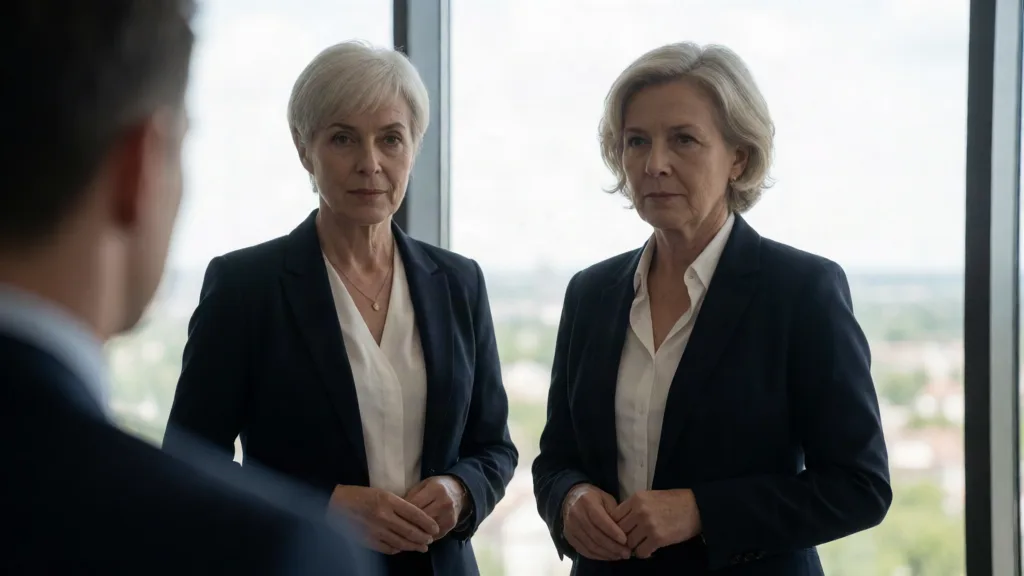
The train had been late leaving the station, and by the time we reached the hotel, the rain had turned the parking lot into a black mirror that reflected nothing but the neon sign and my own tired face. I held the door for them because that's what you do. Marta went through first without looking at me. Elżbieta paused, just long enough to let me feel the weight of the door and the weight of her silence, then followed.
"Room 412," the woman at reception said, sliding two key cards across the counter. "And 413. Adjoining."
Marta took both cards. She was sixty-one years old, silver hair cut sharp at the jaw, and she wore a charcoal suit that probably cost more than my monthly rent. Elżbieta was younger by maybe five years, softer in the face but harder in the eyes, and she dressed in navy blue with a silk scarf knotted at her throat like she was going to a funeral for someone she didn't like.
"Kacper," Marta said, not turning around. "Our bags."
I'd been standing there with my own duffel bag over my shoulder and their two matching leather suitcases at my feet. I'd already carried them from the taxi. I'd already hauled them up the station stairs when the elevator was broken. But I said, "Of course," because that's what you say.
The elevator was small and smelled like lemon cleaning product and old cigarettes. Marta pressed the button for the fourth floor. Elżbieta stood in the corner, checking something on her phone. I watched the numbers climb and tried to remember why I'd thought this job would be different.
Three months. That's how long I'd been at the company. Three months of fetching coffee and formatting spreadsheets and sitting in meetings where I wasn't supposed to speak. When Marta had called me into her office on Friday afternoon and told me I'd be accompanying them to the regional conference in Kraków, I'd actually felt something like hope. A chance to prove myself. A chance to move up.
I should have known better.
The hallway on the fourth floor was long and narrow, with doors that looked like they'd been painted over so many times the numbers were barely visible. Marta stopped at 412 and slid the key card in. The light blinked green. She pushed the door open and stepped inside without a word.
"Your room is next door," Elżbieta said. She was standing close to me now, close enough that I could smell her perfume, something floral and expensive that made my nose itch. "We'll need you at seven. Sharp."
"For what?"
She smiled. It wasn't a warm smile. "For whatever we need."
Then she was gone, disappearing into 412, and the door clicked shut behind her. I stood in the hallway for a long moment, listening to the muffled sounds of them moving around inside. A drawer opening. A zipper. The low murmur of voices I couldn't understand.
My room was smaller than theirs, of course. A single bed with a scratchy duvet, a desk that wobbled when I touched it, a window that looked out onto the parking lot and the highway beyond. I dropped my bag on the floor and sat on the edge of the bed, staring at the wall that separated me from them.
I thought about my father. He'd worked for the same company for thirty-two years. Thirty-two years of showing up early, staying late, never complaining. He'd told me once that the secret to getting ahead was to make yourself indispensable. To be the person they couldn't imagine doing without.
I'd been trying. God, I'd been trying. But there's a difference between being indispensable and being invisible, and I was starting to understand which one I'd become.
The wall was thin. I could hear them talking, their voices rising and falling in a rhythm I couldn't quite follow. Marta's voice was lower, more commanding. Elżbieta's was lighter but no less sharp. They were discussing something, maybe the conference, maybe me. I couldn't tell.
I unpacked my bag because I didn't know what else to do. Two shirts, one spare pair of trousers, a toothbrush. The suit I'd wear tomorrow, navy, the only one I owned, hanging in the closet like a costume waiting for its actor. I ironed it with the little travel iron the hotel provided, even though it didn't really need it. I just needed something to do with my hands.
At six forty-five, I knocked on their door.
Elżbieta answered. She'd changed into a different suit, black this time, with a blouse the color of cream. Her hair was down now, falling past her shoulders, and she'd reapplied her lipstick. She looked at me like I was a piece of furniture that had been delivered to the wrong address.
"You're early," she said.
"You said seven."
"Seven means seven. Not six forty-five."
"I'm sorry. I can wait."
She stepped back, holding the door open. "You're here now. Come in."
Their room was twice the size of mine. Two beds, a sitting area with actual armchairs, a window that looked out onto the city instead of the highway. Marta was standing by the window, a glass of wine in her hand, watching the rain streak down the glass.
"Kacper," she said, still not turning around. "Sit down."
I sat in one of the armchairs. Elżbieta took the other, crossing her legs and folding her hands in her lap like she was about to conduct an interview. Marta remained at the window, a silhouette against the gray sky.
"Do you know why you're here?" Marta asked.
"The conference. To assist with the presentation."
"The presentation is tomorrow at ten. Elżbieta and I will handle that. You're here for something else."
I waited. The rain tapped against the window like fingers on a table.
"We have a client," Marta said. "A very important client. He's arriving tonight, and he expects to be entertained. We need you to make sure that happens."
"Entertained how?"
She turned then, finally, and looked at me. Her eyes were the color of slate, flat and gray and impossible to read. "However he wants."
I felt something cold settle in my stomach. "I don't understand."
"You don't need to understand. You need to do what you're told."
Elżbieta leaned forward. "The client's name is Pan Nowak. He's been with the company for fifteen years. He controls the entire eastern region. If he decides to take his business elsewhere, we lose half our revenue. Do you understand what that means?"
I understood. I'd been at the company long enough to hear the whispers. Pan Nowak was a legend, and not in a good way. He was demanding, unpredictable, and had a reputation for making people's lives difficult just because he could.
"What do you need me to do?"
Marta set her wine glass down on the windowsill. "Whatever he asks. Whatever he wants. You smile, you nod, you fetch his drinks, you laugh at his jokes. And if he tells you to jump, you don't ask how high. You just jump."
"For how long?"
"Until we tell you to stop."
I looked at Elżbieta. She was watching me with something that might have been curiosity, or maybe pity. It was hard to tell. Her face was a mask that never slipped.
"I'm not sure I'm comfortable with that."
The silence that followed was heavy, like the air before a storm. Marta walked toward me, her heels clicking on the hardwood floor, and stopped just in front of my chair. She was tall, taller than me when I was sitting, and she looked down at me like I was something she'd found on the bottom of her shoe.
"Comfortable," she repeated. "You're worried about being comfortable."
"I just mean, I don't know what you're asking me to do. I don't know what he'll expect."
"He'll expect you to be useful. That's all anyone ever expects." She leaned down, her face close to mine. "You want to move up in this company, don't you? You want to prove yourself. This is your chance."
I wanted to say no. I wanted to stand up and walk out and tell them to find someone else. But I thought about my father, about thirty-two years of showing up and staying late and never complaining. I thought about my apartment, the one I could barely afford, and the student loans I'd be paying off until I was forty. I thought about all the reasons I couldn't afford to say no.
"Okay," I said. "I'll do it."
Marta straightened up. For a moment, something flickered in her eyes, something that might have been satisfaction or might have been contempt. "Good. He'll be here at eight. We'll meet him in the bar downstairs. Wear something nice."
"This is the only suit I have."
"Then make it work."
She turned and walked back to the window, picking up her wine glass like the conversation was over. Elżbieta stood up, smoothing her skirt, and gave me a look that I couldn't quite decipher.
"You can go now," she said. "Be in the lobby at seven fifty-five. Don't be late."
I stood up. My legs felt unsteady, like I'd been sitting in the same position for hours instead of minutes. I walked to the door and opened it, pausing in the doorway.
"What happens if I mess up?"
Elżbieta smiled again, that same cold smile from before. "You won't mess up. You can't afford to."
The door closed behind me, and I was alone in the hallway again. The carpet was the color of dried blood, and the lights flickered, just once, like a warning.
I went back to my room and sat on the bed and stared at the wall. On the other side, I could hear them moving around, getting ready. The sound of water running. The click of a hairdryer. Low voices, still discussing something I couldn't hear.
I thought about calling someone. My mother, maybe. My friend Piotr, who'd warned me about this job, who'd told me that companies like this ate people like us for breakfast. But what would I say? That I'd agreed to be a servant for a client I'd never met? That I'd let two women I barely knew treat me like I was nothing?
I didn't call anyone. I just sat there, watching the clock on my phone tick toward seven fifty-five, and tried to convince myself that this was an opportunity instead of a trap.
The bar was on the ground floor, dimly lit, with leather chairs and a fireplace that wasn't lit and a bartender who looked like he'd seen everything and wasn't impressed by any of it. Marta and Elżbieta were already there when I arrived, sitting at a table near the window, each with a glass of white wine in front of them. They didn't acknowledge me when I walked in. I stood by the door for a moment, unsure of what to do, then walked over and sat down in the empty chair across from them.
"You're on time," Elżbieta said. "That's a good start."
I nodded. My throat was dry. I wanted to order a drink, something to steady my nerves, but I didn't know if that was allowed.
Marta was checking her phone. "He's in the lobby. Elżbieta, go meet him. Bring him here."
Elżbieta stood up and walked out of the bar without a word. I watched her go, her heels clicking on the marble floor, her back straight, her head high. She moved like someone who'd never doubted her place in the world.
"Relax," Marta said, not looking up from her phone. "You look like you're about to be executed."
"I've never done anything like this before."
"Nobody has. That's the point." She finally looked at me, and for a moment, her expression softened. Just a fraction. Just enough that I almost believed she might be human after all. "Listen. Pan Nowak is a difficult man. He's used to getting what he wants, and he doesn't like to be told no. But he's also predictable. He likes to feel important. He likes to feel powerful. If you let him feel those things, he'll be easy to manage."
"And if I don't?"
"Then you'll find out what happens when he doesn't get what he wants."
She went back to her phone, and I sat there in silence, watching the door, waiting for Elżbieta to return with the man who was supposed to decide my fate.
He was shorter than I expected. That was the first thing I noticed. Pan Nowak was maybe five foot seven, with a round face and a bald head and a smile that didn't reach his eyes. He wore a suit that was too tight around the middle, and he walked with the confidence of someone who'd never been told he was wrong about anything.
Elżbieta was beside him, her hand on his arm, laughing at something he'd said. She guided him to our table like she was presenting a prize.
"Pan Nowak," Marta said, standing up. "So good to see you again."
They shook hands. He held hers a moment too long, his eyes traveling down her body and back up again. "Marta. You look as beautiful as ever."
"You're too kind."
He turned to me. "And who's this?"
"Kacper," Marta said. "Our new associate. He'll be assisting us this weekend."
Pan Nowak looked at me the way you might look at a piece of meat at the butcher's counter, trying to decide if it was worth the price. "Young," he said. "Eager. I like that."
He sat down, and Elżbieta sat next to him, closer than she needed to be. I was still standing, unsure of what to do.
"Sit," Marta said, and I sat.
The next hour was a blur of drinks and small talk and laughter that felt like it was happening to someone else. Pan Nowak told stories about his early days at the company, about the deals he'd closed and the people he'd crushed, and Marta and Elżbieta laughed at all the right moments. I laughed too, a beat behind, trying to match their rhythm.
"Kacper," Pan Nowak said, turning to me. "You've been quiet. What do you think of all this?"
"I think you've had an impressive career," I said. "I hope to learn from your example."
He smiled. It was the first real smile I'd seen from him, and it was worse than the fake one. "Smart boy. Knows how to flatter his elders."
"He's not just smart," Elżbieta said. "He's loyal. He'll do anything we ask."
Pan Nowak raised an eyebrow. "Anything?"
"Anything."
He looked at me, and I felt something cold crawl down my spine. "Is that true, Kacper? Would you do anything we asked?"
I thought about my father. I thought about my apartment. I thought about all the reasons I couldn't say no.
"Yes," I said. "Anything."
The word hung in the air like smoke. Pan Nowak leaned back in his chair, satisfied, and Marta signaled the bartender for another round.
The night went on. More drinks. More stories. More laughter that felt like a performance I hadn't rehearsed for. At some point, Elżbieta moved from her chair to the arm of Pan Nowak's chair, her hand resting on his shoulder, her lips close to his ear. He whispered something back, and she laughed, a sound like breaking glass.
Marta watched them with an expression I couldn't read. Then she turned to me.
"Walk with me," she said.
I followed her out of the bar, into the lobby, past the reception desk where the night clerk was pretending not to watch us. She led me to a small alcove near the elevators, a space with a single chair and a window that looked out onto the dark parking lot.
"You did well tonight," she said.
"Thank you."
"Don't thank me yet. The hard part is coming."
"What do you mean?"
She looked at me, and for a moment, I saw something in her eyes that I hadn't seen before. Something almost like regret.
"Pan Nowak has certain expectations. Certain appetites. Elżbieta and I have been managing them for years, but we're getting older. We need someone younger. Someone who can keep up."
I felt the floor shift under my feet. "What are you saying?"
"I'm saying that if you want to survive in this company, you need to learn to give him what he wants. Whatever that is. Whenever he wants it."
"That sounds like..."
"Don't say it." Her voice was sharp. "Don't put words to it. Just understand that this is how things work. This is how they've always worked. And if you can't handle it, you should leave now. Before it's too late."
I thought about leaving. I thought about walking out of the hotel, finding a train, going home. But home was an apartment I could barely afford. Home was a job I'd lose if I walked away. Home was a father who'd worked thirty-two years at the same company and had nothing to show for it but a pension and a bad back.
"I can handle it," I said.
Marta studied me for a long moment. Then she nodded. "Good. Because there's no going back now."
We walked back to the bar together. Elżbieta and Pan Nowak were still there, their heads close together, their voices low. When they saw us, they separated, like children caught doing something they shouldn't.
"Everything okay?" Elżbieta asked.
"Everything's fine," Marta said. "Kacper was just getting some air."
Pan Nowak looked at me, and his smile was back, the real one, the one that didn't reach his eyes. "Good. I was worried he might be having second thoughts."
"No second thoughts," I said. "I'm ready."
"Ready for what?"
I looked at Marta. She nodded, just barely.
"Ready to do whatever you need," I said. "Whatever the company needs."
Pan Nowak laughed. It was a wet, unpleasant sound. "I like this one. He's got spirit."
"He's got potential," Elżbieta said. "He just needs to be... trained."
I felt like a dog. I felt like a piece of equipment. I felt like something that could be bought and sold and traded. But I kept smiling. I kept nodding. I kept telling myself that this was the price of admission, that everyone had to pay it somehow.
The bar closed at midnight. We walked to the elevators together, Pan Nowak between Marta and Elżbieta, his arms around both their waists. I followed behind like a shadow.
"Kacper," Pan Nowak said as we waited for the elevator. "Your room is next to theirs, yes?"
"Yes."
"Good. I'll be staying in the suite on the top floor. Room 701. I expect you to check in on me in the morning. Say, eight o'clock."
"Eight o'clock. Yes, sir."
The elevator arrived. Pan Nowak stepped in, pulling Marta and Elżbieta with him. I started to follow, but Marta held up her hand.
"We'll see you in the morning," she said. "Get some sleep."
The doors closed before I could respond. I stood there in the lobby, alone, listening to the elevator hum as it climbed. Then I walked to the stairs and climbed them myself, four flights, one step at a time.
In my room, I lay on the bed and stared at the ceiling. The rain had stopped, and the silence was heavy, like a blanket pressing down on my chest. I could hear them through the wall, Marta and Elżbieta, moving around in their room. The murmur of their voices. The creak of a door.
I thought about what Marta had said. About being trained. About giving Pan Nowak what he wanted. I thought about my father, who'd never had to do anything like this, who'd worked his whole life in a factory where the worst thing you could do was show up late.
I thought about quitting. I thought about packing my bag and walking out and never looking back. But I was twenty-six years old, and I had nothing. No savings. No connections. No other options. This job was all I had, and if I lost it, I didn't know what I'd do.
So I stayed. I lay there in the dark, listening to the rain start again, and I told myself that tomorrow would be better. That I'd figure out a way to survive this. That I'd find a way to turn it around.
I didn't know then how wrong I was. I didn't know that the worst was yet to come. I didn't know that by the end of this weekend, I'd be a different person entirely.
But I would learn.
The alarm on my phone went off at seven. I hadn't slept. I'd spent the whole night staring at the ceiling, running through scenarios in my head, trying to prepare myself for whatever was coming. I showered and shaved and put on my one suit, and I stood in front of the mirror for a long time, trying to see myself as they saw me.
I looked young. That was the first thing. I looked young and scared and out of my depth. I tried to fix it, straightening my tie, smoothing my hair, practicing a smile that felt like a lie.
It didn't work. I still looked like a kid playing dress-up.
At seven fifty-five, I knocked on the door of room 412. Elżbieta answered. She was already dressed, another suit, another scarf, another mask of calm composure.
"Good morning," she said. "You look tired."
"I didn't sleep well."
"Neither did we." She stepped back to let me in. Marta was sitting at the small table by the window, a cup of coffee in her hand, a stack of papers in front of her. She didn't look up when I entered.
"Pan Nowak wants breakfast," Elżbieta said. "Room service. He'll be expecting you to deliver it."
"Okay."
"His order is on the desk. Don't mess it up."
I picked up the piece of paper. Coffee, black. Two eggs, scrambled, no salt. Toast, dry. A glass of orange juice. It was simple enough. I could handle it.
"After breakfast," Marta said, still not looking up, "you'll accompany him to the conference. You'll sit with him. You'll take notes. You'll do whatever he asks."
"And then?"
She finally looked at me. Her eyes were flat and gray and tired. "And then we'll see."
I nodded. I wanted to ask more questions, but I could tell from her expression that the conversation was over. I left the room and walked to the elevator, my heart pounding in my chest.
The suite on the top floor was twice the size of my apartment. I stood in the doorway, holding the tray of food, waiting for Pan Nowak to acknowledge me. He was sitting on the couch, wearing a bathrobe that barely covered his stomach, watching the news on a giant television screen.
"Come in," he said, not looking at me. "Put it on the table."
I set the tray down on the coffee table and stood there, unsure of what to do next. He glanced at me, then at the food, then back at the television.
"Sit," he said.
I sat in the chair across from him, trying to make myself small. He ate slowly, methodically, like a man who'd never had to rush for anything in his life. When he was finished, he pushed the tray away and looked at me.
"You're nervous," he said.
"A little."
"Don't be. I don't bite." He smiled, that same wet smile from last night. "Unless you want me to."
I didn't know what to say to that, so I said nothing. He laughed.
"Marta told me you're new. That you're eager to please. Is that true?"
"I want to do a good job."
"Good jobs are for people who don't have ambition. You have ambition, don't you, Kacper?"
"I want to move up in the company."
"Then you need to learn how things work. You need to learn who has power and who doesn't. You need to learn how to make yourself useful to the right people."
He leaned forward, his elbows on his knees, his eyes fixed on mine.
"I'm the right people," he said. "Do you understand?"
"Yes."
"Good. Now go tell Marta and Elżbieta that I'm ready for the conference. And on your way, stop at the front desk and get me a newspaper. The Financial Times. Not the local rag."
I stood up. "Yes, sir."
"Kacper."
I turned back.
"You did well last night. Keep it up, and we'll get along fine."
I nodded and walked out of the suite, closing the door behind me. In the hallway, I leaned against the wall and took a deep breath. My hands were shaking. My heart was racing. But I was still here. I was still standing.
I walked to the elevator and pressed the button for the fourth floor. The doors opened, and I stepped inside, and as the elevator descended, I caught a glimpse of myself in the mirrored wall. I looked the same as I had that morning. Young. Scared. Out of my depth.
But something had changed. Something in my eyes. Something that hadn't been there before.
I didn't know what it was yet. I didn't know that it was the beginning of something I couldn't control. But I felt it, a small hard knot in my chest, like a seed that had been planted and was waiting to grow.
The elevator doors opened. I stepped out into the hallway and walked toward room 412. Marta and Elżbieta were waiting for me, just like they'd said they would be.
And somewhere above me, in the suite on the top floor, Pan Nowak was waiting too.
The weekend was just beginning. And I had no idea what it would bring.
Watch this moment
Turn the current scene into a cinematic Live Chapter — what you watch becomes the story's next part.
Disclaimer
This is a work of fiction, assisted by artificial intelligence. Any names or characters, businesses or places, events or incidents, are fictitious. Any resemblance to actual persons, living or dead, or actual events is purely coincidental.
Content Removal Policy
- Users may report content that may be illegal or violates our Standards.
- All reported complaints will be reviewed and resolved within seven business days.
- Review Process: Our team will assess the reported content against our guidelines.
- Appeals: If you disagree with a decision, you may appeal within 14 days of notification.
- Potential outcomes include: content removal, account warning, or no action if no violation is found.
To report content, email us at [email protected]