Share
Go Live
Neon Harvest
·
Published 9/18/2026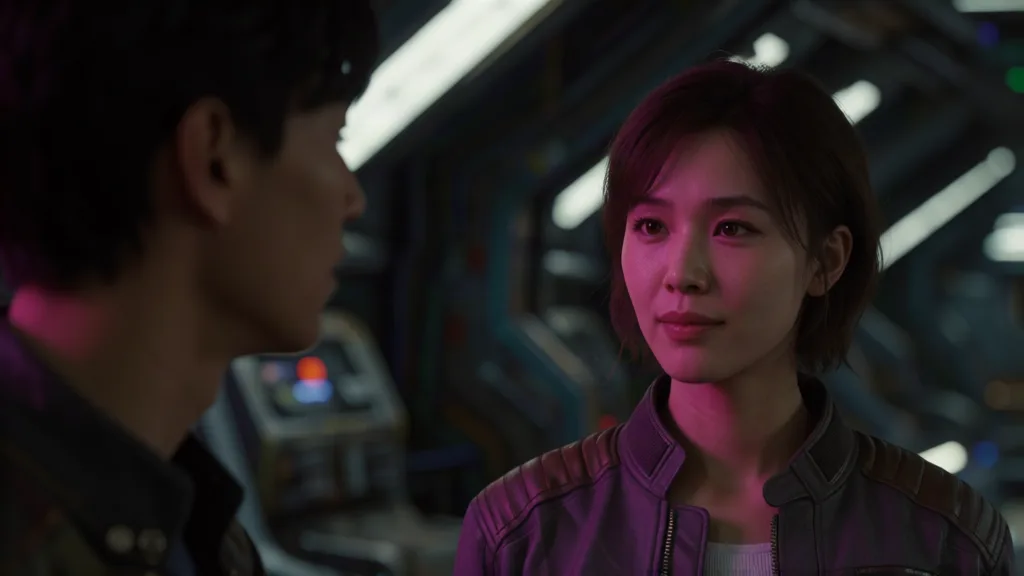
The smell hit me first, like it always did. Wet wool and ozone, the particular stink of a city that had learned to clean itself with electricity instead of water.
I was on my knees in the middle of the transit corridor, hands deep in the guts of a public seating unit, when the kid started screaming.
"Hey. Hey, lady. Lady!"
I didn't look up. The unit's haptic mesh had degraded to the point where sitting on it felt like parking your ass on a bag of frozen peas, and the city wasn't going to fix it. The city didn't fix anything anymore. The city sold contracts to people like me, and people like me fixed things, and the kid screaming at my back was probably just another tourist who'd lost his wristband and wanted me to care about it.
"Lady, I'm talking to you."
"I heard you the first time." I pulled a fried filament from the mesh and held it up to the corridor light. Dead. Of course it was dead. Everything in this sector was dead or dying, and the only reason I was here was because the building manager had paid me half upfront, which in this economy was practically a marriage proposal.
The kid came around to my front. He was maybe nineteen, twenty, with the soft face of someone who'd never had to fix anything with his hands. He wore a jacket that cost more than my entire toolkit, and he was holding a phone like it was a weapon.
"You're a fixer," he said.
"I'm a woman with a screwdriver. Same thing, different pay."
"I need you to fix something."
"I'm busy."
"It's not a thing. It's a person."
That made me look up. Not because I cared, but because in fifty years of living, I'd learned that when rich kids say things like that, it usually meant someone was dying and they wanted me to be the one to find the body.
"People aren't fixable," I said. "Take it to a doctor."
"She won't go to a doctor. She won't go anywhere. She's been in her apartment for eleven days, and she won't answer the door, and I think she's..." He stopped. Swallowed. "I think she's fading."
I stood up. My knees cracked like old wood, and I made a note to stop kneeling on concrete floors at my age. The kid watched me like I was his last hope, which was sad, because I was nobody's last hope. I was a fixer. I fixed seats and doors and light panels and the occasional broken heart, if the price was right.
"What's your name?" I asked.
"Tomas."
"Tomas what?"
"Tomas Reyes. My mother is Eliana Reyes. She's a composer. Was a composer. She hasn't written anything in three years."
The name didn't mean anything to me. Composers were a dime a dozen in this city. Everyone with a neural implant thought they were an artist. But something in the kid's voice made me stop packing up my tools. It was the way he said "was." Like his mother had already died and he was just waiting for the paperwork.
"Eleven days," I said. "You've been feeding her?"
"I've been leaving food outside her door. She takes it in. Sometimes. I hear her moving around at night. But she won't talk to me. She won't talk to anyone."
"And you want me to do what? Break in?"
"I want you to talk to her. You're a fixer. You fix things. Maybe you can fix her."
I laughed. It wasn't a nice laugh. It was the laugh of a woman who'd spent thirty years fixing things that people broke and never once fixing a person who'd broken herself.
"Kid," I said, "I don't do charity."
"I'll pay you. Double your rate."
"Triple."
"Fine."
I should have said no. I should have packed my tools and walked back to my apartment and eaten cold noodles and watched the news feed until I fell asleep. That's what I did every night. That was my life. But something about the way Tomas looked at me, like I was the only person in the world who might understand, made me say yes.
"Give me the address," I said. "I'll go tomorrow."
"She might not open the door."
"Then I'll fix the door."
---
The apartment was on the forty-second floor of a residential tower that had been beautiful fifty years ago and was now just another vertical slum. The elevator didn't work, so I climbed. Forty-two flights of stairs, each one smelling like someone had cooked fish and then died. By the time I reached her floor, my legs were shaking and my lungs were burning and I was seriously reconsidering my life choices.
I knocked on the door. Nothing.
"Ms. Reyes," I said. "My name is Vera. Your son hired me to check on you."
Silence. The kind of silence that has weight. I pressed my ear to the door and heard something. Not movement. Not breathing. Something else. A low hum, like a machine running in another room.
"I'm not leaving," I said. "I've got nowhere else to be, and I'm too tired to walk back down those stairs. So you can either open this door, or I can break it down, and I'll tell you right now, I'm not as strong as I look."
A long pause. Then, the sound of locks clicking. Three of them. The door opened a crack, and a woman's face appeared in the gap.
She was older than me. Maybe seventy, maybe eighty. Her hair was white and tangled, and her eyes were the color of old milk. She wore a bathrobe that had once been blue and was now mostly stains, and she looked at me like I was a ghost she'd been expecting for years.
"You're not from the city," she said.
"I'm from the city. I've lived here my whole life."
"No. You're not from the city. You're from before. You have the look."
I didn't know what that meant. But I knew better than to argue with crazy.
"Can I come in?" I asked.
She studied me for a long time. Then she stepped back and let the door swing open.
The apartment was full of instruments. Not the digital kind. Real ones. A piano in the corner, its keys yellowed with age. A cello leaning against the wall. A violin on the table, its strings snapped. And in the middle of the room, a machine I didn't recognize. It was tall and silver and humming, and it was connected to the wall by a thick cable that pulsed with light.
"What is that?" I asked.
"My composer," she said. "It writes music for me."
"I thought you hadn't written anything in three years."
"I haven't. It has."
She walked to the machine and placed her hand on its surface. The humming changed pitch. The lights inside it flickered, and for a moment, I heard something. A melody. Fragments of one. Beautiful and sad and incomplete.
"It's dying," she said. "The machine. It's been dying for years. And when it dies, I'll have nothing left."
I looked around the room. The dust. The decay. The smell of a life that had stopped moving.
"Why won't you leave?" I asked.
"Because I'm not a composer anymore. I'm just the person who used to be one. And out there, in the city, that's all anyone would ever see."
She turned to look at me, and for the first time, I saw something in her eyes. Not madness. Not despair. Something harder. Something I recognized.
"You're a fixer," she said. "Can you fix a person?"
"No," I said. "But I can fix a machine."
She stared at me. The humming grew louder. And somewhere in the apartment, a violin string snapped, all on its own.
Watch this moment
Turn the current scene into a cinematic Live Chapter — what you watch becomes the story's next part.
Disclaimer
This is a work of fiction, assisted by artificial intelligence. Any names or characters, businesses or places, events or incidents, are fictitious. Any resemblance to actual persons, living or dead, or actual events is purely coincidental.
Content Removal Policy
- Users may report content that may be illegal or violates our Standards.
- All reported complaints will be reviewed and resolved within seven business days.
- Review Process: Our team will assess the reported content against our guidelines.
- Appeals: If you disagree with a decision, you may appeal within 14 days of notification.
- Potential outcomes include: content removal, account warning, or no action if no violation is found.
To report content, email us at [email protected]