Share
Go Live
Crowns of Dust and Frost
·
Published 9/21/2026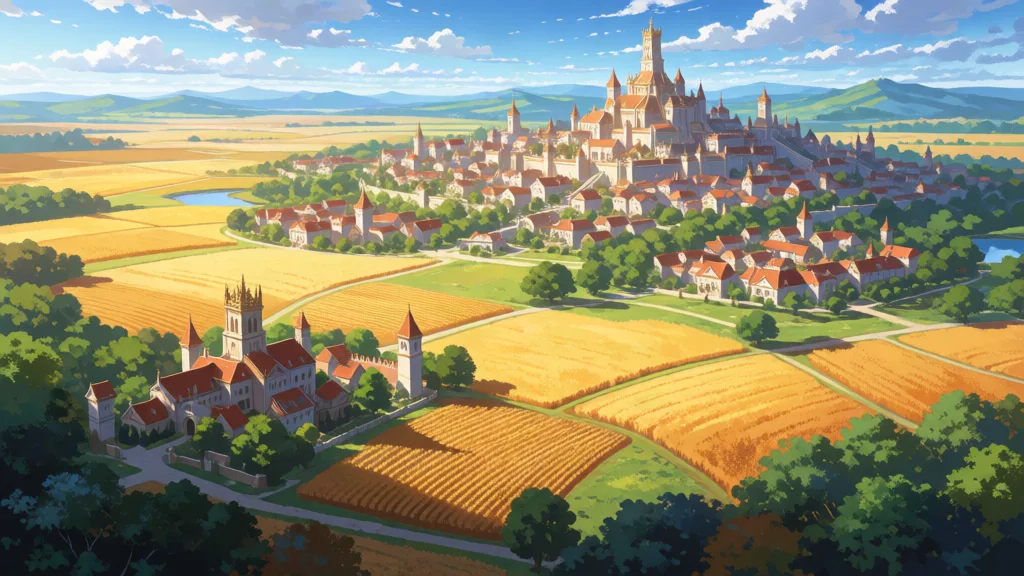
The frost came early that year, and with it, the first of the dead.
I found him at the edge of the barley field, half-buried in the frozen mud, his fingers still clutching a handful of grain. A Brucan soldier, or what was left of one. The cold had preserved him better than any undertaker could have. His lips were pulled back from his teeth in something that might have been a smile, if you didn't look too long. I didn't.
"Don't touch him," my father said from behind me. "The thaw will take him soon enough."
I stepped back. The morning light was thin and gray, the kind that made everything look like a memory already fading. Our field stretched out before us, brown and brittle, the barley we'd planted in the spring now just stalks bent under frost. We'd lost most of it. The rest wouldn't survive the week.
"He's not the first," I said. "There was another one down by the creek."
My father didn't answer. He was a man who measured his words like coin, spending only what was necessary. He turned and walked back toward the house, his boots crunching through the frozen crust of the earth. I followed because there was nothing else to do.
Inside, the fire had burned down to embers. My mother sat at the table with a pile of wool, her fingers moving fast and sure, knitting something that would never be warm enough. She looked up when we came in, her eyes asking a question she didn't need to speak.
"Another one," my father said.
She nodded and kept knitting.
We ate breakfast in silence. Porridge with a little honey, the last of the jar. I watched my father eat, the way his hands moved, the way he stared at nothing. He was thinking about the field, I knew. He was thinking about the winter ahead, about the stores we'd put aside and whether they would last. He was thinking about how one bad harvest could ruin a family, how it had ruined others.
I was thinking about the dead man's smile.
---
The village of Coldwell sat at the southern edge of Suncrest, where the golden farmlands gave way to the rocky foothills that marked the border with Bruca. We were the last stop before the mountains, the last place where the climate was mild enough to grow anything worth growing. Beyond us, the land climbed into ice and stone, and the people who lived there had learned to survive on less.
But they were coming south now. The Brucans. Not as soldiers, not officially. They came as refugees, or so the stories said. Their empire was cracking, something about a succession dispute, a war in the north. I didn't know the details. I only knew that every week there were more of them, ragged figures stumbling down from the passes, their faces hollowed by hunger and cold.
Some of them died before they reached us. Some of them died after.
"The magistrate's called a meeting," my father said that evening. He'd been out to the village square, where the notices were posted. "Tomorrow. At the temple."
"What about?"
He shrugged. "What do you think?"
I didn't sleep that night. I lay in my cot and listened to the wind, which had picked up, rattling the shutters and pushing under the door. The fire had died hours ago. My breath fogged in the air above me.
I thought about the dead man again. His hands, blue and stiff, still holding onto that grain. He'd come all this way, crossed mountains and glaciers and frozen plains, and for what? A handful of barley he'd never get to eat. A patch of frozen ground to die in.
I wondered if he'd had a family. If someone, somewhere, was waiting for him to come back. If they'd ever know what happened to him, or if he'd just become another absence, another silence at the dinner table.
I wondered if that was what my father saw when he looked at me. An absence waiting to happen.
---
The temple was the largest building in Coldwell, which wasn't saying much. It had been built a hundred years ago, when the village was twice its current size, back when the border was still open and trade flowed freely between the kingdoms. Now the roof leaked in three places and the altar had a crack running through it from the last earthquake.
Half the village was there when I arrived with my parents. The other half was probably still deciding whether to come. That's how it worked in Coldwell. We didn't rush into anything. We waited, and we watched, and we made sure we weren't the first to commit.
The magistrate stood at the front, a thin man with a thin voice, his robes too large for his body. He'd been appointed by the noble family that owned this land, the Vorens, who lived in a city three days' ride to the south and had never once visited. They collected their taxes through him, and in return, he got to feel important.
"Good people," he said, spreading his hands. "I've called you here to discuss a matter of some urgency."
The crowd shifted. Someone coughed.
"As you know, we've had an influx of... visitors from the north. Refugees, they call themselves. The crown has issued a decree. All border villages are to provide aid and shelter to those fleeing the Brucan conflict."
A murmur ran through the crowd. My father's jaw tightened.
"The Voren family has generously offered to reduce this season's tax burden by one-tenth in recognition of the additional strain on our resources."
One-tenth. I did the math in my head. We'd lost more than half our harvest to the frost. One-tenth wouldn't cover the difference. It wouldn't even come close.
"But," the magistrate continued, "we must also consider our own people. Our own needs. The crown's decree is clear, but the crown is far away. We must use our judgment."
He paused, looking out at us with his watery eyes.
"I propose we establish a camp outside the village. A place where the refugees can stay until... until the situation in the north resolves itself. We'll provide what we can spare. But we cannot open our homes. We cannot risk our own families."
The crowd was silent. I looked at the faces around me, the farmers and laborers and mothers and children. They were tired. They were scared. They were thinking about their own stores, their own children, their own survival.
And they were thinking about the Brucans, who had crossed the mountains and brought their hunger with them.
---
I left the temple before the meeting ended. I couldn't listen to any more. The magistrate's voice, the murmurs of agreement, the way everyone nodded like they'd already decided and were just waiting for permission to say it out loud.
Outside, the sky was low and gray, the sun a pale disc behind the clouds. I walked through the village, past the houses with their shuttered windows, past the well where a few women stood talking in low voices, past the blacksmith's shop where the forge was cold.
At the edge of the village, where the road turned north toward the mountains, a group of refugees had gathered. They sat on the ground, huddled together under blankets that looked too thin for the wind. There were maybe twenty of them. Men, women, children. Their faces were gaunt, their eyes hollow.
A girl sat apart from the others, her knees drawn up to her chest. She was my age, maybe younger. Her hair was dark and tangled, her lips cracked and blue. She was staring at nothing, or maybe at everything.
I stopped. I don't know why. I had nothing to give her. My family had nothing to give anyone. We were barely surviving ourselves.
But I stopped.
She looked up at me. Her eyes were gray, the color of the sky before snow. She didn't speak. She didn't ask for anything. She just looked at me, and I looked at her, and the wind blew between us, cold and sharp.
Then someone called my name. My father, from the road. It was time to go home.
I turned and walked away. I didn't look back. But I felt her eyes on me the whole way, and I knew, somehow, that I would see her again.
---
That night, I dreamed of the dead man in the field. He was standing now, his blue hands reaching for me, his mouth open in that terrible smile. He was trying to tell me something, but I couldn't hear him. The wind was too loud, and the snow was falling, and somewhere in the distance, a bell was ringing.
I woke to the sound of shouting.
My father was already up, pulling on his boots. "Stay here," he said. "Lock the door."
"What's happening?"
But he was gone before he could answer.
I went to the window. Outside, torches moved through the darkness, flickering like fireflies. Voices rose and fell, angry and afraid. I couldn't make out the words, but I didn't need to.
Something had happened. Something bad.
I thought of the girl at the edge of the village, her gray eyes, her cracked lips. I thought of the camp the magistrate had proposed, the refugees huddled under their thin blankets. I thought of the cold, which was only getting colder, and the food, which was only getting scarcer, and the fear, which was everywhere now, spreading like frost across the land.
I unlocked the door and stepped outside.
The night air hit me like a wall. The sky was clear now, the stars sharp and cold. The torches were moving toward the north road, where the refugees had been.
And I knew, with a certainty that settled into my bones like ice, that nothing would ever be the same again.
Watch this moment
Turn the current scene into a cinematic Live Chapter — what you watch becomes the story's next part.
Disclaimer
This is a work of fiction, assisted by artificial intelligence. Any names or characters, businesses or places, events or incidents, are fictitious. Any resemblance to actual persons, living or dead, or actual events is purely coincidental.
Content Removal Policy
- Users may report content that may be illegal or violates our Standards.
- All reported complaints will be reviewed and resolved within seven business days.
- Review Process: Our team will assess the reported content against our guidelines.
- Appeals: If you disagree with a decision, you may appeal within 14 days of notification.
- Potential outcomes include: content removal, account warning, or no action if no violation is found.
To report content, email us at [email protected]