Share
Go Live
சபையில் சிதைந்த தாலி
·
Published 9/5/2026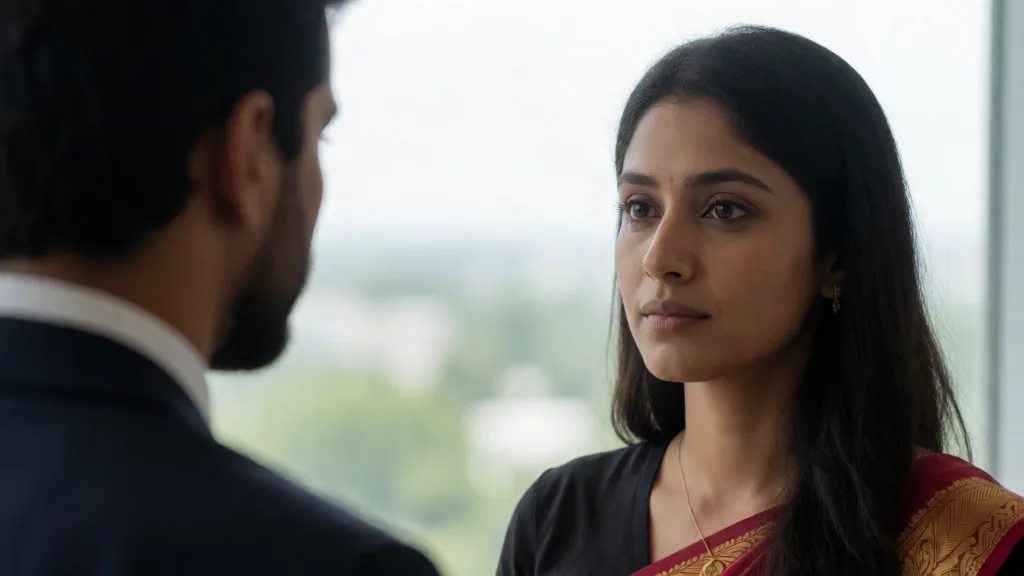
The air in Sanjana’s office was cold, the kind of cold that came from an AC unit set to sixteen degrees and the silence of thirty people who were too afraid to breathe. She stood at the head of the conference table, the glass wall behind her showing the Chennai skyline smeared with the orange of a dying sun. Her blazer was navy blue, tailored to fit like a second skin. The white silk blouse underneath was buttoned to the collar. Her skirt stopped just above the knee. Each piece of clothing was a statement. I am in charge. I belong here.
She didn’t look at the men. She looked at the numbers on the screen.
“This quarter’s revenue is a joke,” she said. Her voice was low, a contralto that carried without effort. “Someone explain to me how we lost the Tidel Park contract.”
No one spoke. The air conditioning hummed. A pen rolled off the table and hit the carpet with a soft thud.
Karthik, the head of operations, shifted in his seat. He was a thin man with a nervous smile that never quite reached his eyes. “Sanjana ma’am, the client felt our proposal was too aggressive. They wanted a more collaborative approach.”
“Collaborative.” She let the word hang. “You mean they wanted us to hold their hand and sing them a lullaby. That’s not how business works in this city.”
She turned to face them fully. Her heels were black, four inches, and they made no sound on the thick carpet. She had learned to walk silently in them. A trick from her first job, where the boss had said a woman who clicks is a woman who is noticed, and a woman who is noticed is a woman who is judged.
“I’ll handle Tidel Park myself,” she said. “Karthik, I want the revised projections on my desk by tomorrow morning. Not the ones you think I want to see. The real ones.”
Karthik nodded, his Adam’s apple bobbing.
The meeting ended. The men filed out, their eyes on the floor, their shoulders hunched. Sanjana watched them go. She knew what they said about her in the break room. The dragon lady. The ice queen. She had heard worse. She did not care. The company was hers. She had built it from nothing, from a single desk in a shared office in Velachery, and she had bled for every square foot of this glass tower.
She touched the thaali chain at her throat. The gold was warm against her skin. It was the only thing her mother had given her before she died, and she never took it off. It was a reminder of where she came from, of the woman who had scrubbed floors so her daughter could wear a blazer.
Her phone buzzed. A message from the security desk.
“Ma’am, there are some men at the main entrance. They say they have a delivery for you. They won’t leave their names.”
Sanjana frowned. She had not ordered anything.
“Let them up,” she typed. “But search them first.”
She walked to her private office, a corner room with a view of the bay. The glass walls were frosted from the outside, but from inside she could see the entire floor. Her desk was a slab of white marble, clean and bare except for a laptop and a single photograph of her mother. She sat down and opened her email.
The door opened without a knock.
She looked up. Four men stood in the doorway. They were not delivery men. They wore cheap shirts, the kind that were too bright and too tight. Their arms were thick, their necks were thick, and their eyes were flat. The kind of eyes that had seen too much and felt nothing.
The one in front smiled. His teeth were yellow. “Sanjana ma’am?”
She did not stand. “Who are you?”
“We have a message from a friend. A mutual friend.” He stepped inside, and the others followed. They spread out, filling the room with their bulk. One of them closed the door.
Sanjana’s hand moved to the drawer where she kept a small can of pepper spray. She did not open it. Not yet.
“I don’t have friends who send men without names,” she said. “You have thirty seconds to explain or I call security.”
The man laughed. It was a dry sound, like stones grinding together. “Security. Sure. Call them. But they’re busy right now. Your whole building is busy.”
He pulled out a phone and showed her a video. It was grainy, shot from a phone held low. She saw the ground floor lobby. The security guards were on their knees. Men in the same cheap shirts stood over them, holding iron rods.
Sanjana’s blood went cold. She kept her face still.
“What do you want?”
The man pocketed the phone. “We want a conversation. A private one. Your office. Now.”
She looked at the four of them. She looked at the door. She looked at the phone on her desk. She could call the police. But the video was already a minute old. By the time they arrived, these men could do anything.
“Fine,” she said. “Talk.”
The man shook his head. “Not here. Your office is too clean. Too many cameras. We want to go somewhere more comfortable.”
He pointed at the ceiling. “The roof.”
The roof. The top floor had been unfinished for months, a shell of concrete and exposed wiring. No cameras. No people. No help.
“No,” she said.
The man stepped closer. He was tall, and she had to tilt her head up to meet his eyes. “It wasn’t a request.”
She thought about the pepper spray. She thought about the security guards on their knees. She thought about the thirty employees on the floor below, the ones who were afraid to breathe, the ones who would not help her even if they heard her scream.
She stood up. Her legs were steady. Her voice was steady.
“If you touch me, if you hurt anyone in this building, I will find you. I will find your family. I will make sure you regret the day you were born.”
The man smiled again. “Big words. Let’s go.”
They walked her through the office. The employees saw her. They saw the men around her. They looked down. Every single one of them looked down. Karthik was at his desk, his face white, his hands trembling over his keyboard. He met her eyes for a split second, then looked away.
She did not blame him. She had hired him because he was smart, not because he was brave. No one in this city was brave. Bravery was a luxury for people who had nothing to lose.
The stairwell was concrete and echo. Her heels clicked on the steps. The men were silent behind her. She counted the floors. Fifteen. Sixteen. Seventeen. The air grew warmer, dustier. The door at the top was metal, painted a faded gray. One of the men pushed it open.
The roof was a wasteland. Piles of bricks. Coils of rusted rebar. A single light bulb hung from a wire, casting a weak yellow circle on the concrete. The city spread out below, a million lights, a million people who did not know she was here.
The man who had spoken gestured to a plastic chair in the middle of the space. “Sit.”
She did not sit. “You wanted to talk. Talk.”
He sighed. “You’re making this hard. Sit down.”
She sat. The chair was cheap, the kind that wobbled. She kept her back straight, her hands on her knees.
The man walked around her. The other three stood in a loose circle, blocking the exits. The door. The edge of the roof. There was nowhere to go.
“Your company is doing well,” the man said. “Very well. You have contracts with the government, with the big IT parks, with the port authority. You have a reputation.”
“I know what I have.”
“But you don’t have protection. Not real protection. The kind that keeps things running smoothly. The kind that makes sure your trucks don’t get stopped at checkpoints, your employees don’t get harassed on the way home, your building doesn’t have a small fire in the server room.”
He stopped in front of her. “We can provide that protection. For a fee.”
“You want to extort me.”
“I want to partner with you. Businessmen understand partnerships.”
She looked at him. She looked at his cheap shirt, his yellow teeth, his flat eyes. She had seen men like him her whole life. They were the ones who took. They took from the poor, from the weak, from anyone who could not fight back. They had never taken from her.
“The answer is no,” she said.
The man did not react. He reached into his pocket and pulled out a knife. It was small, a box cutter with a fresh blade. He clicked the blade out.
“That’s a shame,” he said. “Because we already have a partner. Your partner. The one who told us about the Tidel Park contract. The one who said you would be alone tonight.”
Karthik. Her mind went to him. His nervous smile. His trembling hands. The way he had looked away.
The man crouched in front of her. The blade caught the light. “We know everything about you, Sanjana ma’am. We know you live alone. We know you drive a white Honda. We know you visit your mother’s grave every Sunday. We know you wear a thaali chain that you never take off.”
He reached out and touched the chain. His finger was rough, calloused. He lifted it, the gold sliding against her skin.
“Pretty,” he said. “Old. Family heirloom?”
She did not answer. Her heart was pounding, but her face was stone.
He let the chain drop. “Here’s how this works. You pay us. We protect you. Everyone is happy. If you don’t pay us, we start with your employees. One by one. We know their names. We know where they live. We know their children’s schools.”
He stood up. “You have one week to decide.”
He turned and walked toward the door. The other men followed. The one with the knife clicked the blade back in and pocketed it.
They left. The door clanged shut.
Sanjana sat in the plastic chair. The wind was cold. The city lights were bright. She did not move for a long time.
When she finally stood, her legs were shaking. She walked to the door. She pushed it open. The stairwell was empty.
She went back to her office. The employees were gone. The lights were off. Her laptop was still open. She sat down and stared at the screen.
She thought about Karthik. She thought about the security guards. She thought about the man’s finger on her thaali chain.
She touched the chain herself. The gold was warm.
She picked up her phone and dialed a number she had not called in five years.
It rang. Once. Twice. Three times.
A man’s voice answered. “Yes?”
“It’s me,” she said.
A pause. “Sanjana?”
“I need your help.”
Another pause. Longer this time. “Come to the old place. Tomorrow. Ten PM.”
The line went dead.
She put the phone down. She looked at the photograph of her mother. The woman in the photograph was young, her hair black, her smile wide. She was wearing the same thaali chain.
“I’m sorry, Amma,” Sanjana whispered.
She did not know what she was sorry for. She only knew that something had started tonight, something that would not end well.
She packed her laptop. She turned off the lights. She walked out of the office and did not look back.
The next day was a blur. Sanjana went through the motions. She approved invoices. She signed contracts. She took calls. She did not mention the men. She did not mention Karthik. She watched him from her glass office, saw him checking his phone, saw the sweat on his upper lip.
At six PM, she left. She drove her white Honda through the streets of Chennai, past the IT parks and the shopping malls, past the new apartments and the old temples. She drove north, toward the parts of the city that did not appear in brochures.
The old place was a warehouse in Vyasarpadi. The streets were narrow, the buildings were crumbling, and the air smelled of diesel and frying oil. She parked a block away and walked.
The warehouse door was open. She stepped inside.
The space was dark, lit only by a single bulb. In the center, a man sat on a wooden crate. He was older than her, his hair streaked with gray, his face lined with scars. He wore a white shirt and black pants. He was cleaning a gun.
He looked up when she entered. His eyes were the same. Hard. Calculating. Unforgiving.
“Sanjana,” he said. “You look good.”
“You look old,” she said.
He smiled. It was not a warm smile. “Five years. You disappeared. No calls. No messages. I thought you were dead.”
“I was busy.”
“Building an empire.” He set the gun down. “I heard. MNC CEO. Glass tower. Impressive.”
“It’s not an empire. It’s a company.”
“Same thing. Different clothes.” He stood up. “Tell me about these men.”
She told him. Everything. The office. The roof. The knife. The thaali chain. She did not leave anything out.
When she finished, he was silent for a long moment.
“Karthik,” he said finally. “Your operations head. He sold you out.”
“I know.”
“What do you want me to do?”
She looked at him. She had known this man since she was a child. He was her mother’s brother. He was a gangster. A real one. The kind who killed people and slept soundly.
“I want you to make them go away,” she said. “All of them. The men who came to my office. The men behind them. Karthik. I want them gone.”
He nodded. “It will cost you.”
“I have money.”
“Not money.” He picked up the gun again. “You left this life. You said you were done. You said you wanted to be clean.”
“I am clean.”
“Not after tonight. You call me, you ask for this, you are not clean anymore. You are in the mud with the rest of us.”
She knew. She had known when she dialed the number.
“I don’t have a choice,” she said.
“There is always a choice. You chose the glass tower. You chose the blazer and the heels and the clean hands. You chose to be above us.”
“And look where it got me.” Her voice cracked. “On a roof. In a plastic chair. With a knife at my throat.”
He stepped closer. “You could have paid them. You could have given them what they wanted. You could have kept your hands clean.”
“And then what? They would come back. They always come back. You taught me that.”
He looked at her for a long time. Then he nodded.
“Tomorrow night. Same time. Bring me the names.”
He turned and walked into the darkness of the warehouse.
Sanjana stood alone under the single bulb. She touched her thaali chain. The gold was warm.
She walked out into the night.
The next day, she went to work. She called Karthik into her office. He came, his hands shaking, his eyes darting.
“Close the door,” she said.
He closed it.
“I know,” she said.
He did not pretend. His face crumpled. “Ma’am, I’m sorry. They threatened my family. My wife. My daughter. I had no choice.”
“You had a choice. You chose them.”
“Please. I’ll do anything. I’ll fix it. I’ll make it right.”
She looked at him. She saw the fear in his eyes. She saw the weakness. She had seen it before, in her uncle’s men, in the ones who broke under pressure.
“You’re fired,” she said. “Security will escort you out. If I see your face again, I will not be responsible for what happens.”
He opened his mouth to speak. She held up her hand.
“Go.”
He went.
She watched him walk across the floor, his shoulders slumped, his head down. The employees watched too. They knew something had happened. They did not know what.
She turned to her laptop. She opened a file. She typed the names.
The men who came to her office. The men on the video. Karthik.
She saved the file. She closed the laptop.
At ten PM, she drove to the warehouse. Her uncle was there, with two other men. She handed him a piece of paper.
He read it. He nodded.
“It will be done,” he said.
She turned to leave.
“Sanjana.”
She stopped.
“The thaali chain,” he said. “Your mother’s. You still wear it.”
She touched it. “Yes.”
“She would be proud of you. The company. The tower. All of it.”
“She would be ashamed of me tonight.”
He shook his head. “She would understand. She knew what the world was. She knew what it took to survive.”
Sanjana did not answer. She walked out into the night.
She drove home. Her apartment was on the 25th floor, a penthouse with a view of the sea. She stood at the window and watched the waves.
Her phone buzzed. A message from an unknown number.
“We heard you made a call. Bad idea. You have 24 hours to change your mind.”
She stared at the message. The phone buzzed again. A photo.
It was her mother’s grave. The headstone was cracked. The flowers she had placed there on Sunday were scattered on the ground.
Her blood went cold. She gripped the phone so hard her knuckles turned white.
She did not reply. She did not delete the message. She put the phone down and went to her bedroom.
She opened the closet. Behind her suits and blazers, there was a small box. She pulled it out. Inside was a gun. A small revolver, old, rusted. Her uncle had given it to her when she left, five years ago.
“You might need it,” he had said.
She had laughed. She had said she would never need it.
She held the gun now. It was cold. It was heavy.
She put it in her purse.
She went back to the window. The sea was dark. The city was bright. Somewhere out there, the men were waiting. Her uncle was acting. Karthik was hiding.
And she was standing in her penthouse, holding a gun, wearing her mother’s thaali chain.
She did not know how this would end. She only knew that it had begun.
And there was no going back.
Watch this moment
Turn the current scene into a cinematic Live Chapter — what you watch becomes the story's next part.
Disclaimer
This is a work of fiction, assisted by artificial intelligence. Any names or characters, businesses or places, events or incidents, are fictitious. Any resemblance to actual persons, living or dead, or actual events is purely coincidental.
Content Removal Policy
- Users may report content that may be illegal or violates our Standards.
- All reported complaints will be reviewed and resolved within seven business days.
- Review Process: Our team will assess the reported content against our guidelines.
- Appeals: If you disagree with a decision, you may appeal within 14 days of notification.
- Potential outcomes include: content removal, account warning, or no action if no violation is found.
To report content, email us at [email protected]