Share
Go Live
Office Hours
·
Published 10/5/2026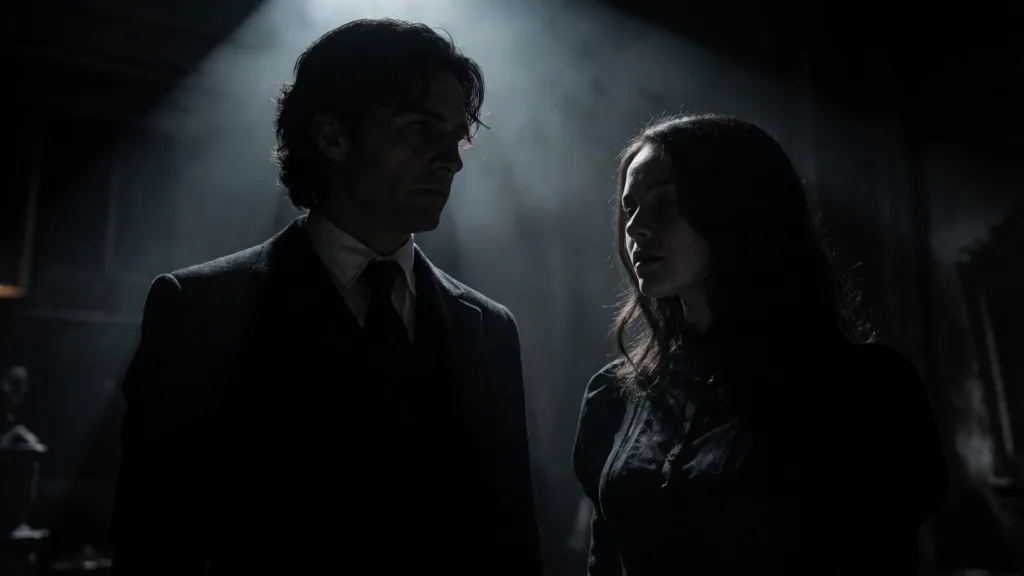
The elevator doors slid shut with a soft hiss, sealing me in with the smell of his cologne and the quiet hum of the building's guts. Twelve floors. That's how long I had to stand beside Marcus Cole without saying something stupid.
I'd been his executive assistant for eight months. Eight months of black coffee at seven-fifteen, of rescheduling meetings he didn't want to attend, of watching his hands move when he talked, those long fingers tracing shapes in the air like he was conducting an orchestra only he could hear. Eight months of telling myself I was too smart for this.
The elevator stopped at nine. A woman in a gray suit stepped in, nodded at Marcus, pressed fourteen. She stood between us, a wall of wool and perfume. I watched the numbers climb and thought about the fact that I'd worn the black dress today. The one that cost more than my rent. The one I'd bought three weeks ago and hadn't had the nerve to wear until this morning, when I'd stood in front of my mirror and told myself it was just a dress, just fabric, just a way to feel like I belonged in the same room as people who didn't check their bank balance before ordering lunch.
The woman got off at fourteen. The doors closed. We were alone again.
"You changed your hair," Marcus said.
I turned my head. He was looking at me, not the numbers, not his phone, not the invisible orchestra. His eyes were the color of whiskey held up to a window, and they didn't move away when I caught them.
"Just a trim," I said.
"It suits you."
The elevator dinged. Sixteenth floor. The doors opened onto the executive corridor, all gray carpet and frosted glass, and he stepped out first, the way he always did, and I followed, the way I always did, and neither of us said anything else.
His office was at the end of the hall. Corner windows, city on three sides. I'd stood in there a hundred times, taking notes, taking dictation, taking deep breaths while he paced behind his desk and talked about quarterly projections and the new acquisition and how the board was full of cowards who couldn't see past their own stock options.
He dropped his briefcase on the credenza and loosened his tie. I set the coffee on his desk, black, no sugar, the way he'd taken it since the day I started.
"Close the door," he said.
I did.
He sat down and pulled a folder from the drawer. "The Pinnacle deal. I need you to read the contract before the meeting tomorrow. Flag anything that smells wrong."
I took the folder. Our fingers brushed. His skin was warm, and mine was cold, always cold, a circulation thing my mother said I'd grow out of and never did.
"Anything specific I should look for?" I asked.
"Everything." He leaned back in his chair and watched me. "You're better at this than the lawyers. Don't tell them I said that."
"I won't."
"Good."
I should have left. The folder was in my hands, the coffee was on his desk, the morning had its rhythm and I knew all the steps. But I didn't move. Neither did he.
"You're wearing that dress," he said.
"I am."
"The one from the charity gala. Last spring."
I felt the heat climb up my neck. "You remember what I wore to a charity gala eight months ago?"
"I remember a lot of things."
The air in the office changed. Got thicker. I could hear the HVAC humming, the faint traffic sixteen floors down, my own heartbeat doing something it had no business doing. He was my boss. He was forty-three and I was twenty-nine and he signed my paychecks and I knew exactly how many women in this building would kill to be standing where I was standing.
But he'd remembered the dress.
"I should get back to my desk," I said.
"Should you?"
"I have work."
"So do I." He stood up. Walked around the desk. Stopped close enough that I could see the thin scar on his jaw, the one he'd told me came from a bicycle accident when he was twelve. Close enough that I could smell the coffee on his breath. "But I've been thinking about something else all morning, and I don't think it's going to go away."
I didn't ask what. I knew what. I'd known since the first week, when he'd looked at me across a conference table and I'd felt it, that low pull in my stomach, that voice in my head saying *don't, don't, don't*. I'd spent eight months not asking.
"Marcus," I said. His name in my mouth felt like a secret I'd been keeping from myself.
"Tell me to stop."
I didn't.
He reached out and touched my wrist. Just his fingers, light, on the inside where the skin is thin and blue veins run close to the surface. My pulse jumped. I saw him notice.
"I've been watching you," he said. "The way you bite your pen when you're concentrating. The way you tuck your hair behind your ear when you're nervous. You're doing it now."
My hand dropped.
"I'm not nervous," I said.
"You're lying."
"So are you. You didn't call me in here to talk about the Pinnacle contract."
"No." He smiled, and it was the real one, the one he never used in meetings. "I didn't."
The door was closed. The blinds were open but we were sixteen floors up and the nearest building was a glass tower full of people who didn't care about two figures standing too close in a corner office. I could walk out. I could hand him the folder and go back to my desk and pretend this never happened. I could keep the job, the paycheck, the health insurance, the life I'd built out of careful choices and sensible shoes.
He ran his thumb along my wrist, one slow stroke, and I felt it everywhere.
"I don't mix business with pleasure," I said. "That's a rule."
"Rules are for people who don't know what they want."
"I know what I want."
"Then say it."
I looked at him. The whiskey eyes, the scar, the mouth that was always serious except when it wasn't. He was the most dangerous man I'd ever met, and not because of his money or his power or the way the whole building straightened up when he walked through. He was dangerous because he saw me. The real me, the one I kept hidden under spreadsheets and sensible shoes and a smile that said *I'm fine, everything's fine*.
"I want the folder," I said. "And I want to go back to my desk."
He let go of my wrist.
"Okay," he said.
I walked to the door. My hand was on the handle when he spoke again.
"But if you change your mind, I'll be here. I'm always here."
I didn't turn around. I opened the door and stepped into the hallway and the air was cooler out there, thinner, easier to breathe. The receptionist looked up from her screen and smiled. I smiled back. I walked to my desk and sat down and opened the folder and stared at the first page without reading a single word.
My wrist still felt his fingers.
The contract blurred. I blinked, and the words came back, and I started to read. Line by line. Clause by clause. I found three problems in the first ten pages. I flagged them all.
At noon, Marcus walked past my desk on his way to lunch. He didn't stop. He didn't look at me. But he slowed down, just for a second, and I heard him exhale, and then he was gone.
I ate a sandwich at my desk and thought about the way he'd said my name. Not the way he said it in meetings, clipped and professional. The other way. The way he'd said it in the elevator, when he'd told me my hair suited me.
I stayed late that night. Everyone else left at six, and by seven the floor was empty, the lights dimmed, the city glittering through the windows. I finished the contract and left it on his desk with a sticky note listing the three flagged clauses. Then I stood in the dark and looked out at the skyline and tried to remember why I'd said no.
The answer came back the way it always did: because I was smart. Because I'd seen what happened to women who fell for their bosses. Because I had a plan, and the plan didn't include him.
But the plan didn't account for the way he'd touched my wrist. The way he'd remembered the dress. The way he'd said *tell me to stop* and meant it.
I left the office and rode the elevator down alone. Twelve floors. Plenty of time to change my mind.
Watch this moment
Turn the current scene into a cinematic Live Chapter — what you watch becomes the story's next part.
Disclaimer
This is a work of fiction, assisted by artificial intelligence. Any names or characters, businesses or places, events or incidents, are fictitious. Any resemblance to actual persons, living or dead, or actual events is purely coincidental.
Content Removal Policy
- Users may report content that may be illegal or violates our Standards.
- All reported complaints will be reviewed and resolved within seven business days.
- Review Process: Our team will assess the reported content against our guidelines.
- Appeals: If you disagree with a decision, you may appeal within 14 days of notification.
- Potential outcomes include: content removal, account warning, or no action if no violation is found.
To report content, email us at [email protected]