Share
The Reel of Doom
·
Published 8/16/2026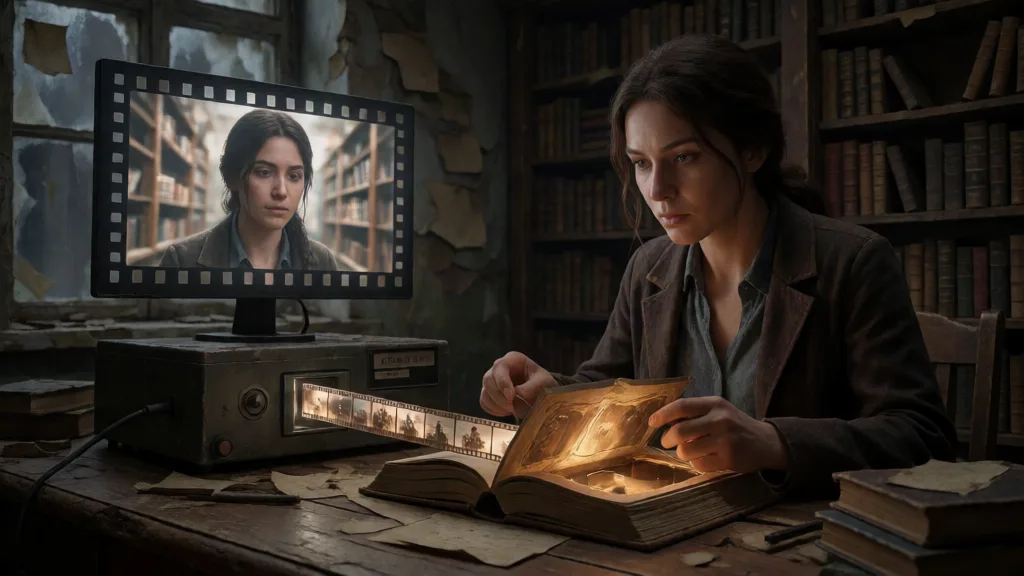
The book was warm.
Not metaphorically warm. Not the warmth of human hands or afternoon sun through a grimy window. Physically warm, as if something inside it had been breathing. Irina felt it before she saw it, her fingers brushing the spine as she reached for the dusty encyclopedia beside it. The heat stopped her cold.
She pulled her hand back. Looked at her palm like it might be burned.
The library was silent. It was always silent. That was the point of the State Archive of Obsolete Media, buried three floors beneath a former party headquarters in a district of Moscow that even taxi drivers forgot. Irina had worked here for eleven years. She knew every shelf, every crack in the plaster, every dead bulb that nobody would replace. She knew the smell of old paper and oxidized film stock and the faint chemical tang of Soviet glue that never quite stopped off-gassing.
She did not know why a book was warm.
The volume sat on Shelf 47-C, Section 6, in the Restricted Periodicals corridor. A hollowed-out encyclopedia. Volume 14 of the Great Soviet Encyclopedia, 1952 edition. The entry on "Kolkhoz" had been cut away with something sharp, leaving a rectangular cavity lined with black velvet.
Inside the cavity was a film reel.
Irina touched it. The metal can was cool. The warmth came from somewhere else. From the book itself, maybe. Or from the space between the book and the reel. She couldn't explain it, and that bothered her more than the heat.
She was not a woman who tolerated mysteries.
At forty-three, Irina had built her life around systems. Cataloging systems. Filing systems. The precise order of things. She arrived at the archive every morning at 7:47, exactly twenty-three minutes before her shift officially started, because the tram arrived at 7:23 and the walk took seventeen minutes and the remaining six minutes were for removing her coat, making tea, and sitting at her desk with her eyes closed for exactly ninety seconds. She did this every day. She had done it every day for eleven years.
Her coworkers thought she was strange. They were right.
The reel was standard 35mm. No label. No markings. Just silver-gray metal and the faint smell of vinegar, which meant the film stock was degrading. Nitrate, probably. Dangerous stuff. The kind that could combust if you looked at it wrong.
She should have reported it.
She should have called Comrade Petrov, the head archivist, who would have filled out Form 47-B and Form 89-C and placed the reel in a quarantine box and forgotten about it for three years while the paperwork moved through channels that no longer had anyone to receive it. That was how things worked here. That was how things had worked since the Union collapsed and the archive became a bureaucratic ghost ship, still sailing because nobody had thought to sink it.
Irina did not report it.
She took the reel to her desk. She hid it in her bag beneath her lunch container and the book of crossword puzzles she never actually solved. She told herself she would examine it properly. Determine its origin. Make a note of its contents. Then she would report it.
She was lying to herself, and she knew it.
The projector was in Room 14, which was not a real room. It was a closet. A closet that had been converted into a viewing station sometime in the 1970s, when the archive still had a budget and a purpose. The projector was a Krasnogorsk K-100, built in 1968, maintained by Irina herself because nobody else remembered how. She had taught herself from a manual she found in the break room, a manual printed in 1971 that smelled like someone had spilled tea on it and then tried to dry it with a radiator.
She threaded the reel with practiced hands. The film was black and white. Short. Maybe five minutes of footage.
She turned off the lights. She pressed the button.
The projector hummed. The first image flickered onto the small screen, and Irina felt her stomach drop.
She was looking at herself.
Not a photograph. Not a still. Moving footage of herself, shot from above, as if the camera had been mounted on the ceiling. She was sitting at her desk in the archive. Her hands were folded on the blotter. Her face was pale.
She watched herself stand up. Watched herself walk to the door.
The image cut.
Now she was in the hallway. The Restricted Periodicals corridor. Shelf 47-C. She watched herself reach for a book. Watched herself pull it from the shelf.
It was the same book. The hollowed-out encyclopedia. Volume 14.
She watched herself open it. Watched herself stare at the empty cavity where the reel had been.
The film stopped.
Irina blinked. The screen went white. The projector clicked and whirred, winding the rest of the reel through the gate, but there was nothing else. Just blank leader.
She sat in the dark for a long time.
Her hands were shaking. She made them stop. She was not a woman who shook.
She rewound the reel. She watched it again.
Same footage. Same sequence. Same impossible image of herself doing something she had just done, something she had only decided to do twenty minutes ago.
The third time she watched it, the ending was different.
She was not at Shelf 47-C anymore. She was in the boiler room. The camera showed her from behind, walking down the narrow stairs, her footsteps echoing on concrete. She stopped at the furnace. She opened the door. The fire inside was bright, almost white.
She threw the reel into the flames.
Then she turned and walked back up the stairs, and her face was calm. Resigned. Like someone who had already accepted something Irina had not yet been asked to accept.
The film ended.
Irina rewound it. Watched it again.
This time she was in the boiler room again, but the furnace was closed. She was standing in front of it with a pair of scissors in her hand. She was cutting the film into strips. Tiny pieces. Confetti. She let them fall into a trash bin and then she poured something over them. Alcohol. She lit a match.
The screen went white.
She watched it again.
Now she was in the director's office. The old director's office, the one that had been sealed since 1991, when Comrade Mikhailov locked it and walked out and never came back. She was sitting at his desk. She was writing something on a piece of paper. The camera zoomed in on the paper, but the image was too blurry to read.
She watched it again.
Now she was in the courtyard. The one that had been paved over in 1985, where the concrete was cracked and weeds pushed through like fingers. She was standing in the center. She was looking up at the sky. The camera pulled back, and she saw that she was not alone. There were other people in the courtyard. Men in suits. Men with cameras. Men with guns.
She watched it again.
Now she was dead.
The image was clinical. A body on a metal table. Fluorescent lights overhead. The sheet pulled up to her chin. Her eyes were closed. Her face was gray. There was a wound on her temple. Small. Precise. A single bullet hole.
A date appeared in the corner of the screen. Typewriter font. White on black.
THREE DAYS.
The projector ran out of film. The screen went dark.
Irina sat in the closet for a long time.
Her hands were not shaking anymore. They had stopped. They were perfectly still, resting on her knees, and she looked at them like they belonged to someone else. Like they were evidence of something she hadn't done yet.
She checked the date on her watch.
Thursday. October 12th.
The film said Sunday.
She watched it again.
This time the opening was different. She was not at her desk. She was in her apartment. The camera showed her from across the room, sitting on her couch, staring at the wall. The television was on but the screen was static. Her phone was off the hook. She was holding the reel in her hands, turning it over and over like a worry stone.
The image cut.
Now she was in the stairwell of her building. Running. Her shoes were untied. She was carrying a bag. The camera followed her down, floor by floor, and she could see the numbers above the doors changing. 4. 3. 2. 1.
The lobby door was locked.
She watched herself try the handle. Watched herself pull. Watched herself slam her palm against the glass. The camera zoomed in on her face, and Irina saw something she had never seen in herself before. Not fear. Not panic. Something worse. Recognition. The look of someone who had known this was coming and had hoped she was wrong.
The screen went white.
She watched it again.
Now she was in the archive. The main reading room. Rows of empty tables. Dust motes floating in the light from the high windows. She was standing at the reference desk, and there was a man standing across from her. She couldn't see his face. The camera was behind him, showing only his shoulders, the back of his head, the shape of his body. He was tall. He was wearing a coat that looked expensive.
She watched herself hand him something. An envelope. White. Plain.
He took it. He left.
The camera stayed on her face. She was watching him go. Her expression was unreadable, but her hands were gripping the edge of the desk so hard her knuckles were white.
The film ended.
Irina watched it again.
She watched it six more times. Each viewing was different. Different scenes. Different angles. Different versions of herself in different places, doing different things, but always the same ending. The body on the table. The date in the corner. Three days.
The last time she watched it, the film showed her in the archive basement, standing in front of a wall of filing cabinets. She was opening one. She was pulling out a folder. The camera zoomed in on the label, and Irina felt her blood go cold.
The label said her name.
Irina Volkov. Case File No. 7843-K.
She had never seen that file before. She had never known it existed. But the woman on the screen was opening it, reading it, and her face was changing. Not to fear. Not to surprise. To something harder. Something colder. The face of a woman who had just learned that everything she believed about her life was wrong.
The film stopped.
Irina sat in the dark.
She should have reported the reel. She should have left it in the book. She should have never touched it, never looked at it, never let it into her hands. But she had. And now the film was showing her things she could not explain, things that should have been impossible, things that made her question whether the world worked the way she had always assumed it did.
She was not a woman who questioned things.
She was a woman who filed things. Who organized things. Who put things in their proper place and left them there. That was her job. That was her life. That was the only thing she was good at.
But the film had shown her a file with her name on it, and she knew where that file was.
She knew because she had organized that section of the basement herself. She knew every cabinet, every drawer, every folder. She knew that the K section was in Cabinet 8, Drawer 3, and that the file labeled Volkov would be between Vlasov and Voronov, exactly where it was supposed to be.
She knew because she had put it there.
But she had never put it there. She had never seen it before. And yet she knew exactly where it was.
The thought made her feel like the floor had tilted.
She stood up. She turned off the projector. She took the reel and put it back in its can and put the can in her bag and walked out of the closet and down the hallway and through the main reading room and past the front desk where Yuri was reading a newspaper and didn't look up.
She went to the basement.
The stairs were concrete. The lights were fluorescent, buzzing, flickering. The air was cold and smelled like old paper and mildew and something else. Something metallic. Something that made her think of the film's ending. The body on the table. The wound on the temple.
She stopped at Cabinet 8.
She opened Drawer 3.
She found the file between Vlasov and Voronov, exactly where she knew it would be.
It was thin. Brown cardboard. The label was typed, official, stamped with the archive's seal. Her name. Her date of birth. A case number she had never seen before.
She opened it.
Inside was a single photograph.
It was her. But not her now. Her younger. Maybe twenty years younger. Maybe more. She was standing in front of a building she didn't recognize. She was wearing a uniform she had never owned. A military uniform. Soviet. The collar was stiff, the shoulders broad, the cap pulled low over her eyes.
She was holding a gun.
Not like she was trained to hold it. Like she was comfortable with it. Like she had held it before. Like the weight of it was familiar.
Irina stared at the photograph.
She did not remember this. She did not remember the uniform. She did not remember the building. She did not remember the gun. She did not remember ever holding a gun in her life.
But the woman in the photograph was her. The same jaw. The same eyes. The same small mole above her left eyebrow. The same way of standing with her weight on her back foot, like she was ready to leave.
She turned the photograph over.
On the back, in handwriting she did not recognize, was a date.
October 12th.
Today.
And an address.
She knew the address. Everyone in Moscow knew the address. It was the Lubyanka. The old KGB headquarters. The building that had been turned into a museum after the Union fell, a museum of state security, a monument to the people who had disappeared.
The people like her.
Irina put the photograph back in the file. She put the file back in the drawer. She closed the drawer. She stood there for a long time, her hand resting on the cool metal of the cabinet, her mind racing through possibilities she did not want to consider.
She was a mute archivist. She had been mute since she was seventeen, when something happened that she could not remember, something that had taken her voice and left her with a job in a basement and a life so small she could hold it in one hand.
But the film had shown her a different life. A life with a gun. A life with a uniform. A life with a file in a cabinet that she had organized but never seen.
She went back upstairs.
She went to her desk. She sat down. She opened the bottom drawer and pulled out a small mirror that she kept for checking her hair, a habit from a time when she had cared about such things. She looked at her face. She looked at her eyes. She looked at the mole above her left eyebrow.
She looked at her hands.
They were not shaking. They were still. They were the hands of a woman who had made a decision.
She took the reel out of her bag. She held it in her lap. She looked at the clock on the wall.
7:23 PM.
She had three days.
The tram had stopped running at 10 PM. She would have to walk home. Seventeen minutes, usually. But tonight she would not go home. Tonight she would go to the Lubyanka. Tonight she would find out who she used to be.
She stood up.
Yuri was still at the front desk, still reading his newspaper. He looked up when she passed. He said something, but she didn't hear it. She was already gone.
The streets were cold. The sky was gray. The city was the color of concrete and exhaust, the color of a place that had been built for a future that never arrived. Irina walked with her head down, her bag pressed against her side, the reel inside it like a second heartbeat.
She did not know what she would find at the Lubyanka.
She did not know why the film showed her dying on Sunday.
She did not know why the photograph showed her holding a gun she had never held.
But she knew one thing. She knew it with the same certainty that she knew the order of the shelves, the location of every file, the exact number of steps from her desk to the door.
The film was not a prediction.
It was a message.
And someone had wanted her to find it.
The Lubyanka was dark. The museum closed at 6, and the building had been empty for hours. But Irina did not go to the front entrance. She went around the side, to a door she had never seen before, a door she should not have known existed.
She knew it was there.
She knew the code.
She pressed the numbers without thinking. 7-8-4-3-K. The same number as the file. The lock clicked. The door opened.
She stepped inside.
The hallway was dark. The air was cold. The walls were bare concrete, unpainted, unadorned. She walked forward. Her footsteps echoed. She did not know where she was going, but her feet knew. Her body knew. Her hands knew which door to open, which stair to climb, which corridor to follow.
She stopped at a door marked 7843.
She opened it.
The room was small. A desk. A chair. A filing cabinet. A photograph on the wall. The photograph was old, black and white, showing a group of men in uniforms standing in front of a building she recognized. The same building from the photograph in the file. The same building she had been standing in front of when she was twenty years younger and holding a gun.
She looked at the faces in the photograph.
She did not recognize them.
But one of them was looking at her. Not in the photograph. In the room. A man standing in the corner, watching her. A man she had not seen when she walked in.
He was tall. He was wearing a coat that looked expensive.
He was the man from the film.
"Irina," he said.
She tried to speak. She tried to ask who he was, how he knew her, what the film meant. But her voice was gone. It had always been gone. She opened her mouth and nothing came out.
He smiled. It was not a kind smile.
"You found the reel," he said. "Good. I was starting to think you never would."
She took a step back.
He took a step forward.
"You have three days," he said. "Three days to remember. Three days to decide. Three days to choose what kind of person you want to be."
He reached into his coat. He pulled out an envelope. White. Plain. The same envelope she had handed him in the film.
"This is for you," he said. "Open it when you're ready."
He set it on the desk. He turned. He walked to the door. He paused with his hand on the frame.
"One more thing," he said. "The film changes because you change. Every time you watch it, you're a different person. You've already started to change. You just don't know it yet."
He left.
The door closed behind him.
Irina stood in the empty room. She looked at the envelope on the desk. She looked at the photograph on the wall. She looked at her hands.
They were shaking.
She picked up the envelope. She opened it.
Inside was a key.
And a note.
The note had two words.
*Find yourself.*
She did not know what it meant. She did not know where the key went. She did not know who the man was, or why he had given her the reel, or what she was supposed to remember.
But she knew one thing.
She was going to watch the film again.
And this time, she was going to pay attention.
Disclaimer
This is a work of fiction, assisted by artificial intelligence. Any names or characters, businesses or places, events or incidents, are fictitious. Any resemblance to actual persons, living or dead, or actual events is purely coincidental.
Content Removal Policy
- Users may report content that may be illegal or violates our Standards.
- All reported complaints will be reviewed and resolved within seven business days.
- Review Process: Our team will assess the reported content against our guidelines.
- Appeals: If you disagree with a decision, you may appeal within 14 days of notification.
- Potential outcomes include: content removal, account warning, or no action if no violation is found.
To report content, email us at [email protected]