Share
Go Live
Chipped Bindis
·
Published 9/15/2026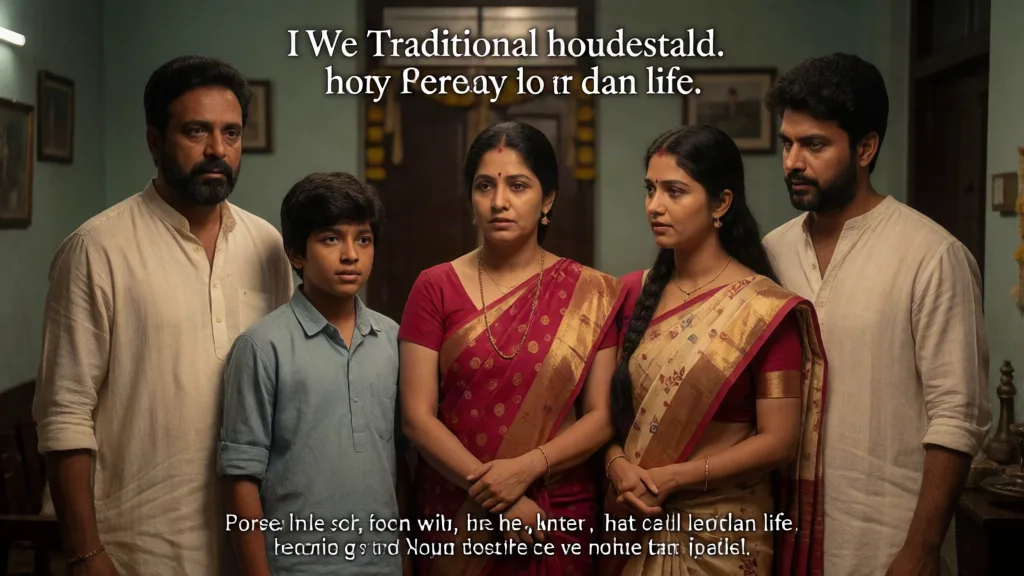
The first sound I hear every morning is not the chai boiling or the pressure cooker hissing. It is Amma’s dupatta dragging across the marble floor. A soft, dry whisper. Like a snake shedding its skin in slow motion. She moves through the house before anyone else wakes, checking that the gods have enough milk, that the newspaper is folded properly on Papa’s side of the dining table, that no one has left a glass in the sink. She is the ghost the house requires to function. No one thanks her. No one even sees her.
I see her.
I lie still on my cot in the corner of the room I share with my husband, and I watch the strip of light under the door. It flickers as she passes. She pauses. I know she is pressing her ear to the wood, listening for my breathing. Checking if I am awake. If I am awake, she will ask me to start the morning chores. If I am not, she will let me sleep five more minutes. Ten, if she is feeling generous. Amma is not generous.
I close my eyes. I count to thirty. Then I swing my legs off the cot and stand.
The floor is cold. January in Mumbai is not cold the way Delhi is cold, but it is cold enough that the tiles bite your feet. I walk to the window and pull the curtain aside. The building across the lane is still dark. Only one window has a light on. A woman my age, maybe younger, stands at her stove. She is alone. She moves freely. She does not have a mother-in-law listening at her door. She does not have a husband who expects his tea exactly when he opens his eyes.
I hate her. I love her. I do not know her name.
I turn away from the window. I pull my pallu over my shoulder and tuck it into my petticoat. I do this without looking. My hands know the motion the way they know how to roll chapatis or wash rice. I have done it ten thousand times. I will do it ten thousand more.
The kitchen is small. It was designed for one woman, but it holds three. Amma is already there, her back to me. She is stirring something in a pot. The smell of ginger and cardamom fills the room. She does not turn around.
“Good morning, Amma.”
“Haan. The milk is on the stove. Don’t let it boil over.”
That is how she says good morning. A command. A warning. I have not been given a greeting in this house since the day I stepped through the front door with sindoor in my hair and flowers around my neck. That day, everyone greeted me. They touched my feet. They put kheel and batasha in my hands. They smiled. The smiles lasted exactly three days. On the fourth day, Amma handed me a broom and said, “The pooja room needs sweeping.”
I take the milk off the stove before it boils. I pour it into a steel glass for Papa. He likes it with a pinch of turmeric and a spoon of sugar. No more. No less. If the sugar is too much, he will push the glass away and say nothing. That is worse than if he shouted. The silence sits in the room like a third person. Everyone looks at the floor. Everyone waits for him to pick the glass up again. He never picks it up. Amma picks it up. She adds water. She stirs. She brings it back. He drinks it then, but he still does not speak.
I have learned that the men in this house do not need to raise their voices. Their silence is louder than any slap.
My husband’s name is Rohan. He is a good man. Everyone says this. My mother said it before the wedding. My father said it. My aunts, my uncles, the neighbor aunty who had arranged the match. “He is a good man. He has a job. He doesn’t drink. He doesn’t hit.” The bar was so low I could step over it without lifting my feet. And he is good. He works hard. He comes home on time. He gives me money for the household expenses. He does not ask where every rupee goes.
But he does not see me.
He sees the tea I put in his hand. He sees the food on his plate. He sees the clothes I iron and hang in the cupboard. He does not see the woman who puts the tea in his hand. I am a function. A service. A warm body in the bed next to his. He does not look at me the way he looked at me before we were married. Those looks are gone. They have been replaced by a kind of comfortable indifference. He is not cruel. He is not kind. He is simply there, like the furniture.
I do not know which is worse.
By six-thirty, the house is awake. Papa is in the living room, reading the newspaper. He holds it with both hands, arms extended, as if the news is something he must keep at a distance. He is a retired bank manager. He has been retired for seven years. He still wakes up at five-thirty. He still wears a white shirt and white pajamas. He still parts his hair exactly in the middle. He has not changed a single thing about his routine since the day he stopped going to work. The only difference is that now he has more time to watch us.
My sister-in-law, Neha, comes down the stairs. She is married to my husband’s younger brother, Arjun. They live in the room next to ours. Neha is from Gujarat. She speaks Hindi with a sweet, rolling accent that makes everything sound like a question. She is pregnant. Five months. Her belly is a small, hard mound under her kurti. She walks with her hand on her lower back, the way pregnant women do in movies. I do not know if it is real or if she learned it from television.
“Good morning, Bhabhi,” she says. Her voice is soft. She is always soft. I have never heard her raise her voice. I have never seen her frown. She smiles the way Amma sweeps. Automatically. Without thinking.
“Good morning. Did you sleep well?”
“Haan. Baby was kicking all night. He is a footballer, I think.”
“He.”
She touches her belly. “Arjun wants a boy. So it is a boy.”
I say nothing. I do not tell her that Arjun wants a boy because every man in this house wants a boy. I do not tell her that if the baby is a girl, the silence will last for months. She knows. She knows everything. She just does not say it. None of us say it.
The front door opens. My sister, Kavita, walks in with her husband, Vikram. They live ten minutes away, in a flat that Vikram’s father bought as a wedding gift. They come every Sunday for breakfast. It is not an invitation. It is an expectation. Papa expects his daughter to visit. Amma expects to feed her. Vikram expects to be fed well. Kavita expects nothing, because she has learned that expecting nothing is the only way to avoid disappointment.
Kavita is younger than me by three years. She was married two years ago. She was nineteen. I was twenty-three when I got married, which made me old. My parents had started to worry. They had started to accept lower proposals. They had started to lower their standards. When Rohan’s family came with their offer, my mother cried with relief. She did not cry because I was happy. She cried because I was settled.
Kavita was settled before she finished college. She did not finish college. She did not need to. She had a husband. That was her degree.
She kisses Papa’s feet. She touches Amma’s feet. She comes to me and touches my feet too. I pull her up before she can complete the gesture. I hate it when she touches my feet. She is my sister. She is blood. She should not bow to me.
“Did you eat?” I ask.
“We ate before coming. Vikram wanted to stop at the stall near the station. He likes their vada pav.”
She says this without expression. Her face is a blank wall. I know what she means. Vikram wanted vada pav. She did not want vada pav. But she ate it anyway, because that is what we do. We eat what they want. We go where they want. We become what they want.
I look at Vikram. He is sitting on the sofa next to Papa. He is talking about the stock market. He uses words like “bullish” and “correction” and “diversification.” Papa nods. He does not understand. Neither does Vikram. But they both pretend, because pretending is what men do when they do not want to admit they are lost.
Rohan comes down. He is wearing his office shirt. Blue. He has four blue shirts. They are all the same shade. He wears them in rotation. Monday, Wednesday, Friday. On Tuesday and Thursday, he wears white. On Saturday, if he goes to the office, he wears a light grey shirt. He has never worn a striped shirt. He has never worn a checked shirt. He has never worn anything that might make someone look at him twice.
He does not want to be looked at.
He sits at the dining table. I bring his tea. He takes it without looking up. He is scrolling through his phone. WhatsApp. Group messages. A joke about a Sardarji. A video of a cat falling off a table. He laughs once, a short burst of air. He does not tell me what is funny.
I stand there for a moment. I wait. I do not know what I am waiting for. Maybe for him to look at me. Maybe for him to say thank you. Maybe for him to notice that I am standing there, waiting.
He does not.
I go back to the kitchen.
Breakfast is a production. Amma makes poha. I make chai. Neha cuts fruit. Kavita sets the table. The men sit. The women serve. It is a dance we have performed so many times that we do not need to speak. We move around each other like planets in a small, hot system. We do not collide. We do not touch. We simply orbit.
Papa eats first. Then Vikram. Then Arjun. Then Rohan. The women eat last. We eat in the kitchen, standing up. We eat what is left. There is always enough. There is never more than enough. We do not complain. Complaining is a luxury we cannot afford.
“The poha is too dry,” Papa says.
Amma stops chewing. She swallows. “I will add more lemon next time.”
“You always say that. You never do.”
She says nothing. She looks at her plate. She takes another bite. She chews slowly. I watch her jaw move. I wonder how many times she has heard those words. I wonder how many times she has swallowed them along with her food.
I want to say something. I want to say that she has been cooking for forty years. I want to say that she knows how to make poha. I want to say that if he does not like it, he can make it himself. But I do not say anything. I am not brave. I am not stupid. I know my place.
My place is in the kitchen. My place is on the floor. My place is in the bed next to a man who does not see me.
After breakfast, the men go to the living room. They turn on the television. A cricket match. India versus Australia. The volume is high. The commentary is loud. The men shout at the screen. They argue about the bowling. They argue about the batting. They argue about things that do not matter.
The women clean.
Amma washes the dishes. Neha dries them. Kavita wipes the counter. I sweep the floor. We do not talk. We do not need to. The work is the conversation. The work is the bond. The work is the thing that holds us together and the thing that keeps us apart.
“Did you hear about the Sharma girl?” Amma says. She does not turn around. She is scrubbing a pan. Her hands are red from the hot water.
“Which Sharma girl?” Kavita asks.
“The one from the third floor. She ran away with a boy from her office.”
I stop sweeping. I hold the broom still. I listen.
“Ran away?” Neha says. Her voice is soft, but there is something in it. Something that sounds like wonder.
“Haan. Her parents are heartbroken. They don’t know where she is. They have filed a police complaint.”
“What kind of boy?” Kavita asks.
“Muslim,” Amma says. She says it the way she says “stale” or “too salty.” A judgment. A dismissal.
No one speaks. The water runs. The pan clangs against the sink. I start sweeping again. I sweep the dirt into a dustpan. I empty it into the bin. I do not look at anyone. I do not want them to see my face.
I am thinking about the Sharma girl. I am thinking about her running. I am thinking about her leaving. I am thinking about the moment she decided that the life she had was not worth living. I am thinking about the moment she chose herself over her family.
I do not know if she was brave or foolish. I do not know if she will be happy or miserable. I only know that she is gone. She is not here. She is somewhere else, with someone she chose, living a life she built.
I am here.
I am sweeping the floor.
The afternoon is slow. The men sleep. The women sit in the kitchen. We drink chai. We talk about nothing. The price of vegetables. The new serial on Star Plus. The wedding of a cousin we have not seen in ten years. We fill the silence with words that mean nothing. We do this because the alternative is to say something that means everything.
Kavita looks at me. Her eyes are tired. She is twenty-one years old. She looks forty. Her face has the kind of exhaustion that sleep cannot fix. It is the exhaustion of being married to a man who does not see her. It is the exhaustion of living a life she did not choose. It is the exhaustion of smiling when she wants to scream.
“Didi,” she says. Her voice is low. Amma is in the other room. Neha is dozing on the floor. “Do you ever think about leaving?”
I look at her. I do not answer. I do not need to. She knows. She knows I think about it every day. She knows I think about it every night, when I lie next to Rohan and stare at the ceiling. She knows I think about it when I wake up in the morning and realize that nothing has changed. She knows because she thinks about it too.
“Where would we go?” I say.
She shrugs. “Anywhere. Somewhere.”
“We don’t have money. We don’t have jobs. We don’t have anything.”
“We have each other.”
I almost laugh. Almost. The laugh dies in my throat. It turns into something else. Something that feels like grief.
“That is not enough,” I say. “It has never been enough.”
She looks away. She stares at the wall. The paint is peeling near the ceiling. A small patch of damp has turned the white into brown. No one has fixed it. No one will fix it. It will stay there until the house falls down.
“I am pregnant,” she says.
The words land like a stone in still water. I feel the ripples spread through my chest.
“How far along?”
“Two months. I haven’t told anyone. Not even Vikram.”
“Why not?”
She does not answer. She does not need to. I know why. She is afraid. She is afraid of what it means. She is afraid of being trapped. She is afraid of the life that is waiting for her. A child is a chain. A child is a door that closes. A child is the end of the possibility of leaving.
“You have to tell him,” I say.
“I know.”
“He will be happy.”
“I know.”
“Then why are you scared?”
She looks at me. Her eyes are wet. Her lips are pressed together. She is trying not to cry. She is failing.
“Because I don’t want to be happy,” she says. “I want to be free.”
I take her hand. Her fingers are cold. I hold them tight. I do not know what to say. I do not know how to comfort her. I do not know how to tell her that freedom is a word we use for other people. It is not a word we use for ourselves.
“You will be okay,” I say. It is a lie. We both know it is a lie. But it is the only thing I have to give her.
She nods. She wipes her eyes. She straightens her pallu. She becomes the woman she is supposed to be. The wife. The daughter-in-law. The mother-to-be. She locks the fear away in a small room inside her chest. She puts on her smile. She stands up.
“I should go. Vikram will be waking up soon.”
She leaves. I stay. I sit in the kitchen. I listen to the sounds of the house. The clock ticking. The fan spinning. The men snoring. The women moving.
I think about the Sharma girl.
I think about running.
I think about the front door. It is ten feet away from where I am sitting. Ten feet. That is all that separates me from the outside world. Ten feet and a lifetime of fear.
I do not move.
I stay.
The evening comes like a slow tide. The men wake up. They eat snacks. They watch more cricket. The women prepare dinner. The cycle repeats. It is the same as the morning. It is the same as yesterday. It will be the same tomorrow.
I stand at the stove. I stir the dal. The steam rises. It coats my face. It makes me sweat. I do not wipe my face. I let the sweat fall. I let it mix with the dal. No one will taste it. No one will know.
Rohan comes into the kitchen. This is unusual. He never comes into the kitchen. The kitchen is not his space. It is ours. He stands at the doorway. He looks at me. For a moment, I think he is going to say something. I think he is going to ask me how my day was. I think he is going to look at me the way he used to.
“The remote is not working,” he says. “Did you move it?”
I do not answer. I keep stirring the dal.
“Did you hear me?”
“I heard you.”
“So? Did you move it?”
“No.”
He stares at me. I can feel his eyes on my back. I do not turn around. I do not give him the satisfaction.
“Fine,” he says. He leaves.
I close my eyes. I count to ten. I open them. I keep stirring.
Dinner is served at eight. The same ritual. The men eat first. The women serve. The men finish. The women eat. The men go to the living room. The women clean.
I am washing the dishes when Amma comes up behind me. She puts her hand on my shoulder. I flinch. I do not mean to. It is a reflex.
“You are quiet today,” she says.
“I am always quiet.”
“No. Today you are quieter.”
I do not answer. I scrub a plate. The water is cold. The soap is running out. I will have to buy more tomorrow. I will have to ask Rohan for money. I will have to explain why the soap ran out so fast. I will have to justify every rupee.
“I saw you talking to Kavita,” Amma says.
“We were talking.”
“What about?”
“Nothing.”
She is silent. She is waiting. She is good at waiting. She has spent her whole life waiting. Waiting for Papa to come home. Waiting for the children to grow up. Waiting for the grandchildren to arrive. Waiting for death.
“She is pregnant,” I say.
Amma’s hand stops moving. She is drying a glass. She holds it still. The cloth is wrapped around her fingers.
“How do you know?”
“She told me.”
“She should have told her mother first.”
“She told me.”
Amma puts the glass down. She turns to face me. Her eyes are hard. Her mouth is a thin line.
“You will not tell anyone,” she says.
“I know.”
“If Vikram finds out from someone else, it will be a problem.”
“I know.”
“She has to tell him. It is her duty.”
Duty. The word hangs in the air. It is heavy. It is old. It is the word that has defined every woman in this house for generations. Duty. Duty to the husband. Duty to the family. Duty to the home. Duty to everyone except yourself.
“I will talk to her,” I say.
“Good.”
She turns back to the dishes. The conversation is over. The matter is settled. The women will handle it. The men will never know. That is how it works. That is how it has always worked.
I go to bed at ten. Rohan is already in bed. He is on his phone. He is scrolling. He does not look up when I enter. I change into my nightie. I lie down on my side of the bed. I stare at the ceiling.
“Goodnight,” I say.
“Hmm.”
That is all. That is everything. That is the sum total of our communication at the end of the day. A grunt. A sound. A noise that means nothing.
I close my eyes. I do not sleep. I lie awake. I listen to the house. The pipes groaning. The fan clicking. The rats scratching in the walls. The sounds of a building that is falling apart.
I think about the Sharma girl.
I think about her running.
I think about her freedom.
I think about the front door.
Ten feet.
That is all.
I do not move.
I stay.
But tonight, something is different. Tonight, I am not just staying. I am waiting. I am waiting for something to change. I am waiting for something to break. I am waiting for the moment when the door opens and I walk through it.
I do not know if that moment will come.
But I know that I am ready.
I am ready to be seen.
I am ready to be free.
I am ready to be myself.
And that is the most dangerous thing a woman in this house can be.
Watch this moment
Turn the current scene into a cinematic Live Chapter — what you watch becomes the story's next part.
Disclaimer
This is a work of fiction, assisted by artificial intelligence. Any names or characters, businesses or places, events or incidents, are fictitious. Any resemblance to actual persons, living or dead, or actual events is purely coincidental.
Content Removal Policy
- Users may report content that may be illegal or violates our Standards.
- All reported complaints will be reviewed and resolved within seven business days.
- Review Process: Our team will assess the reported content against our guidelines.
- Appeals: If you disagree with a decision, you may appeal within 14 days of notification.
- Potential outcomes include: content removal, account warning, or no action if no violation is found.
To report content, email us at [email protected]