Share
Radha’s Ledger
·
Published 8/22/2026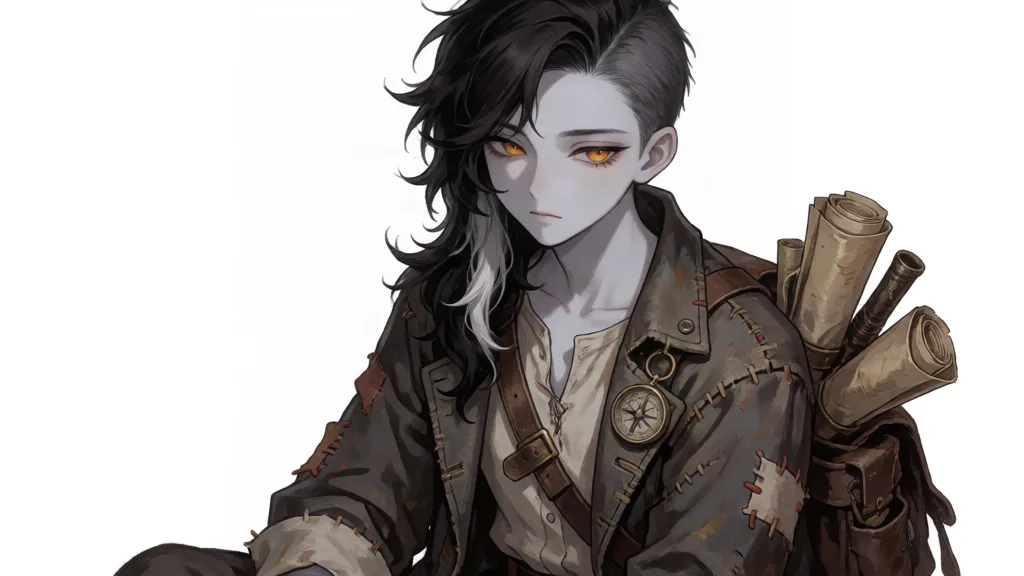
I found the first piece of the map inside a dead man’s boot.
Not a hero’s boot. Not a king’s. Just a leather thing, cracked and stained with mud, still warm from the man who’d worn it an hour before. He’d died on his back in the tall grass outside Vrindavan, his eyes open to the sky, a hole in his ribs the size of my thumb. No one had robbed him yet. That told me something about the road ahead.
I knelt beside him and pulled the boot off. The map was folded small, pressed into the sole like a secret. The paper was old, the kind that crumbles if you breathe too hard. I opened it anyway.
The ink was faded but legible. Lines curved and crossed, marking paths that didn’t match any road I knew. Rivers that ran in circles. A mountain that sat in the middle of a plain. And at the center, drawn in a hand so careful it might have been a prayer, a single word: *Barsana.*
I knew that name. Every cartographer knew that name. It was the lost village, the one the old songs said was built by Radha herself, hidden from the world when Krishna left it. Some called it a myth. Some called it a lie. I called it the reason I’d crossed three kingdoms on foot.
The dead man hadn’t been so lucky. He’d found the map, and then someone had found him.
I looked up. The road stretched empty ahead, dust and heat shimmering above it. To my left, the forest of Vrindavan pressed close, dark and thick, the trees bent like old women whispering. I could hear the river Yamuna somewhere beyond them, a low constant hum, like the world was breathing.
I folded the map and put it in my satchel. Then I took the dead man’s coin purse, because I wasn’t a saint, and because saints don’t live long on the road.
The village of Vrindavan was half a day’s walk south. I made it by evening.
It was a small place, the kind that looked the same as every other small place I’d passed through. Mud walls and thatch roofs. A well in the center square. Children chasing a dog that didn’t want to be chased. But there was something else here, something I’d felt since I crossed the river at dawn. The air was thick. Not with heat. With *memory.*
The old stories said Krishna grew up in these streets. That he stole butter from these kitchens, danced with these girls, played his flute under these trees. I’d heard the songs a hundred times in a hundred taverns. I’d sketched the temples, drawn the peacocks, traced the patterns of the gopis’ skirts. I thought I understood.
I didn’t understand anything.
I found a room at a house that took travelers. The woman who ran it was old, her face a map of wrinkles, her eyes the color of river stones. She looked at me the way everyone looked at me, like I was a question she didn’t want to answer.
“You’re a mapmaker,” she said. Not a question.
“I draw what I see.”
“Then you won’t find what you’re looking for here.”
I set my satchel on the cot. “What am I looking for?”
She didn’t smile. “Everyone who comes here is looking for the same thing. A path to something they lost. But this place doesn’t give back. It only takes.”
She left before I could ask what she meant.
That night I sat by the window and unfolded the map again. The dead man’s blood had dried on the edges, brown and flaking. I traced the lines with my finger, following the river, the mountain, the strange circular paths. Barsana was marked at the center, but the map didn’t show how to get there. It showed the *shape* of the place, not the route. Like a memory of a room you can’t remember entering.
I heard a flute.
It came from outside, thin and high, carried on the wind. I leaned out the window. The street was empty. The moon hung low and fat, lighting the dust like silver. The sound came again, closer this time, from the direction of the forest.
I grabbed my coat and went.
The trees swallowed me whole. The path was narrow, barely visible, roots rising like hands from the earth. I followed the music. It pulled me deeper, past stones covered in moss, past a broken wall that might have been a temple once. The notes twisted and turned, never settling into a melody I recognized. They felt older than that. Older than me. Older than the map.
I stopped in a clearing. The grass was tall, up to my waist. In the center stood a single tree, its branches heavy with yellow flowers. The flute stopped.
“You’re early.”
The voice came from behind me. I turned.
A man stood at the edge of the clearing. He was young, younger than I’d expected, with dark skin and dark eyes and a smile that didn’t quite reach them. He wore a simple white cloth around his waist. No shoes. No weapon. No flute, though I’d heard one.
“Early for what?” I said.
“For the map you’re holding.”
I didn’t ask how he knew. I just waited.
He stepped closer. The grass didn’t bend under his feet. That’s when I knew I wasn’t talking to a man.
“You want to find Barsana,” he said. “Everyone does. But the map you carry is a map of *loss*, not of place. It won’t lead you where you think.”
“Then where will it lead me?”
He tilted his head. The smile stayed, but something behind his eyes shifted, darkened.
“To the one who drew it,” he said. “And she’s been waiting a very long time for someone to follow.”
The wind picked up. The yellow flowers fell around us like rain. And I understood, with a certainty that settled cold in my chest, that I had not found this map by accident. I had been called.
The question was what answered.
Disclaimer
This is a work of fiction, assisted by artificial intelligence. Any names or characters, businesses or places, events or incidents, are fictitious. Any resemblance to actual persons, living or dead, or actual events is purely coincidental.
Content Removal Policy
- Users may report content that may be illegal or violates our Standards.
- All reported complaints will be reviewed and resolved within seven business days.
- Review Process: Our team will assess the reported content against our guidelines.
- Appeals: If you disagree with a decision, you may appeal within 14 days of notification.
- Potential outcomes include: content removal, account warning, or no action if no violation is found.
To report content, email us at [email protected]