Share
Go Live
Forbidden Coffee
·
Published 11/2/2026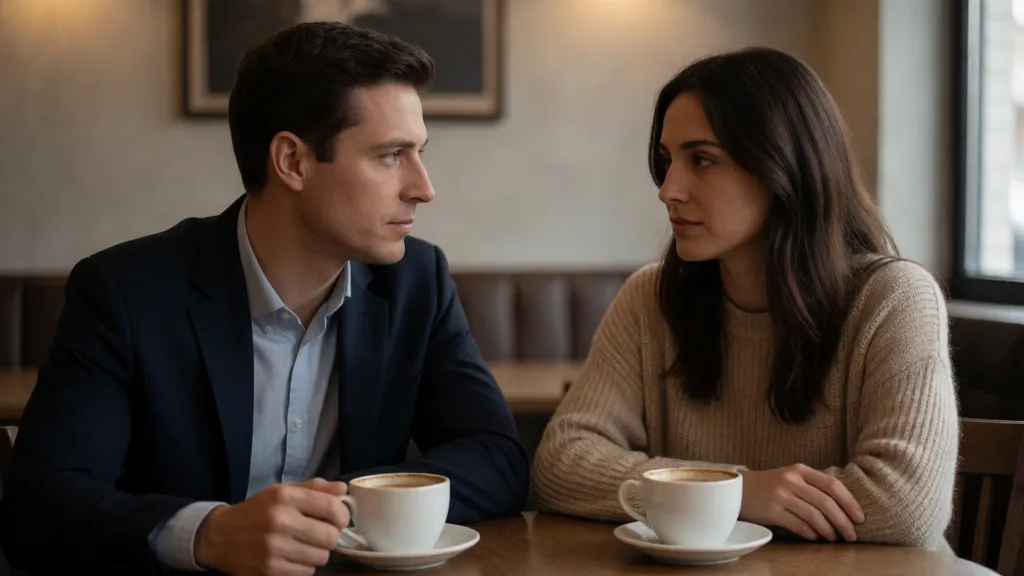
The coffee was terrible. That was the first thing I noticed, before her hand on my wrist, before the way her knee pressed against mine under the narrow table. The espresso machine at The Grind had been broken for three weeks, according to the laminated sign taped to the register, and the kid behind the counter had shrugged when I ordered a flat white.
"Best I can do is drip," he'd said.
So I sat with a cup of lukewarm drip coffee, watching Vanessa stir her tea. She didn't drink coffee. Never had. Something about the acidity, she'd told me once, years ago, at a backyard barbecue where our spouses were arguing about property taxes and we'd drifted to the edge of the patio like two magnets sliding across a table.
That was four years ago. Maybe five.
"You're staring," she said now, not looking up from her tea.
"I'm admiring."
"Same thing." She tapped the spoon against the rim of her cup, three precise clicks, then set it down on the saucer. Her fingers were long and bare. No rings. She'd taken them off before she walked in, or maybe she'd stopped wearing them months ago. I didn't ask.
The coffee shop was half-empty for a Tuesday afternoon. A college kid hunched over a laptop in the corner, earbuds in, oblivious. An older man reading a paperback near the window, his lips moving slightly as he read. Nobody was paying attention to us. Nobody ever did.
"I shouldn't have come," she said.
"You said that last time."
"And I meant it last time."
I leaned back in my chair. The wood creaked. "But you came."
She finally looked at me. Sixty years old and her eyes were still the sharpest thing in any room, pale green, unblinking, the kind of eyes that made you feel like you'd been caught doing something you shouldn't before you'd even done it. She'd been a professor once. Art history. Retired now, or semi-retired, whatever that meant for someone who'd spent thirty years lecturing to bored undergrads about Renaissance painters.
"You look tired," she said.
"I am tired."
"Rebecca keeping you up?"
The name landed like a slap. Not because she said it with any malice. She didn't. She said it the way you'd mention the weather, casual, offhand. But it was there now, between us, the reason this shouldn't be happening. The reason we were sitting in a coffee shop at two in the afternoon instead of somewhere else, somewhere with a bed and a locked door.
"Rebecca's fine," I said. "She's been working late. The hospital's short-staffed."
Vanessa nodded. She knew about Rebecca's job, had known for years. We'd been at each other's weddings, for God's sake. I'd watched her marry David in a garden ceremony fifteen years ago, watched her cry during the vows, watched David's hands shake as he slid the ring onto her finger. And she'd been at mine, eight years back, sitting in the third row next to my mother, wearing a blue dress that matched her eyes.
We'd been friends. That was the word for it. Friends who saw each other at dinner parties and holiday gatherings, who exchanged Christmas cards and birthday texts, who knew each other's spouses and kids and dogs and favorite restaurants. Friends who never touched, never flirted, never did anything that would raise an eyebrow.
Until six months ago.
"You want to tell me why you called?" she asked.
I did. I'd been wanting to tell her for weeks, ever since the thought had first lodged itself in my brain like a splinter. But saying it out loud would make it real, and real things had consequences.
"I've been thinking about you," I said.
"That's not why you called."
"No."
She waited. Vanessa was good at waiting. She'd spent decades in classrooms, letting silence do the work that words couldn't. Most people couldn't stand it. They'd fill the quiet with nervous chatter, reveal things they didn't mean to reveal, just to make the silence stop.
I wasn't most people. I'd grown up with a father who communicated in grunts and long stretches of nothing. Silence was a language I understood.
But this was different. This silence had weight. It pressed down on my chest, made it hard to breathe.
"I don't know how to say it," I admitted.
"Try."
I took a sip of the terrible coffee. It had gone cold. "I think about you when I wake up. Before I open my eyes. I think about you in the shower. On my commute. In meetings, when someone's droning on about quarterly projections, I'm thinking about the way you laugh, that little snort you do when something catches you off guard."
She didn't react. Not a blink, not a twitch.
"I think about you when I'm with Rebecca," I said. "And that's the part I can't forgive myself for."
There it was. The ugly truth, laid out on the table between the cold coffee and her untouched tea. I'd said it. No taking it back now.
Vanessa picked up her cup, took a slow sip. When she set it down, her hand was steady. Mine would have been shaking.
"How long?" she asked.
"Months. Maybe longer. I don't know when it started. I just know it hasn't stopped."
"And what do you want me to do with that?"
It was a fair question. A brutal one, but fair. What did I want? Did I want her to say she felt the same? Did I want her to tell me I was imagining things, that I should go home to my wife and forget this conversation ever happened?
I didn't know. That was the problem. I'd spent weeks trying to figure out what I wanted, and every answer felt like a lie.
"I don't know," I said. "I just couldn't keep it inside anymore."
She leaned forward, elbows on the table, close enough that I could smell her perfume. Something floral. Lavender, maybe. It was the same perfume she'd worn to my wedding. I remembered because I'd hugged her that night, a brief, friendly hug, and the scent had stayed on my collar for hours afterward.
"You're forty-three years old, Jon. You're not a teenager with a crush. You know exactly what this is."
"Do I?"
"You want something you can't have. That's all this is. The forbidden fruit. The thing behind the glass. If I said yes, if we did this, you'd wake up in a month and realize I'm just a woman. An old woman, at that. And you'd hate yourself for throwing away your marriage for a midlife crisis."
The words stung. Not because they were cruel, but because they were smart. Vanessa had always been smart. Smarter than me, smarter than anyone I knew. She saw through people like they were made of cellophane.
"You're not just a woman," I said.
"Everyone's just a woman. Or just a man. That's all any of us are."
She stood up, reached for her purse. For a second, I thought she was leaving. I thought that was it, the end of the conversation, the end of whatever this was.
But she didn't leave. She walked around the table, stood beside my chair, close enough that her hip brushed my shoulder. She looked down at me, and for the first time, I saw something in her eyes that wasn't composure or control or careful distance.
Fear. She was afraid.
"David's in Chicago until Thursday," she said quietly. "If you come to my house tonight, I won't turn you away. But you need to understand something first."
"What?"
"This doesn't end well. It never does. One of us will get hurt. Probably both of us. And when it falls apart, we'll lose everything. Our marriages. Our friendships. The life we've built. You understand that, right?"
I nodded. My throat was too tight for words.
"And you're still going to come."
It wasn't a question. She already knew the answer. She'd known it before I walked into the coffee shop, before I called her, before any of this started. We'd been circling each other for years, two planets in a decaying orbit, and now gravity had finally won.
"Yes," I said.
She held my gaze for a long moment. Then she turned and walked out the door, and I sat there with my cold coffee and my racing heart, watching through the window as she climbed into her car and drove away.
Watch this moment
Turn the current scene into a cinematic Live Chapter — what you watch becomes the story's next part.
Disclaimer
This is a work of fiction, assisted by artificial intelligence. Any names or characters, businesses or places, events or incidents, are fictitious. Any resemblance to actual persons, living or dead, or actual events is purely coincidental.
Content Removal Policy
- Users may report content that may be illegal or violates our Standards.
- All reported complaints will be reviewed and resolved within seven business days.
- Review Process: Our team will assess the reported content against our guidelines.
- Appeals: If you disagree with a decision, you may appeal within 14 days of notification.
- Potential outcomes include: content removal, account warning, or no action if no violation is found.
To report content, email us at [email protected]