Share
Go Live
The Glass C-Suite
·
Published 8/15/2026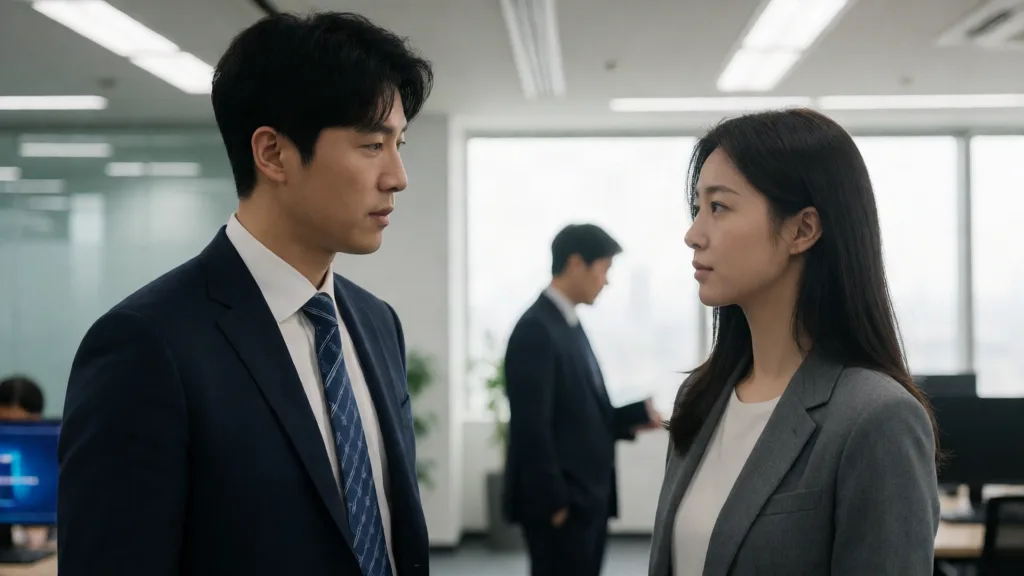
The first time I saw Yul fire someone, I understood why the seventh-floor break room had a nickname. The Chamber. Not because of anything dramatic, no shouting or thrown staplers. He just looked at the man, a senior director with twenty years at the company, and said, “Your logic is flawed. You know it. You presented it anyway. Clean out your desk.” Three sentences. The man’s face went the color of old rice. He didn’t argue.
That was three months ago. I’ve watched Yul reduce junior developers to stammering apologies with a single raised eyebrow. I’ve seen him walk through the open-plan office and watched grown adults physically shrink into their chairs, suddenly fascinated by their monitors. The man doesn’t radiate authority. He radiates something colder. Absolute certainty. The kind of certainty that doesn’t need to raise its voice because it knows it’s right.
So when he walked into the conference room for our first project meeting, I had my game face on. Neutral expression. Prepared notes. Voice that didn’t wobble.
“Ms. Han,” he said, settling into the chair across from me. Not at the head of the table, like a normal boss. Across from me, like an opponent. Or a partner. “Walk me through the timeline.”
I walked him through the timeline. He asked three questions, each one cutting straight to the weakest point in my projections. I answered them. He nodded once, a small thing, barely a movement. Then he said, “Good. Proceed.”
That was it. I spent the rest of the day waiting for the other shoe to drop. It never did.
The second meeting, he brought coffee. Two cups. He slid one across the table without looking at me, like it was nothing. Like he did this for everyone. I knew he didn’t. I’d seen his assistant, Minji, scramble to fetch his Americano every morning, always black, always from the shop three blocks away because the machine on the sixth floor made it too bitter.
“I don’t take sugar,” I said, because I didn’t know what else to say.
“I know.”
He said it so casually, so flat, that I convinced myself I’d misheard. He’d probably seen my coffee order on some HR form. That was it. That was all.
But then he started showing up at my desk. Not hovering, not looming. He’d appear, lean against the edge of my cubicle, and ask a single question about the project. Then he’d leave. Thirty seconds, maybe a minute. Always at the end of the day, when the office was thinning out and the light through the windows had gone gold and soft.
“The integration test,” he said on a Tuesday. “Are you handling it yourself?”
“I’m overseeing it.”
“You’re writing the code.”
It wasn’t a question. I closed my laptop and looked up at him. He was tall, taller than I remembered, and the light caught the sharp line of his jaw. His coat, that ridiculous black high-collared thing, made him look like he’d stepped out of some noir film. A detective who solved murders by staring at suspects until they confessed.
“I like to stay hands-on,” I said.
“So do I.”
He held my gaze for a beat too long. Then he pushed off from the cubicle wall and walked away. I watched him go, the straight line of his shoulders, the way people parted for him without looking up, like fish sensing a shark.
I told myself I was imagining things. I told myself that Yul didn’t have a soft voice, he just had a quiet one. That the way he said my name, Lara, like he was tasting it, was just his accent. That the coffee was a coincidence. That the questions at my desk were standard project oversight.
I told myself all of this, and I almost believed it.
But then there was the night I stayed late. Really late. Eleven PM, and the project timeline had slipped by three days because the backend team couldn’t get their heads out of their asses. I was rewriting their code, line by line, because it was faster than explaining it to them. The office was empty, the lights on a timer that clicked off floor by floor, leaving me in a pool of fluorescent glow.
I didn’t hear him come in. I just felt someone behind me, a presence, a shift in the air. I turned, and there he was, holding a paper bag that smelled like garlic and sesame oil.
“You haven’t eaten,” he said.
“I’m fine.”
“You’re not fine. You’re running on caffeine and spite. Eat.”
He set the bag on my desk. Then he pulled up a chair, the one from the empty cubicle next to mine, and sat down. Not across from me. Beside me.
I stared at the bag. “You brought me dinner.”
“I brought us dinner. I hadn’t eaten either.”
“Why?”
He looked at me, and for a second, just a second, the mask slipped. His eyes, those deep brown eyes that made junior developers cry, went soft. Warm. Human.
“Because you’re the only person in this building who talks to me like I’m a person,” he said. “And because you’re good at your job. And because I wanted to.”
I didn’t know what to say to that. So I opened the bag. Jjajangmyeon, the good kind, from the place two blocks over that I’d mentioned once, in passing, to Minji. I’d said I missed it, that my mother used to make it, that the instant stuff never tasted right.
He’d remembered.
We ate in silence. Not awkward silence, but the comfortable kind, the kind that settles over you like a blanket. He didn’t try to talk about the project. He didn’t ask about my weekend. He just sat there, eating noodles from a cardboard container, his sleeves rolled up to his elbows, looking more human than I’d ever seen him.
When we finished, he took my empty container and threw it away. Then he stood at the door and said, “Don’t stay past midnight. The cleaning crew comes at one, and they’ll lock you in.”
“That’s happened to you?”
“Twice.”
He smiled. It was small, barely a curve of his lips, but it transformed his face. Made him look younger. Made him look like someone who laughed, who joked, who stayed up late and got locked in buildings.
“Goodnight, Lara.”
“Goodnight, Yul.”
I said his name without thinking. His first name. No honorific, no title. Just Yul. He paused, his hand on the doorframe, and I saw his shoulders tighten. Then he walked out.
I sat there for a long time, staring at the empty doorway. My heart was doing something stupid, something I refused to acknowledge. I told myself it was the caffeine. The late hour. The stress of the project.
But I knew, even then, that I was lying.
The next morning, there was a new notebook on my desk. Leather-bound, plain, expensive. No note. But I knew who it was from. I knew because when I looked up, Yul was standing at the end of the hall, talking to a department head. He didn’t look at me. But his hand, the one holding his coffee cup, lifted slightly. A wave. A greeting. A secret.
I opened the notebook. The first page was blank. So was the second. But on the third, in his handwriting, sharp and precise, were two words.
*Keep thinking.*
I closed the notebook and shoved it in my bag. Then I went back to work, and I didn’t think about it. I didn’t think about the way he’d said my name. I didn’t think about the dinner. I didn’t think about the notebook.
I didn’t think about any of it.
But I kept the notebook. And I kept thinking.
Watch this moment
Turn the current scene into a cinematic Live Chapter — what you watch becomes the story's next part.
Disclaimer
This is a work of fiction, assisted by artificial intelligence. Any names or characters, businesses or places, events or incidents, are fictitious. Any resemblance to actual persons, living or dead, or actual events is purely coincidental.
Content Removal Policy
- Users may report content that may be illegal or violates our Standards.
- All reported complaints will be reviewed and resolved within seven business days.
- Review Process: Our team will assess the reported content against our guidelines.
- Appeals: If you disagree with a decision, you may appeal within 14 days of notification.
- Potential outcomes include: content removal, account warning, or no action if no violation is found.
To report content, email us at [email protected]