Share
Go Live
Echoes of Us
·
Published 10/14/2026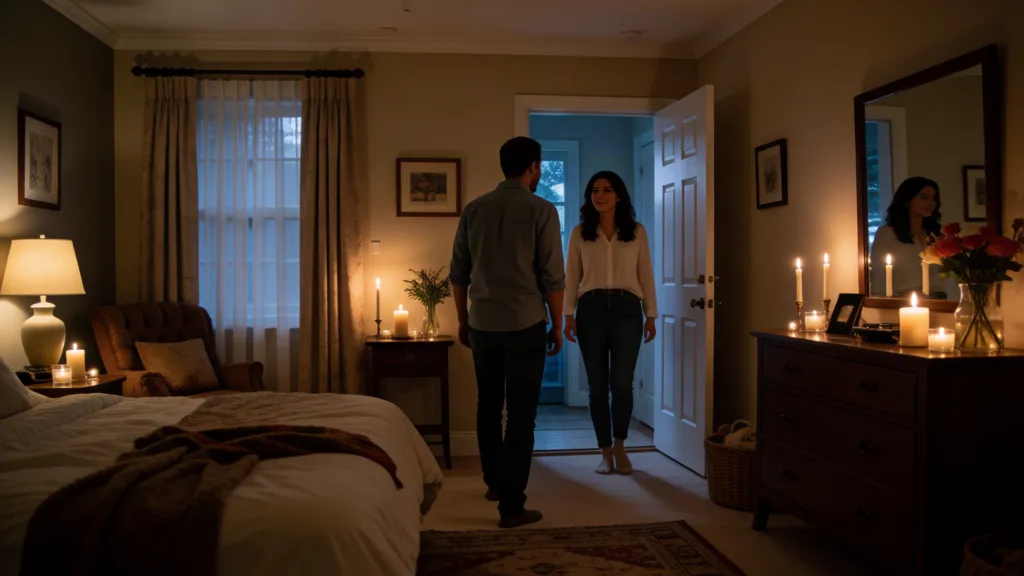
The recorder was already running when I heard the key turn in the lock. I'd set it on the kitchen counter an hour ago, mostly out of habit, mostly because the apartment had been making sounds all evening that I didn't want to lose. The radiator ticking through its slow arrhythmia. The neighbor's television bleeding through the wall, muffled into something like weather. My own footsteps, bare against the hardwood, pacing the same six feet of floor between the stove and the sink.
I'd been pacing for twenty minutes. The biryani was getting cold.
"Honey, I'm home."
The voice came from the front hallway, bright and tired at the same time, the way Emily always sounded when she'd been holding it together all day and could finally let go. I heard her bag hit the floor. Heard the particular sigh she made when she kicked off her heels, that small exhale of relief that I'd recorded once, without telling her, because it was the sound of her arriving and I wanted to keep it.
"Kitchen," I called back.
She appeared in the doorway and stopped. Her face did something complicated. I watched it happen in real time: the initial smile, the slight narrowing of her eyes, the way her mouth opened and then closed without producing sound. She was looking at the table. At the two plates I'd set out, the candles I'd lit, the bottle of wine I'd opened an hour ago because I thought she'd be home by seven.
It was nine-forty.
"What's all this?" she asked.
"Anniversary," I said.
She blinked. I watched her do the math behind her eyes, watched her arrive at the correct answer and hate herself for needing to arrive at it at all. Three years. City Hall, a Tuesday, neither of us wearing white. Her mother still hadn't forgiven us for the lack of notice.
"Dhvani." She said my name like it was a sentence she didn't know how to finish.
"The biryani's cold," I said. "But the wine's still good. Sit down."
She sat. I poured. The candles flickered between us, throwing her face into that soft amber light that made everyone look like a version of themselves they'd recognize in a photograph ten years later. She was still in her work clothes, a gray blouse with a coffee stain near the collar that I hadn't noticed until now. Her hair, usually pulled back, had escaped in pieces around her face. She looked exhausted in a way that had nothing to do with the hour.
"I'm sorry I'm late," she said.
"I know."
"I should have called."
"You did. Three times." I pushed her plate toward her. "I saw the messages. I just didn't answer."
She looked at me then, really looked, and I saw the question forming. Why didn't you answer. What are you doing. What is this really about. Emily had a way of reading me that I'd never been able to replicate, a kind of emotional echolocation that found the shape of things I hadn't said yet. It was one of the reasons I married her. It was also, if I was being honest, one of the reasons I'd been pacing the kitchen for twenty minutes instead of calling her back.
"I wanted to do something," I said. "That's all."
"That's all."
"That's all."
She picked up her fork. Took a bite. Chewed. The biryani was cold, but she didn't say so. She just ate, methodically, the way she did everything, and I watched her and felt the recorder on the counter watching us both. I hadn't meant to leave it running this long. The tape was probably full by now, or close to it. Somewhere in there was the sound of me opening the wine, the sound of the radiator, the sound of Emily coming home to a table she'd forgotten was waiting for her.
I reached over and stopped it. The click was loud in the quiet room.
"What was that?" she asked.
"Nothing. The recorder."
"You were recording?"
"Not on purpose." I poured myself more wine. "I had it running earlier. For the project. The one on Maple Street."
She nodded, and something in her shoulders loosened. The project. She understood the project. She understood me disappearing into the city with my headphones and my microphone, chasing sounds that most people didn't notice, that most people didn't care about. She'd never once asked me to explain why it mattered. She'd just accepted it, the way she accepted most things about me, with a patience I wasn't sure I deserved.
"The demolition's next month," I said. "They're tearing down the whole block. The bodega, the laundromat, that church with the tin roof that sounds like rain even when it's not raining."
"I know. You told me."
"I recorded the church last week. The whole thing. Every creak. Every echo." I swirled the wine in my glass. "It's the last time anyone will hear it. Once it's gone, it's gone."
Emily set down her fork. "Is that what tonight is about?"
"No."
"Because you get like this when you're losing something. You get quiet. You start recording everything."
"I'm not losing anything."
She didn't argue. That was the thing about Emily. She never argued. She just waited, with that patient look, until I either told her the truth or didn't. And I sat there across from her, holding my wine, feeling the weight of the small silver ring on its cord against my chest, and I tried to figure out what the truth even was.
The truth was that I'd gotten a letter three days ago. From a lawyer I'd never heard of, representing a woman I'd never met, informing me that my biological mother had died and left me something. A house. In a city I'd never been to. The letter was four paragraphs long and I'd read it forty times.
The truth was that I hadn't told Emily.
The truth was that I'd spent the whole day cooking because I didn't know what else to do with my hands.
"Dhvani," she said. "You're doing the thing."
"What thing."
"The thing where you're in the room but you're not in the room."
I looked at her. At the coffee stain on her collar. At the pieces of hair around her face. At the candlelight making her look like a stranger I was meeting for the first time, someone I might pass on the street and not recognize, someone whose voice I'd have to record just to remember.
"I got a letter," I said.
She waited.
"From a lawyer. About my mother."
Her face didn't change, but her hands did. They folded together on the table, knuckles going white.
"Your mother," she repeated. "Your mother who died when you were six."
"That's what I was told."
She absorbed this. I watched her do it, watched the information move through her like water finding its level. Emily had a mind like a ledger. She balanced everything. She'd balanced me for three years, all my strange hours and stranger silences, all the nights I came home smelling like the city and couldn't explain where I'd been.
"She left you something," Emily said. It wasn't a question.
"A house. In a town called Marrow." I laughed, because it was absurd. "Marrow. Like the bone."
"Where is that?"
"I don't know. I haven't looked."
"You haven't looked."
"I've been cooking."
She stood up. Walked to the counter. Picked up the recorder, turned it over in her hands, set it back down. The candles threw her shadow across the wall, long and thin, a version of her that was all edges.
"Three years," she said quietly. "Three years of marriage, and you didn't tell me you had a mother who might still be alive."
"She wasn't. She's not. She died. That's what the letter says."
"That's what the letter says."
"Emily."
She turned around. Her eyes were wet, but her voice was steady. That was Emily. She could cry and keep talking at the same time, a skill I'd never mastered.
"I'm not angry that you didn't tell me," she said. "I'm angry that you cooked me dinner instead."
I didn't have an answer for that.
The radiator ticked. The neighbor's television murmured through the wall. Somewhere in the building, water ran through pipes, a sound I could have recorded, a sound I could have kept. But I just sat there, holding my cold wine, watching my wife cry in the candlelight, and I thought about Marrow, and the house I'd never seen, and the mother I'd never known, and the letter sitting in my jacket pocket, still folded, still unread after the first forty times.
"The train leaves at six," I said.
Emily wiped her eyes with the back of her hand. "What?"
"To Marrow. There's a train. It leaves at six in the morning." I set down my glass. "I looked it up. I just didn't book the ticket."
She stared at me. The candles flickered. The recorder sat silent on the counter, its tape full, its red light dark, holding everything we'd said and everything we hadn't.
"Book two," she said.
Watch this moment
Turn the current scene into a cinematic Live Chapter — what you watch becomes the story's next part.
Disclaimer
This is a work of fiction, assisted by artificial intelligence. Any names or characters, businesses or places, events or incidents, are fictitious. Any resemblance to actual persons, living or dead, or actual events is purely coincidental.
Content Removal Policy
- Users may report content that may be illegal or violates our Standards.
- All reported complaints will be reviewed and resolved within seven business days.
- Review Process: Our team will assess the reported content against our guidelines.
- Appeals: If you disagree with a decision, you may appeal within 14 days of notification.
- Potential outcomes include: content removal, account warning, or no action if no violation is found.
To report content, email us at [email protected]