Share
Go Live
Sunshine and Steel
·
Published 9/13/2026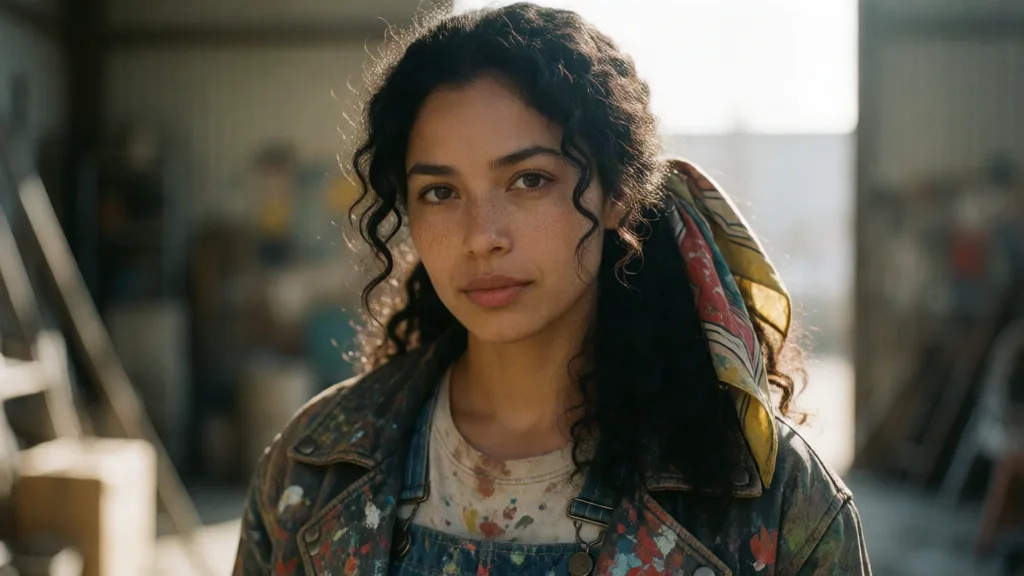
The first time I saw Zavion, he was falling out of a third-story window with my painting tucked under his arm.
Not my best work. A study in blues and greys, the face of a woman I’d seen sleeping in the transit tunnels. I’d spent three nights getting her right, the hollow of her cheek, the way her fingers curled even in sleep. The piece was supposed to be part of a series on the invisible city. The people the neon lights forgot.
Instead, it was wrapped in canvas and clutched to the chest of a man who was about to break his neck on the pavement below.
I didn’t think. I just moved.
The fire escape ladder hit me in the shoulder as I yanked it down, the metal cold and rusted against my palm. I swung onto the first rung, climbed two, three, four at a time. The window he’d come through was still open, a dark mouth in the brick face of the gallery. Below me, the alley was a canyon of shadow and garbage.
He hit the dumpster.
The sound was wet and wrong. A crunch that traveled up through the metal and into my teeth. I froze, my heart slamming against my ribs. For a second, nothing moved. Then the dumpster lid creaked, and a hand appeared, pale and ringed with silver.
“You’ve got to be kidding me,” I muttered.
He pulled himself up, coughing, one arm still wrapped around my painting. His jacket was torn at the shoulder, and there was a thin line of blood running from his temple to his jaw. But he was grinning. The bastard was grinning.
“Nice catch,” I called down.
He looked up, squinting through the dim light. His eyes found me on the ladder, and the grin widened. “I aim to please.”
“You aim to steal.”
“Tomato, tomahto.” He swung his legs over the edge of the dumpster, landing on the asphalt with a grunt. He was taller than I’d expected. Lean and coiled, like a wire pulled tight. The silver streak in his hair caught the light from a nearby sign. “This yours?”
He held up the painting. Even in the dark, I could see the blues I’d mixed myself, the greys I’d stolen from the sky before a storm.
“Give it back,” I said.
“Come and get it.”
I dropped off the ladder, landing in a crouch. The alley was narrow, maybe ten feet across. The walls on either side were covered in layers of tags and wheatpastes, the ghost of every artist who’d ever worked this block. The air smelled like piss and wet cardboard and the sharp chemical tang of fresh paint.
I straightened up. He was watching me, head tilted, that smirk still in place.
“You don’t know who I am,” I said.
“Should I?”
“I’m the one who painted that wall.” I pointed to the mural behind him. A phoenix, rising from a cityscape that bled into flames. It had taken me two weeks and every ounce of rage I had after the precinct got shut down. “And that one.” I pointed to the next block. “And the one on the corner of Ash and Meridian. The one the mayor tried to have painted over.”
His eyes flickered. Just for a second. Then they were back on me, sharp and grey and unreadable. “Marisol.”
“Rolling,” I corrected. “To my friends.”
“And to the people who steal your work?”
“They get a fist.”
He laughed. It was a good laugh. Warm and unexpected, like it had caught him off guard. “Fair enough.” He held out the painting. “Here. I wasn’t going to keep it.”
I took it. The canvas was warm from his body, the edges slightly crumpled. I checked the corners, the surface. No damage. “Then why take it?”
He shrugged. “I wanted to see who would follow.”
“That’s stupid.”
“That’s effective.” He wiped the blood from his temple with the back of his hand. “I needed to know if you cared enough to chase.”
“I care about my work.”
“Sure.” He said it like he didn’t believe me. Like he knew something I didn’t. “But you also care about the girl in the painting. The one sleeping in the tunnels.”
My stomach tightened. “How do you know about that?”
“I know a lot of things.” He stepped closer. Close enough that I could smell him. Sweat and metal and something herbal, like crushed mint. “I know you’ve been painting the same faces for months. The same corners. The same stories no one wants to tell.”
“You’ve been watching me.”
“I’ve been noticing you.” He said it like it was different. Like it meant something more.
I should have walked away. Should have tucked the painting under my arm and disappeared back into the city I knew better than anyone. But I didn’t. I stood there, in the stinking alley, and let him look at me.
“What do you want?” I asked.
“A partnership.”
“I don’t partner.”
“You don’t trust.” He corrected. “There’s a difference.”
“Same result.”
“Not always.” He reached into his jacket. I tensed, but he only pulled out a folded piece of paper. It was creased and soft, like it had been carried for days. He held it out to me. “Take it.”
I didn’t move.
“It’s not a bomb, Rolling. It’s an address.”
“Whose address?”
“The man who owns the building on Ash and Meridian. The one who had your mural sandblasted.” His voice dropped, losing the playfulness. “I know where he lives. I know his schedule. I know what he’s afraid of.”
I took the paper. The address was written in sharp, angular letters. A penthouse in the Spire district. The kind of place where people paid more for a bathroom than I made in a year.
“And what exactly am I supposed to do with this?”
“Whatever you want.” He stepped back, hands raised. “I’m not here to tell you how to work. I’m here to give you the tools.”
“And what do you get out of it?”
“The satisfaction of watching someone finally hit back.” He turned, walking toward the mouth of the alley. His boots were silent on the asphalt. “And maybe a drink, if you’re feeling generous.”
“I don’t drink with strangers.”
He paused. Looked over his shoulder. The neon from the sign caught his face, turning his eyes to mercury. “Then I guess you’ll have to get to know me.”
He was gone before I could answer. Swallowed by the city, by the noise and the light and the endless hum of Veridia at night.
I stood in the alley for a long time. The painting was cold in my hands. The paper was warm. I could still smell him. Mint and metal and something I couldn’t name.
I folded the address into my pocket.
The next night, I went to the Spire district.
I told myself it was research. That I was just scoping the building, testing the security, seeing if the information was even real. I didn’t plan to do anything. I wasn’t that stupid.
But I brought my paint.
The Spire district was everything I hated about Veridia. Clean streets. Clean people. Buildings that scraped the sky like glass fingers, each one more sterile than the last. The air smelled like ozone and money. There were no murals here. No tags. No stories that didn’t come with a price tag.
The address Zavion had given me was a tower near the center of the district. Forty stories of reflective glass and polished steel. A doorman in a blue uniform stood at the entrance, his face blank and professional.
I circled the block twice. Found the service entrance. Found the cameras. Found the fire escape that led to the roof.
It was almost too easy.
I climbed. Forty stories, my lungs burning, my hands raw from the metal. The city spread out below me, a grid of light and shadow. Somewhere down there, people were sleeping in tunnels. Eating from dumpsters. Dying in rooms no one would find.
And up here, a man who’d erased my work was probably sleeping in sheets that cost more than my rent.
I reached the roof. The door was locked, but the lock was old. A credit card and a few seconds of patience, and I was inside.
The penthouse was everything I expected. Marble floors. Floor-to-ceiling windows. Art on the walls that cost more than I’d make in a lifetime. Abstract pieces. Safe pieces. The kind of art that didn’t say anything.
I found his bedroom. He was asleep, snoring softly, his face slack and innocent. A man who’d never had to fight for anything. A man who’d never woken up cold.
I could have hurt him. Could have taken his money, his jewelry, his sense of safety. But that wasn’t why I was here.
I found the wall in the living room. A blank white expanse, fifteen feet wide, facing the windows where everyone could see.
I opened my paint.
The sun was rising when I finished. A phoenix again, but different. This one was rising from a city of glass, its wings made of fire and shadow. At its feet, the people he’d erased. The faces I’d painted on Ash and Meridian. The woman from the tunnels. The children from the projects. The old man who’d lost his store.
I signed it with my tag. A rolling wave, black and red.
I was packing up when the door opened.
“You’re good.”
I didn’t turn around. “You followed me.”
“I wanted to see if you’d actually do it.” Zavion’s voice was soft. Almost admiring. “Most people talk. You act.”
“I told you. I care about my work.”
“This isn’t about work.” He stepped into the room. I could see his reflection in the glass. He was wearing the same jacket, but his hair was wet, like he’d just showered. “This is about justice.”
“Same thing.”
“No.” He stood beside me, looking at the mural. The light from the window caught his face, softening the sharp edges. “Justice is personal. Work is just work.”
I didn’t have an answer for that.
He turned to me. His eyes were grey in the morning light. Grey and deep and full of something I couldn’t read. “I know a place. Breakfast. Quiet. No questions.”
“I don’t eat with strangers.”
“Then I guess you’ll have to get to know me.” He smiled. It was smaller than the grin from the alley. More real. “Come on, Rolling. You’ve been up all night. You’re hungry. I’m hungry. And I promise, I’m much more charming over eggs.”
My stomach chose that moment to growl. Loud enough that he heard it.
His smile widened.
“That’s a yes,” he said.
“That’s a maybe.”
“I’ll take it.”
We left through the service entrance. The city was waking up, the streets filling with people who didn’t know what had happened in the penthouse above them. They’d find out soon enough. The morning news. The social media feeds. The whispers that spread through the underground like wildfire.
I should have felt satisfied. I’d made my point. I’d reclaimed my story.
But all I could think about was the man walking beside me. The way he moved. The way he talked. The way he’d looked at my painting like it mattered.
The diner was a hole-in-the-wall three blocks from the tower. Fluorescent lights. Cracked vinyl booths. A waitress who called him “Z” and didn’t blink at my paint-stained hands.
We sat in a booth by the window. The coffee was terrible. The eggs were greasy. It was the best meal I’d had in weeks.
“So,” he said, stirring sugar into his cup. “What’s next?”
“Next?”
“You hit a penthouse. You made a statement. But one wall doesn’t change a city.” He leaned forward. “What’s the bigger picture?”
I stared at him. “Why do you care?”
“Because I’ve been watching you for months, Rolling. I’ve seen your work. I’ve seen what you’re trying to say.” He set down the spoon. “And I think you’re the only person in this city who might actually be able to say it.”
The words hit me harder than I expected. I looked down at my coffee. The surface was dark and still.
“I don’t trust you,” I said.
“I know.”
“I don’t work with people.”
“I know that too.”
“Then why are you here?”
He was quiet for a long moment. When he spoke, his voice was low. Careful. “Because I’ve been alone a long time. And I know what it looks like when someone else is alone too.”
I looked up. His eyes were steady. Honest.
I didn’t say anything.
But I didn’t leave.
And when he asked if I wanted to see something, later that night, I said yes.
Watch this moment
Turn the current scene into a cinematic Live Chapter — what you watch becomes the story's next part.
Disclaimer
This is a work of fiction, assisted by artificial intelligence. Any names or characters, businesses or places, events or incidents, are fictitious. Any resemblance to actual persons, living or dead, or actual events is purely coincidental.
Content Removal Policy
- Users may report content that may be illegal or violates our Standards.
- All reported complaints will be reviewed and resolved within seven business days.
- Review Process: Our team will assess the reported content against our guidelines.
- Appeals: If you disagree with a decision, you may appeal within 14 days of notification.
- Potential outcomes include: content removal, account warning, or no action if no violation is found.
To report content, email us at [email protected]