Share
Go Live
Shadows of the Sun
·
Published 10/3/2026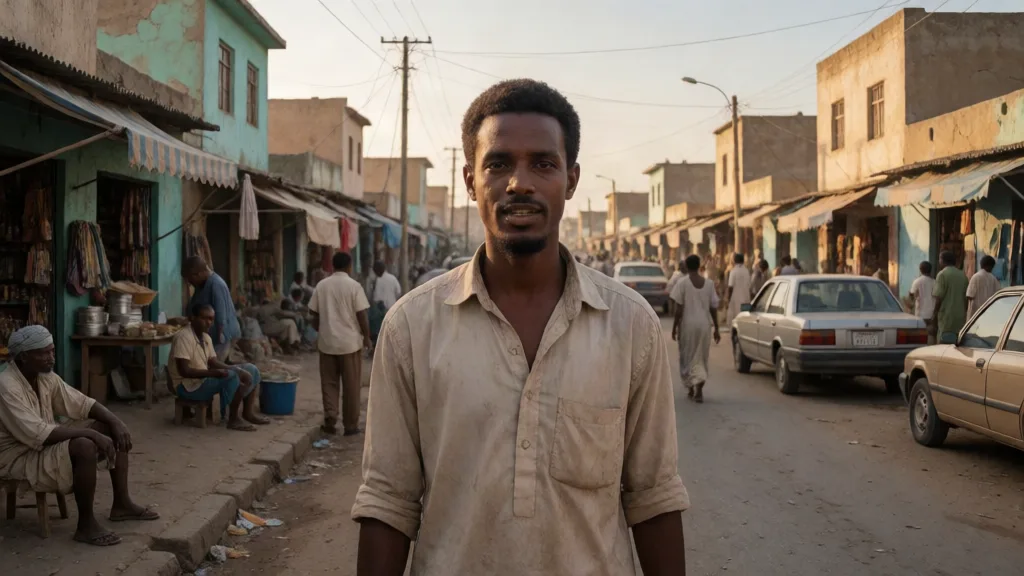
The trick is not the coin.
The coin is nothing. A disc of brass, a little worn on the face where the old king's profile has gone smooth as a river stone. Any child on the street could palm it. Any drunk in the cafés could lose it behind his own ear and call it magic.
The trick is the moment before the coin. The half-second when the mark's eyes go wide and soft, when the brain steps aside and lets the body believe. That's the real work. That's what I sell.
I was selling it that afternoon on a street in Mogadishu, on a corner near the old port where the smell of salt and diesel and grilled goat meat braided together in the heat. The sun had begun its slow slide toward the Indian Ocean, and the city had that honeyed light it gets around four o'clock, when everything looks like it's been dipped in something sweet. Whitewashed walls going gold. The blue of a woman's hijab turning electric. Even the dust in the air caught fire.
A crowd of six or seven had gathered. Three kids, two men in macawiis and sandals, an old woman with a basket of limes balanced on her head who had stopped because stopping cost nothing. I had their attention. That's the only currency I ever really need.
"Watch the hand," I said, rolling the coin across my knuckles. Left to right, right to left, a little shine of brass moving like water. "Don't watch the coin. The coin is honest. I'm the one you should worry about."
The kids laughed. The old woman did not.
I made the coin vanish. I made it appear in the smallest boy's ear, then in my own mouth, then gone again. I made it come back. Applause, thin but real. One of the men dropped a few shillings into the cap at my feet. Not much. Enough for tea.
And then I saw him.
He was walking up the street from the direction of the lighthouse, tall and lean, the kind of lean that comes from not eating enough or from eating exactly right, hard to tell. Dark hair slicked back. A leather jacket in this heat, which told me something about him or about what he wanted people to think of him. He wasn't watching my hands. He was watching my face. That's how I knew.
Amateurs watch the hands. Professionals watch the eyes. He was watching my eyes and he was smiling, a small private smile, the smile of a man who has already bought his ticket and knows how the show ends.
I finished the routine. I bowed. The crowd dispersed into the afternoon, back to their lives, back to their shops and their conversations and their goats. The old woman with the limes adjusted her basket and moved on without ever having smiled once, which I respected.
The man in the leather jacket stayed.
"You're good," he said. His voice was low, a little amused. "Not great. But good."
"Not great," I repeated. I picked up my cap and shook the coins into my palm. "That's the nicest thing anyone's said to me all week."
"I'm not being nice." He stepped closer. Close enough that I could smell him, sandalwood and something sharper underneath, maybe cardamom, maybe gun oil, hard to say. "I'm being accurate. You telegraph the vanish. Left shoulder drops about a centimeter. Anybody who's watched you twice would catch it."
"Good thing nobody watches me twice."
"I did."
I looked at him properly then. Green eyes, the kind of green that doesn't quite exist in nature, the kind that makes you wonder if he's wearing contacts or if he's just been lucky. A ring on every finger, silver and brass and one that looked like bone. A silk vest under the jacket, the color of old blood. He looked like a man who had assembled himself from a rummage sale and come out the other side looking expensive.
"Congratulations," I said. "You want a prize?"
"I want to hire you."
The words landed in the space between us and sat there. Down the street, a car horn sounded twice, impatient. Somewhere behind me a shopkeeper was arguing with a delivery boy about the price of rice. The city went on doing what it does, which is everything at once, all the time, without apology.
"Hire me for what?"
"A job. Tonight." He tilted his head, studying me the way I'd been studying him. "You're Mohamettt."
It wasn't a question, but I answered it anyway. "Depends who's asking."
"Fair." He reached into his jacket and I felt my body go still, the old animal stillness, the one that lives in the spine and doesn't care how many coins you can palm. But he only pulled out a folded piece of paper and handed it to me. "Read it tonight. If you're interested, be at the old cinema on Via Roma at nine. If you're not, burn it."
I unfolded the paper. It was a photograph, grainy, printed on cheap paper. A building I didn't recognize, low and long, with a courtyard and a single tree. In front of the building, four men stood in a row, facing the camera. Three of them I didn't know. The fourth one I did.
I folded the paper again and put it in my pocket. My face, I'm proud to say, did not change. That's a trick too. Maybe the only one that ever really matters.
"Nine o'clock," I said.
He nodded once and walked away, up the street, toward the lighthouse, his jacket swinging with the rhythm of his stride. I watched him until he turned a corner and the city swallowed him.
---
I walked home along the water. The ocean was doing its late-afternoon thing, that lazy roll of blue going gray, fishing boats bobbing near the shore, gulls arguing over something dead. A boy was flying a kite made from a plastic bag and sticks, and it was actually working, riding the wind like it had been born to it.
I like this city. I want to say that plainly, because people who don't live here have ideas about it that have nothing to do with the place. They think of one thing, and the one thing is not the city. The city is tea stalls and tailors and women selling mangoes from wheelbarrows. The city is the call to prayer and the smell of cardamom coffee and the sound of generators and the way the light comes off the ocean in the evening like someone spilled a jar of coins across the water. The city is a hundred thousand small negotiations happening at once, and I love it the way you love a difficult relative, with your whole chest and no illusions.
My apartment was on the third floor of a building that had been yellow once. Now it was the color of old teeth. I climbed the stairs past the neighbor's radio and the smell of whatever she was cooking, which was always something with onions. Inside, I locked the door, pulled the curtain, and laid the photograph on the table.
Four men. Three strangers. One not.
Yusuf.
I hadn't seen his face in six years, not since the night he put a gun to my head in a warehouse near the port and told me I owed him more than I could ever pay. I'd talked my way out of it. That's what I do. But he'd kept the debt on the books, the way men like him keep everything, and I'd spent six years walking through this city with a small cold stone in my chest, waiting for the day the stone would move.
Now here it was, printed on cheap paper, handed to me by a stranger with impossible eyes.
I should have burned it. That was the smart thing. The smart thing was to take my tea money and my tricks and my quiet life and stay far away from whatever this was. I knew that. I knew it the way you know the tide is coming in.
But I kept looking at the photograph. At the building. At the tree. At the four men standing in a row like they were posing for a wedding.
And I kept thinking about what the stranger had said. You telegraph the vanish. Left shoulder drops.
Nobody had ever watched me that closely. Nobody in this whole city had ever looked at me long enough to see the tell.
I folded the photograph and put it in my jacket. Then I sat by the window and watched the light go down over the ocean, and I waited for nine o'clock, and I told myself I was only going to find out what the job was.
That's what I told myself.
Watch this moment
Turn the current scene into a cinematic Live Chapter — what you watch becomes the story's next part.
Disclaimer
This is a work of fiction, assisted by artificial intelligence. Any names or characters, businesses or places, events or incidents, are fictitious. Any resemblance to actual persons, living or dead, or actual events is purely coincidental.
Content Removal Policy
- Users may report content that may be illegal or violates our Standards.
- All reported complaints will be reviewed and resolved within seven business days.
- Review Process: Our team will assess the reported content against our guidelines.
- Appeals: If you disagree with a decision, you may appeal within 14 days of notification.
- Potential outcomes include: content removal, account warning, or no action if no violation is found.
To report content, email us at [email protected]