Share
Go Live
Drumbeat of the Silent
·
Published 10/1/2026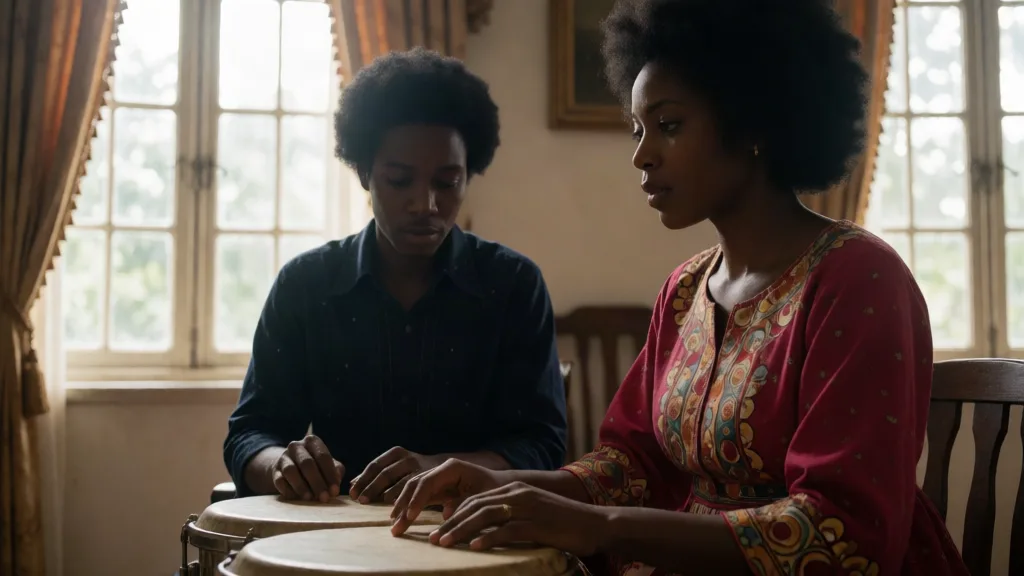
The floorboards of the General's mansion were iroko, hard as stone, and they carried his heartbeat to me like a drum.
I felt it first in my feet. That's where music enters me. Not my ears, which have been closed since the fever took my hearing when I was six years old, but the soles of my feet, the bones of my ankles, the long muscles of my calves. I was standing in the servants' corridor with a tray of kola nuts, waiting for the house girl to tell me where to put them, when the General walked past on the other side of the wall. His footsteps struck the wood like a talking drum: heavy, deliberate, each step a stroke.
But underneath the footsteps, something else.
A pulse. His heart, pushing blood through his body with enough force that the vibration traveled through the floor, up through my bare feet, and into my chest. I stood very still. The tray tilted in my hands. The kola nuts shifted and clicked against each other.
The rhythm was wrong.
I don't mean irregular. I mean wrong in the way a drum is wrong when the drummer is lying. I'd heard that kind of wrongness before, in the market drummers who played for coins and smiled too wide. They'd beat out one rhythm with their hands and tap a different one with their heel, a private rhythm, the one that told the truth. The General's heart did the same thing. His footsteps said I am powerful. His heartbeat said something else entirely.
I counted the beats without meaning to. It's what I do. My body counts rhythm the way other people breathe. Four beats, then a pause, then three beats, then a longer pause, then five. A pattern that didn't repeat. A pattern that felt like a sentence being spoken in a language I almost understood.
"Girl. Girl!"
The house girl was snapping her fingers in my face. I felt the air move before I saw her hand. I looked up. She was tall, taller than me by a head, and she pointed at the tray with her chin.
"Take it to the small parlor. Not the big one. The small one. And don't stand there like a goat."
I nodded. I'm good at nodding. I've spent twenty-three years learning how to be invisible in a world that doesn't know what to do with a woman who can't hear. I took the tray to the small parlor and set it on the sideboard and stood by the wall with my hands folded, waiting.
That was my first day in the General's house.
That was the day I learned that silence isn't empty. It's full of things no one else can feel.
---
My name is Adaeze. My mother named me after a princess in a story, which was optimistic of her, since we lived in a two-room flat in Mushin with a shared toilet and a roof that leaked in three places. My father was a mechanic who died when I was twelve, crushed under a lorry he was repairing. After that, my mother sold akara from a stall by the roadside and I helped her, and in the evenings I went to the compound of the local drummers and stood with my feet on the ground and let the rhythm come into me.
The drummers didn't know what to make of me at first. A deaf girl, standing there with her eyes closed, swaying. They thought I was simple. Then one of them, an old man named Baba Femi who played the gangan, the talking drum, saw me flinch when he hit a wrong note. He stopped playing. He stared at me.
"You felt that," he said.
I couldn't hear him, but I could read his lips. I nodded.
He crouched down and put his hand flat on the ground, then looked at me, then at the ground. A question. I crouched too and put my hand next to his. The drum was still vibrating under the packed earth. I could feel it in my palm, a faint tickle, like a fly walking on my skin.
Baba Femi laughed. He had a gap between his front teeth and his laugh was silent to me but I could see it in his shoulders, in the way his head tipped back. He stood up and pulled me to my feet and put the drum in my hands.
"Then you play," he said.
I was ten years old. I'd never held a drum before. I put my fingers on the tension cords and squeezed, and the drum spoke, and I felt the sound in my ribs. It was like being struck by lightning. It was like discovering a door in a wall you'd thought was solid. I played until my hands bled. Baba Femi watched me and didn't stop me.
That was the beginning. The drum was my ear. The drum was my voice. I learned to play the gangan, the dundun, the omele. I learned to make the drum talk, to send messages across distances, to tell stories with rhythm. I learned that a drum can say Come home or Danger or I love you or The king is dead. I learned that a drum can lie.
And I learned that a heartbeat is just a drum that never stops.
---
The General's house was in Ikoyi, on a street where the houses had walls around them and the walls had broken glass on top. I'd never been to Ikoyi before. I'd seen it from the bus, the big houses behind their gates, the mango trees leaning over the walls, the Mercedes cars with drivers who wore white gloves. It was another country. It was a country where people like me went to work and then went home.
I got the job because my mother's cousin's neighbor knew the cook. The cook needed a kitchen girl. I could carry things and clean things and stay out of the way. The cook didn't care that I couldn't hear. He cared that I was quiet and didn't steal and didn't talk back. I was all three.
The General's name was Sani Abubakar. He was a big man, tall and wide, with a voice I could feel in my chest when he was in the same room. He wore white agbadas and gold watches and sunglasses even indoors. He had a wife, Madam Folake, who was thin and nervous and spoke to me only in gestures. He had three children who were away at school in England. He had soldiers who came and went at all hours, their boots striking the floor like hammers.
He had secrets. I knew that from the first day. Not because anyone told me. Because I felt them.
The house was full of vibrations. The generator in the back, humming through the walls. The air conditioner in the General's study, a low steady pulse. The footsteps of the servants, light and quick, trying not to be noticed. And underneath all of it, the General's heartbeat, moving through the iroko floorboards like a rumor.
I started keeping track of it. Not on purpose. I couldn't help it. When he walked past me in the corridor, I counted the beats. When he sat in the dining room and ate his dinner, I stood in the kitchen and felt his pulse through the floor. When he slept, I lay in my small room at the back of the house and pressed my palm to the wall and felt the rhythm of his sleeping heart, slow and heavy, like a drum being played underwater.
The pattern was always wrong. Always. His footsteps said one thing, his heart said another. I didn't know what the secret was. I only knew it was there.
---
The resistance found me three weeks after I started working at the house.
I didn't know they were resistance. I didn't know anything. I was walking home from the bus stop, my feet sore from standing all day, my head full of the General's heartbeat, when a woman fell into step beside me. She was tall, taller than me by almost a foot, with short hair and a scar on her cheek that looked like a comma. She wore a man's shirt and jeans and carried a bag that bulged like it was full of books.
"You're the deaf girl," she said.
I read her lips. I kept walking.
"The one who works at Abubakar's house."
I stopped. She stopped too. We stood on the corner of the street, under a streetlight that flickered and buzzed. I could feel the buzz in my teeth.
"I'm not deaf," I said. My voice is strange. I know that. I learned to speak by watching mouths and feeling throats, and my words come out flat sometimes, like a drum with a loose skin. "I'm hard of hearing. There's a difference."
She smiled. The scar pulled tight. "Okay. You're the hard-of-hearing girl who works at Abubakar's house."
"Who are you?"
"My name is Yemi. I'm a friend."
"I don't have friends in Ikoyi."
"You do now."
She reached into her bag and pulled out a piece of paper. On it was written a single word: HELP.
I stared at it. The streetlight flickered. A car went past, its headlights sweeping over us like searchlights.
"I can't hear," I said. "I can't help anyone."
"You can feel," she said. "That's better."
I looked at her. She was so tall. I had to tilt my head back. I always have to tilt my head back. I'm five feet two, and the world is built for people who are taller. The world is built for people who can hear. The world is built for people who don't notice the things that move under the floor.
"How do you know about me?" I asked.
"Baba Femi," she said. "He told me there's a girl who can feel the drum through the ground. He said she's the best he's ever taught. He said she can hear things with her feet that other people can't hear with their ears."
Baba Femi. I hadn't seen him in years. He'd moved to Ibadan to live with his daughter. I'd heard he was sick.
"He's dead," Yemi said. "Last year. He told me about you before he died. He said if I ever needed someone who could feel the truth, I should find you."
I didn't know what to say. I stood there with the paper in my hand and the General's heartbeat still echoing in my bones and I felt something shift inside me. A door opening. A drum speaking.
"What do you want me to do?" I asked.
"Just listen," she said. "Feel. And tell me what you feel."
---
The General had a visitor that night. A man in a military uniform, short and stocky, with a mustache that looked like a caterpillar. They sat in the study with the door closed. I was in the kitchen, washing dishes, my feet on the cold tile floor. The tile didn't carry vibrations the way the iroko did. But the walls did. The whole house was a drum, and I was inside it.
I dried my hands and walked to the corridor that ran past the study. I stood by the wall and put my palm against it. The plaster was cool and slightly rough. I closed my eyes.
The General's voice came through as a rumble, low and steady. I couldn't make out words, but I could feel the rhythm. He was angry. His heartbeat was fast, a rapid tattoo, like a drummer playing a war rhythm. The other man's voice was higher, quicker, and his heartbeat was different. Calm. Too calm. The heartbeat of a man who was not afraid.
I pressed my ear to the wall. I couldn't hear anything, but I could feel the vibrations of their voices, the rise and fall of their speech. And underneath it, their hearts. Two drums playing different rhythms. Two drums that didn't match.
The meeting ended. The door opened. I stepped back and picked up a broom and started sweeping the corridor, my eyes on the floor. The man in uniform walked past me without looking. The General stood in the doorway of his study and watched him go. I felt his heartbeat through the floor, slow and heavy, and then I felt something else. A third rhythm. A vibration that didn't come from him or from the man in uniform.
It came from the floor itself. From the iroko boards. From the space beneath the house.
I stopped sweeping. I stood very still. The General went back into his study and closed the door. I knelt down and put my palm flat on the floor.
The vibration was faint. A slow pulse, like a heart beating far away. Like a drum being played in a room I couldn't see.
I stayed there for a long time. The house was quiet. The General's heartbeat faded into the background, a steady thump, thump, thump. But the other rhythm remained. The one from under the floor. The one that didn't belong to anyone in the house.
I counted the beats. Four, pause, three, pause, five. The same pattern as the General's heart. But slower. Deeper. Like an echo.
I stood up. My legs were shaking. I went back to the kitchen and finished the dishes and went to my room and lay on my bed with my feet pressed against the wall. The rhythm was still there, faint but clear. A secret heartbeat. A drum that no one else could hear.
I didn't sleep that night. I lay awake and listened with my feet and thought about what Yemi had said. Feel. Tell me what you feel.
What I felt was fear. And something else. Something that felt like the first time I'd touched a drum. Like a door opening in a wall I'd thought was solid.
---
The next day, I found the trapdoor.
It was in the back of the pantry, behind a shelf of canned goods. The shelf was heavy, and I had to move it inch by inch, my shoulder against the wood, my feet braced on the floor. The trapdoor was set into the floor, flush with the tiles, almost invisible. If I hadn't been looking for it, I would never have seen it. But I'd felt the vibration coming from below, and I'd traced it to this corner of the house, and I'd known there had to be something there.
The trapdoor had a ring handle, brass, tarnished. I pulled it up. The door swung open with a groan I couldn't hear but could feel in my teeth. Below was a ladder, metal, leading down into darkness.
I stood at the edge and looked down. The vibration was stronger now, rising up through the opening like heat from an oven. I could feel it in my feet, in my legs, in my chest. A slow, steady pulse. A heartbeat.
I climbed down.
The space below the house was a cellar, low and narrow, with a dirt floor and walls of rough concrete. It was dark, but there was a crack of light from somewhere above, and my eyes adjusted. I saw shelves along the walls, stacked with boxes and crates. I saw a table in the corner with papers on it. I saw a chair, empty.
And I saw the drum.
It was in the corner, half-hidden behind a crate. A gangan, old and worn, the tension cords frayed, the skin cracked. It was lying on its side, and it was vibrating. Not much. Just a faint tremor, like a muscle twitching. But it was enough.
I knelt down and put my hand on the drum. The skin was warm. The vibration traveled up my arm and into my shoulder and into my chest. It was the same rhythm I'd felt through the floor. The same pattern. Four, pause, three, pause, five.
I didn't understand. A drum can't play itself. A drum needs a hand, a stick, a touch. But this drum was vibrating on its own, like a heart beating in a body that wasn't there.
I sat back on my heels and stared at it. The cellar was silent, but I could feel the rhythm in my bones. I could feel it in the dirt under my feet. I could feel it in the walls.
Someone had been here. Someone had left this drum. Someone had made it play.
I thought of the General's heartbeat. The wrongness. The secret. And I thought of Yemi, and the word on the paper. HELP.
I climbed back up the ladder and closed the trapdoor and moved the shelf back into place. I went to the kitchen and washed my hands and started chopping vegetables for dinner. My hands were steady. My feet were steady. But inside, I was shaking.
I had found something. I didn't know what it meant. But I knew it was important.
I knew it was the reason I was here.
---
The General's wife found me crying in the garden three days later.
I wasn't crying because I was sad. I was crying because I was overwhelmed. The house was too much. The vibrations were too much. The General's heartbeat, the hidden drum, the secret rhythm under the floor. I couldn't sleep. I couldn't eat. I kept feeling things I didn't understand, and I had no one to tell.
Madam Folake sat down beside me on the bench. She was thin and nervous, but she had kind eyes. She didn't speak. She just sat there, her hands folded in her lap, and waited.
I wiped my face with the back of my hand. "I'm sorry," I said. "I'm not... I'm fine."
She looked at me. Her lips moved. "You're not fine."
I shrugged. I didn't know how to explain. I couldn't explain. She wouldn't understand.
She reached out and touched my hand. Her fingers were cold. She looked at me for a long moment, and then she said something I didn't catch. I leaned closer. She repeated it.
"Do you feel it too?"
I stared at her. My heart, my own heart, started beating faster. "Feel what?"
She looked around, as if checking to see if anyone was watching. The garden was empty. The mango trees cast long shadows on the grass. The house was quiet.
"The house," she said. "It's not right. It hasn't been right for years."
I didn't say anything. I didn't know what to say.
"My husband," she said. "He's not the man he pretends to be. He's done things. Terrible things. And I think... I think the house knows."
She looked at me, and her eyes were full of tears.
"I can't hear it," she said. "But I can feel it. At night. When I'm lying in bed. A vibration. A rhythm. Like a drum. It comes from under the floor."
I nodded. My throat was tight.
"You feel it too," she said. "Don't you?"
"Yes," I said.
She closed her eyes. A tear ran down her cheek. "What is it?" she asked. "What is it?"
I didn't know. But I was going to find out.
---
I went back to the cellar that night.
The house was asleep. The General was in his room, his heartbeat slow and steady, a drum playing a lullaby. The servants were in their quarters. The guards were at the gate. I crept down the corridor in my bare feet, feeling the vibrations through the floor, and I moved the shelf and opened the trapdoor and climbed down.
The drum was still vibrating. The same rhythm. Four, pause, three, pause, five. I knelt beside it and put both hands on the skin. The vibration traveled up my arms and into my chest and I closed my eyes and let it fill me.
I don't know how long I sat there. Minutes. Hours. The rhythm didn't change. It was steady, patient, like a heart that had been beating for a long time and would keep beating for a long time more.
And then I felt something else. A second vibration. Fainter. Higher. Coming from the drum itself, not the skin but the body, the wood, the cords. A second rhythm, layered over the first. A rhythm that was trying to speak.
I pressed my ear to the drum. I couldn't hear anything, but I could feel it. The vibration was in my skull, in my teeth, in the bones of my face. And I understood, suddenly, what it was.
It was a message. A drum message. The kind Baba Femi had taught me to play. The kind that could travel for miles, from village to village, from hill to hill. The kind that could say Come home or Danger or The king is dead.
The drum was speaking. And I was the only one who could feel it.
I sat back. My hands were shaking. The cellar was dark and cold and the drum was vibrating and I was alone with a secret that was too big for me.
I thought of Yemi. Feel. Tell me what you feel.
I thought of Madam Folake. The house knows.
I thought of the General. His heartbeat. The wrongness.
And I thought of my mother, who sold akara by the roadside, who had named me after a princess, who had told me that silence is not empty. It's full of things no one else can hear.
I put my hands back on the drum and I started to play.
Not loud. Not hard. Just a soft tap, tap, tap, matching the rhythm of the drum's vibration. A response. A question. Who are you?
The drum vibrated under my hands. The rhythm changed. Four, pause, three, pause, five became something else. Something new. A pattern I didn't recognize. A pattern that felt like an answer.
I played again. Tap, tap, tap. What do you want?
The drum vibrated. The pattern shifted. And this time, I understood.
The drum was telling me a story. A story about a man who had done terrible things. A story about a secret that had been buried under the house. A story about a heartbeat that was not the General's heartbeat, but the heartbeat of everyone he had hurt.
I sat in the dark and felt the story in my bones. And I knew, with a certainty that was like a drumbeat, that I had been brought here for a reason.
I was the only one who could hear it. I was the only one who could feel it. I was the only one who could take the secret and turn it into something that could be heard.
I climbed back up the ladder and closed the trapdoor and went to my room. I lay on my bed and stared at the ceiling and listened with my feet to the rhythm of the house. The General's heartbeat. The hidden drum. The secret that was waiting to be told.
And I made a decision.
I was going to tell Yemi. I was going to tell her what I had found. And then I was going to do whatever it took to make the secret known.
Even if it killed me.
---
The next morning, I found Yemi at the market.
She was standing by a stall that sold fabric, running her hand over a bolt of blue cloth. She was so tall that she stood out above the crowd, a head and shoulders above everyone else. I walked up to her and stood at her elbow and waited until she noticed me.
She looked down. Her scar pulled tight when she smiled. "You found something."
"Yes," I said.
She paid for the fabric and we walked to a tea shop and sat at a table in the back. The shop was crowded and loud, but I couldn't hear any of it. I could only feel the vibrations of the people moving, the cups clinking, the chairs scraping. I put my feet flat on the floor and let it all come into me.
"There's a cellar under the house," I said. "There's a drum down there. It's vibrating on its own. It's playing a rhythm."
Yemi leaned forward. Her eyes were sharp. "A rhythm?"
"A message," I said. "It's telling a story. About the General. About things he's done."
"What things?"
"I don't know yet. I can't understand all of it. But I can feel it. It's like... it's like the drum is a witness. It's been down there for years, feeling everything that happened in the house, and now it's trying to speak."
Yemi sat back. She was quiet for a long moment. The tea shop hummed around us.
"Baba Femi told me something before he died," she said. "He told me that drums can remember. He said that if you play a drum in a place where something terrible happened, the drum will hold the memory. It will keep the rhythm of the pain. And if you know how to listen, you can hear it."
I nodded. My throat was tight.
"He also told me that there's a drum in Abubakar's house. A special drum. A drum that was played at a massacre. A drum that was used to call people to their deaths."
I stared at her. "What massacre?"
"1971," she said. "A village called Odi. The army went in and killed everyone. Men, women, children. They burned the houses and they shot the people and they played a drum while they did it. A drum to cover the screams."
I felt cold. The vibrations of the tea shop seemed to fade, replaced by something else. A memory. A rhythm of pain.
"The General was there," Yemi said. "He was a captain then. He gave the orders. And he took the drum. He brought it back with him and he put it in the cellar of his house and he thought no one would ever know."
"But the drum remembers," I said.
"The drum remembers."
I sat there and felt the truth of it in my bones. The drum in the cellar was not just a drum. It was a witness. It was a grave. It was a voice that had been silenced and was trying to speak.
"I can hear it," I said. "I can feel it. I can translate it."
Yemi looked at me. Her eyes were bright. "Can you?"
"Yes."
"Then we have a weapon," she said. "A weapon that no one can see. A weapon that no one can hear. A weapon that can topple a regime."
I thought of the General. His heartbeat. The wrongness. The secret that was buried under his feet.
"What do you want me to do?" I asked.
"Learn the drum's message," she said. "Translate it. And then play it. Play it so that everyone can feel it. Play it so that the whole city knows what he did."
I nodded. My hands were shaking. But my feet were steady. My feet were always steady.
"I'll do it," I said.
---
I went back to the house and I went back to the cellar and I sat with the drum and I listened.
For three nights, I sat in the dark and felt the rhythm. Four, pause, three, pause, five. The pattern of the General's heartbeat. The pattern of the drum's memory. The pattern of a secret that had been buried for years.
And slowly, I began to understand.
The drum was telling a story. Not in words, but in rhythm. In the spaces between beats. In the way the vibration changed when I touched certain parts of the skin. It was like learning a new language, a language of pulses and pauses, of pressure and release.
I learned that the massacre had happened at dawn. I learned that the drum had been played by a soldier who was crying. I learned that the General had stood on a platform and watched and smiled. I learned that there had been a child, a little girl, who had survived. She had hidden in a well and listened to the drum and remembered the rhythm.
The drum remembered her. The drum remembered everything.
I learned that the General had a secret. Not just the massacre. Something else. Something that was still happening. Something that involved the man in uniform, the one with the mustache. Something that involved money and guns and a plan to take over the government.
The drum knew. The drum had been listening. The drum was waiting to speak.
I sat in the cellar and I played. I played the rhythm back to the drum, and the drum responded, and together we made a new rhythm. A rhythm that was a translation. A rhythm that was a message. A rhythm that could be played on any drum, in any part of the city, and understood by anyone who knew the code.
I played until my hands were raw. I played until the rhythm was burned into my bones. And then I climbed back up the ladder and closed the trapdoor and went to my room and slept.
The next morning, I found Yemi at the market and I told her what I had learned.
She listened. Her face was still. And then she nodded.
"Good," she said. "Now we play."
---
The resistance had a network of drummers. They were in every part of Lagos, in every market, in every compound. They played for coins and for ceremonies and for weddings, and no one suspected them of anything. They were just drummers. They were just part of the noise of the city.
But they were also messengers. They played the rhythms I gave them, and the rhythms traveled from drummer to drummer, from market to market, from ear to ear. And the people who heard them understood.
They understood that the General was a murderer. They understood that he was planning something terrible. They understood that the drum had spoken and the drum did not lie.
The city began to change. It was small at first. A whisper here, a rumor there. A drummer in Oshodi played a rhythm that made a woman cry. A drummer in Yaba played a rhythm that made a man clench his fists. A drummer in Surulere played a rhythm that made a crowd go silent.
The rhythm was the truth. And the truth was spreading.
I stayed in the house. I carried trays and swept floors and washed dishes. I stood in the corridor and felt the General's heartbeat through the floor. And every night, I went down to the cellar and played with the drum.
The General didn't know. He walked through his house with his head high and his heart beating its wrong rhythm. He ate his dinner and talked to his soldiers and planned his coup. He didn't know that a deaf girl was listening. He didn't know that a drum was speaking. He didn't know that his secret was already out.
But he would. Soon.
---
The night everything changed, I was in the kitchen, washing dishes. The General was in his study with the man in uniform. Their heartbeats were fast, excited. Something was happening. Something was about to happen.
I dried my hands and walked to the corridor and put my palm on the wall. The vibrations were strong. The General's voice was loud, triumphant. The other man's voice was sharp, eager. I couldn't understand the words, but I could feel the rhythm. It was a rhythm of victory. A rhythm of violence.
And then I felt something else. A third heartbeat. Coming from the front of the house. Coming from the gate.
I walked to the window and looked out. A car had pulled up. Men were getting out. They were not soldiers. They were not servants. They were something else.
The resistance.
I stood there and felt the vibrations of their footsteps on the driveway. I felt the General's heartbeat change. It went from triumph to fear. It went from fast to frantic. It went from a war rhythm to a rhythm of panic.
The door burst open. The men came in. They were armed. They were not afraid.
The General stood in the doorway of his study. His face was pale. His heart was pounding. I could feel it through the floor, a wild, desperate rhythm.
"What is this?" he said. "What do you want?"
The leader of the men stepped forward. He was tall, taller than the General, taller than anyone in the room. He looked at the General and he smiled.
"We want the truth," he said. "We want the drum."
The General's heartbeat stopped. For a moment, it stopped. And then it started again, faster than before, a rhythm of terror.
"The drum," he said. "What drum?"
"The drum from Odi," the man said. "The drum you brought back. The drum you buried in your cellar. The drum that remembers."
The General took a step back. His mouth opened. His heart was beating so fast I could barely count the beats.
"I don't know what you're talking about," he said.
"Yes, you do," the man said. "And so does she."
He pointed at me.
I stood in the doorway of the kitchen, my hands at my sides, my feet on the floor. I could feel the General's heartbeat. I could feel the heartbeats of the men. I could feel the drum in the cellar, vibrating, waiting.
The General looked at me. His eyes were wide. His heart was a drumroll of fear.
"You," he said. "You did this."
I didn't say anything. I didn't need to. The drum had spoken. The truth was out.
The men took the General away. They took him out of the house and into the car and they drove away. The house was quiet. The vibrations faded. The only thing left was the drum in the cellar, still vibrating, still speaking.
I went down to the cellar and I sat with the drum and I put my hands on the skin. The rhythm was slow now. Peaceful. Like a heart that had finally stopped hurting.
I played a rhythm back. A rhythm of thanks. A rhythm of goodbye.
And then I climbed up the ladder and closed the trapdoor and went out into the night.
The city was full of drums. I could feel them through the ground, through the walls, through the air. They were playing the rhythm I had taught them. They were playing the truth.
I stood on the street and felt the vibrations of a thousand heartbeats. And I knew, for the first time in my life, that I was not invisible. I was not silent. I was not alone.
I was the drum. And the drum would never stop speaking.
Watch this moment
Turn the current scene into a cinematic Live Chapter — what you watch becomes the story's next part.
Disclaimer
This is a work of fiction, assisted by artificial intelligence. Any names or characters, businesses or places, events or incidents, are fictitious. Any resemblance to actual persons, living or dead, or actual events is purely coincidental.
Content Removal Policy
- Users may report content that may be illegal or violates our Standards.
- All reported complaints will be reviewed and resolved within seven business days.
- Review Process: Our team will assess the reported content against our guidelines.
- Appeals: If you disagree with a decision, you may appeal within 14 days of notification.
- Potential outcomes include: content removal, account warning, or no action if no violation is found.
To report content, email us at [email protected]