From Story Premise to Character Portrait: Six Prompts That Keep the Character in Focus
A portrait prompt works better as a visual brief than as a compressed biography. Choose the details the viewer can actually see, decide what must stay consistent, and put the character in one readable moment.
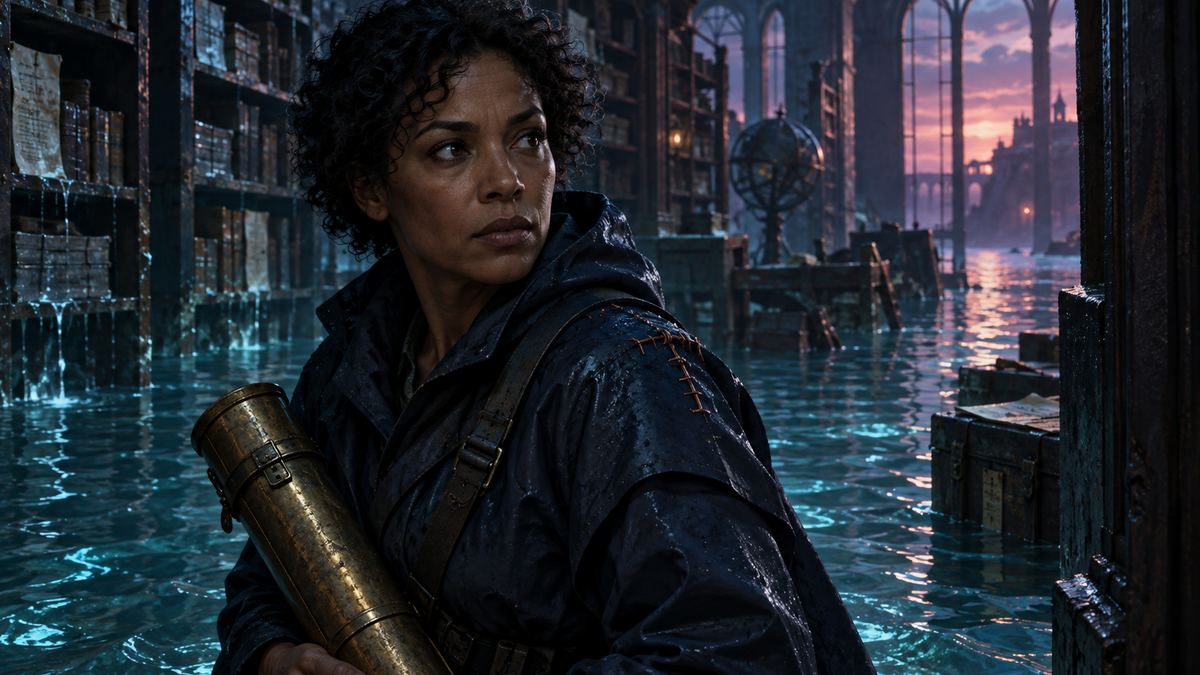
The six prompts below develop one original character in different ways. They are starting points to adapt, not tested DeepFiction outputs or a tour of its interface. The cover is an editorial illustration. No prompt can guarantee an exact face, a correct prop, or continuity between separate generations.
Turn the premise into visible information
Start with a story situation: Noor, an adult archive courier, must deliver a sealed map case through a flooded city. She suspects the map has been altered, but opening it would break the promise that earned her the job.
That premise contains several things a single portrait cannot directly show: a promise, a suspicion, and the history of a job. Asking for all three as abstract qualities leaves the visual interpretation wide open.
Translate selectively. The sealed case can be visible. Her attention can be directed toward a doorway she is deciding whether to enter. A repaired waterproof coat can suggest practical work without inventing medals, weapons, or a royal lineage.
| Story information | Possible visible choice | What the image cannot establish alone |
|---|---|---|
| She carries something entrusted to her | A closed map case held securely | Whether she has kept every promise |
| The route is flooded | Wet fabric and reflected water light | The complete geography of the city |
| She suspects a problem | Attention directed toward a specific object or exit | Whether her suspicion is correct |
| She works for a living | Functional clothes with a visible repair | Her entire social background |
You are choosing an interpretation, not decoding a secret visual language. A repaired coat could mean thrift, attachment, or limited supplies. Let the story establish which meaning matters.
Choose a few identity anchors
For this exercise, Noor is 38, with short tightly curled black hair and dark brown eyes. She wears an indigo waterproof work coat with a copper-colored repair on the left shoulder and carries a cylindrical brass map case.
Those details are our anchors. Framing, expression, weather, and background can change without deliberately redesigning her. Keep the list short enough to compare against an actual image.
Appearance is not a personality test. Dark eyes do not mean secrecy, and a scar would not prove toughness. Use behavior and situation to suggest character rather than treating physical traits as moral shorthand.
If you are adapting someone from an existing story, separate established details from choices you are making for the portrait. Our character-consistency guide can help you keep that distinction clear.
Keep identity separate from the shot
Hair, coat repair, map case
Framing and attention
Identity before polish
Change the scene without redesigning Noor
Keep the anchor description. Replace only the archive doorway with the stone arch, and note that damp hair belongs to this moment. Compare the new image against the reference before accepting it.
An attractive result gets the prop wrong
A book is not a closed map case. Correct the story-relevant mismatch first. Save the earlier version so you can reject an edit that changes the face or coat.
A prompt-planning model. Separate generations may still vary.
Six portrait prompts for six different jobs
Each prompt has a purpose. Choose the purpose before adding more adjectives. Keep the identity anchors when you change the rest, and treat any promising result as something to inspect rather than automatic story canon.
1. A clear reference portrait
Use this when you need to settle the basic appearance. Keep the setting quiet so the face, clothing, and important object are easy to judge.
Chest-up reference portrait of Noor, a 38-year-old archive courier with short tightly curled black hair and dark brown eyes. Indigo waterproof work coat with a copper-colored repair on the left shoulder. A closed cylindrical brass map case rests under her arm. Relaxed neutral expression, simple dark background, soft even light, natural proportions. No lettering or logos.
Check whether the shoulder repair and case remain visible. If they are hidden, the image may still be attractive, but it has not answered the reference brief. Simplify the pose before adding more detail.
2. A portrait at the point of decision
Use this to connect appearance with a particular story moment. Give the character one action or direction of attention, not a sequence of events.
Three-quarter chest-up portrait of Noor, 38, short tightly curled black hair, dark brown eyes, indigo waterproof coat with copper-colored stitching at the left shoulder. She holds a closed brass map case beneath her arm and looks toward an open archive doorway outside the frame. Water reflections cross the wall behind her. Alert, considering whether to enter, not panicked. Cinematic realism, navy shadows, cyan reflected light, restrained magenta in the distant windows. No text.
The viewer cannot read the promise in her mind. The image's job is to make the pause visible. The accompanying scene can explain why entering the archive would matter.
3. A working portrait with an environmental clue
Use this when occupation matters more than glamour. One relevant clue is usually easier to read than a room crowded with equipment.
Waist-up portrait of Noor, an adult archive courier aged 38, with short tightly curled black hair and dark brown eyes. Her indigo waterproof coat has a copper-colored repair on the left shoulder. She stands beside an archive sorting shelf, holding one closed cylindrical brass map case. Damp sleeve edges, practical stance, softly visible numbered shelf shapes without readable lettering. Cool reflected water light, realistic fabric and metal, no weapons or ceremonial clothing.
Inspect whether the setting supports the courier idea or turns her into another occupation. Do not change the story just because an unexpected uniform looks impressive.
4. A restrained expression study
Use this when you are exploring how a character reacts. Keep the wording physical enough to be visible without demanding a specific emotional interpretation from every viewer.
Close portrait of Noor, 38, short tightly curled black hair and dark brown eyes. The indigo collar of her waterproof work coat is visible. She has just noticed that the seal on her brass map case is different: her gaze is lowered slightly, her mouth still, her brow gently tightened. Soft side lighting, plain navy background, realistic skin texture. A quiet moment of attention rather than theatrical shock. No text.
This prompt changes what she notices, so it belongs to a different possible scene. Keep that distinction in your notes. Exploring an expression does not require deciding that the broken-seal event happens in the final story.
5. A graphic character introduction
Use this when the portrait needs to remain legible beside a short introduction or at a small display size. Reduce background competition rather than piling on sharpness instructions.
Simple graphic editorial portrait of Noor, a 38-year-old archive courier with short tightly curled black hair and dark brown eyes. Indigo work coat, copper-colored shoulder repair, one closed brass map case. Clear three-quarter silhouette against a quiet navy field, broad cyan illumination and one restrained magenta accent. Restrained shapes and readable clothing structure. Leave open space beside the figure, but add no words, symbols, border or logo.
This is a medium change, not an identity change. Compare the anchor list again. A useful stylization may simplify detail while preserving the parts that let readers recognize her.
6. A portrait after a difficult journey
Use this to explore a changed state. Specify temporary effects separately so they do not become permanent features in later references.
Chest-up portrait of Noor, 38, short tightly curled black hair and dark brown eyes, after crossing a flooded district. Same indigo waterproof coat with copper-colored repair on the left shoulder; same closed cylindrical brass map case. Damp curls, wet coat shoulders, tired but attentive posture. Shelter beneath a stone arch, gentle cyan reflected light, distant magenta evening sky. Natural anatomy and realistic materials. No injuries, new accessories or text.
Wet hair and fatigue belong to this moment. Save a clean reference separately if you want one. Otherwise, later prompts can accidentally accumulate every temporary mark from earlier scenes.
Compare variations without losing track of the change
Keep a short note beside each result: the prompt used, the intended change, and the details that must remain. If the interface exposes model or reference settings, record those too. Do not assume that the same wording will reproduce the same result across tools or model changes.
For one round, change framing only. For another, change lighting only. If you rewrite the character, wardrobe, medium, and setting at once, you will have little evidence about why the next result differs.
Some image tools offer reference-image controls. Use their current documentation rather than assuming every “reference” feature preserves identity in the same way. Text anchors are helpful instructions, not an identity lock.
Repair the most important mismatch first
Suppose the portrait has the right face and coat but the map case has become an open book. Ask for the object correction without adding a new camera angle or a more elaborate background.
Keep the adult character, face, hairstyle, coat, pose and lighting unchanged. Replace only the open book with one closed cylindrical brass map case held beneath her arm. Do not add writing or another object.
This is an edit brief for a tool that supports image editing, not a promise about the result. Check the supposedly unchanged features afterward. If the correction damages more than it repairs, return to the earlier version rather than repeatedly editing a deteriorating image.
Check the portrait before adopting it
Look at both the full image and a small thumbnail. The large view helps reveal malformed objects or inconsistent clothing. The small view shows whether the face and story-relevant prop are readable without explanation.
Check three things in order: identity, story facts, then finish. A lovely color treatment should not distract you from an incorrect age or an object that changes the premise. Minor background preferences can wait until the character is right.
Keep prompt syntax product-specific. NovelAI's image-generation basics discuss prompt construction for its own system. They should not be treated as universal instructions for every image model. The prompts here deliberately use plain descriptions so you can adapt them to the tool you choose.
Frequently asked questions
Should I paste the character's whole biography?
Usually, start with the visible details relevant to the image. Keep motives and history in your story notes, then decide which parts need a visible consequence. A portrait does not have to communicate everything about a person.
Can one portrait become a permanent reference?
You can choose it as your reference, but later generations may still drift. Record the details you accept and check subsequent images against them. Do not assume a saved image automatically controls future output.
What should I do when an unexpected detail improves the character?
Choose deliberately. If you keep it, update the story reference so the change is explicit. If it contradicts something important, preserve the story and revise the image instead.
Pick one prompt and make its purpose specific. DeepFiction's current plans list image generation and editing among its creative activities. Explore the DeepFiction studio with your brief ready, then judge the result against the character you meant to depict.