15 Fantasy Story Prompts Built Around Difficult Choices
Its presence keeps the creatures following them asleep.
Protect the refugees. Accept the consequence of violating the keeper's duty.
Enforce the rule. Put the people at the bridge in danger.
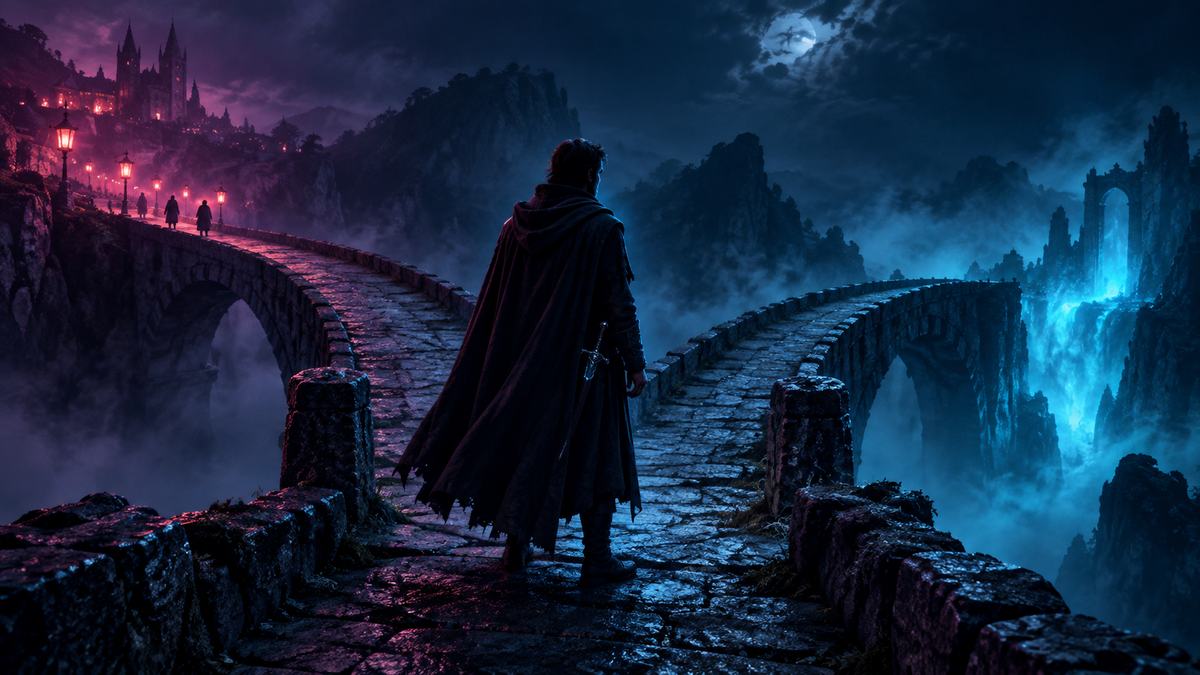
The bridge keeper has a rule: no weapons may cross. Then refugees arrive carrying a blade that keeps the creatures behind them asleep. Taking it away would follow the rule and endanger everyone. That's enough trouble to start a story.
The fifteen prompts below each put someone in a difficult position. Pick the one that makes you wonder what you'd do, then write from the perspective of the person who has to choose.
Magic with a personal cost
1. The borrowed skill
A village can lend its most skilled worker's talent to anyone for one day. During a flood, the only person capable of repairing the gates is too injured to work. The volunteer who borrows her skill discovers that returning it will erase everything he has learned since childhood.
2. The unfinished protection spell
An apprentice finds a way to make a town's protective barrier permanent. The final step requires naming one person the barrier will never admit. The town council wants to choose a stranger. The spell will accept only someone the apprentice loves.
3. The honest enchantment
A jeweler makes wedding rings that grow warm when their wearers tell each other the truth. A royal customer orders a pair that will stay cold forever. Fulfilling the request could prevent a war, but the jeweler's own partner has already promised to expose the deception.
4. The second harvest
A farmer discovers a spell that lets a field produce its next year's harvest immediately. A starving neighboring village needs it now. The land's keeper warns that someone is already living in the year the farmer intends to borrow from.
5. The spell with two owners
Two rival healers each inherit half of a spell that could cure a spreading illness. Completing it requires them to surrender their ability to practice magic separately. One is ready to agree. The other has a patient who cannot survive the time needed for the ritual.
Loyalty under pressure
6. The royal substitute
A palace servant has spent years impersonating a sheltered prince at harmless public ceremonies. On the morning of a binding peace negotiation, the prince disappears. The servant knows how to imitate his manners but disagrees with every promise the court expects him to make.
7. The bridge keeper's oath
A bridge keeper is bound to deny passage to anyone carrying a weapon. Refugees arrive with a ceremonial blade that keeps the creatures pursuing them asleep. Letting them cross breaks the keeper's oath. Taking the blade away wakes what is following.
8. The recovered banner
A retired soldier finds her defeated army's banner in a merchant's storeroom. Raising it will summon every surviving member of her old company. She needs their help defending the town, but some have spent twenty years hiding from the promises the banner will force them to keep.
9. The language of surrender
An interpreter discovers that the two sides of a peace treaty understand its central phrase differently. Both leaders prefer the misunderstanding because it lets them claim victory. Correcting the translation will restart negotiations while their armies are already moving home.
10. The wrong guardian
A sanctuary's protective statue awakens and identifies its beloved caretaker as an intruder. The caretaker insists the statue is broken. The young keeper responsible for maintaining it finds signs that someone has been replacing its memories one stone at a time.
Unfamiliar lives and impossible bargains
11. The migration route
A settlement learns that its new waterworks block the underground migration of creatures no resident has ever seen. Moving the machinery will leave the settlement without water for months. The creatures offer a different source, but it lies beneath the settlement's oldest burial ground.
12. The guest who cannot leave
A innkeeper offers shelter to a traveler during a storm. By morning, the building has become part of the traveler's moving homeland. The guests can return to their own country only if the innkeeper withdraws an invitation that local custom considers permanent.
13. The patient mountain
A mountain asks a quarry worker to remove a painful seam of crystal. The crystal supports the town built on its eastern slope. The worker must decide whether to believe the mountain's promise that it can hold the town steady while she works.
14. The inheritance of silence
A community communicates partly through colors that appear across its members' skin. Its next leader is born without them and learns to lead through speech. When an illness silences the colors throughout the community, restoring them may also restore the rule that once excluded her.
15. The keeper of small doors
A repairer maintains tiny doors that allow household spirits to move between homes. A wealthy district orders every door sealed after a theft. The repairer discovers the stolen objects are being used to build a shelter for spirits whose houses were demolished.
The refugees are waiting at the bridge.
The first child reaches the far bank. Around the keeper's wrist, the mark of his oath begins to burn.
The refugees are safe for now. The next scene must deal with the broken oath.
The keeper lifts the sword from its sheath. Beyond the trees, something enormous draws its first waking breath.
The oath holds, but the threat is awake. Decide who acts first.
Turn one prompt into an opening scene
Take the bridge keeper's oath. Begin at the decision, with the refugees already at the bridge. Choose the keeper's immediate goal: get the group across without waking the creatures or breaking the oath.
Then make the problem visible. The blade might hum whenever someone tries to set it down. The keeper's oath might appear as a mark that tightens around his wrist when he considers allowing passage.
A possible opening line is:
The woman at the front of the column laid everything she owned on the bridge except the sword, and asked the keeper which of his rules mattered more than sleep.
You could change the viewpoint, make the keeper unsympathetic, or discover that the refugees misunderstand what the blade does. Give the keeper time to weigh the choice before you resolve it.
A reusable scene template
Premise: [Choose one prompt.]
Viewpoint character: [Who must make the difficult choice?]
Immediate goal: [What do they want in this scene?]
Obstacle: [Why can't they simply do it?]
Cost of action: [What could they lose by acting?]
Cost of inaction: [What happens if they refuse?]
Tone: [For example, intimate, adventurous, unsettling, or hopeful.]
Stopping point: [End at a discovery or decision; leave room to continue.]
Avoid explaining every magical rule before anything happens. Introduce the rule that affects the choice, show its consequence, and let the rest of the setting emerge through the character's actions.
Choose the kind of story you want to spend time in
A negotiation, a rescue, and an investigation need different openings. If you're not sure which prompt to use, start with the kind of scene you enjoy writing.
| If you want… | Start with… | Put the first scene here |
|---|---|---|
| A tense negotiation | The language of surrender | The interpreter notices the conflicting meanings while both leaders prepare to sign |
| A character caught between duties | The bridge keeper's oath | The refugees reach the bridge and refuse to surrender the blade |
| A close personal conflict | The spell with two owners | One healer arrives ready for the ritual and finds the other treating a patient |
| An unfamiliar society | The inheritance of silence | Someone makes an important public decision that nobody can express in the customary way |
| A mystery with a concrete trail | The wrong guardian | The keeper discovers a fresh repair in a stone nobody reported damaged |
Three ways to change a prompt
Change who bears the cost. In the borrowed-skill story, the volunteer expects to lose his own memories. What changes if another person offered them on his behalf? The plot shifts toward consent, trust, and the authority to make a sacrifice for someone else.
Change what the character believes. The bridge keeper may initially think the sword is an excuse to break the law. The first unmistakable sign of the sleeping creatures forces him to reconsider. Let evidence change the decision instead of making the character understand the entire problem at the start.
Change the scale. A conflict does not need to threaten the world. The small doors could matter to one household, one street, or a whole city. A smaller setting often gives you more room to show exactly what someone stands to lose.
Keep one central tension while changing the surrounding details. If you change every part at once, you may lose the question that made the original premise interesting.
Frequently asked questions
Can I turn these prompts into roleplay scenarios?
Yes. Choose who you play, give another character an independent goal, and begin before the central decision is resolved. State which actions and dialogue remain yours to control. The bridge keeper and the refugee carrying the blade offer two different perspectives on the same encounter.
Do I need to build a complete magic system first?
You need enough clarity for the immediate choice to make sense. Decide what the relevant rule allows, what it prevents, and what breaking it costs. You can develop other rules as they become important, then check that new details do not contradict established scenes.
How can I make a prompt feel less predictable?
Give both sides a credible reason to want different outcomes. Avoid making one answer obviously correct and the other merely foolish. Make the decision harder for a reason. Another twist won't help if it has nothing to do with the problem.
What if I cannot decide how it should end?
Write the first consequential choice before fixing the ending. Then outline two possible consequences. You may discover the ending by deciding which consequence puts the character's values under the most meaningful pressure.
Choose the premise that makes you curious about both possible answers. Then start your fantasy story in DeepFiction and shape the decision into a scene of your own.