How to Continue an AI-Generated Story Without Losing the Plot
To continue an AI-generated story, give the next scene a specific job. Preserve the last meaningful action, name the problem it leaves behind, and decide where the continuation should stop. A summary can remind you what happened. It cannot, by itself, decide what needs to happen next.
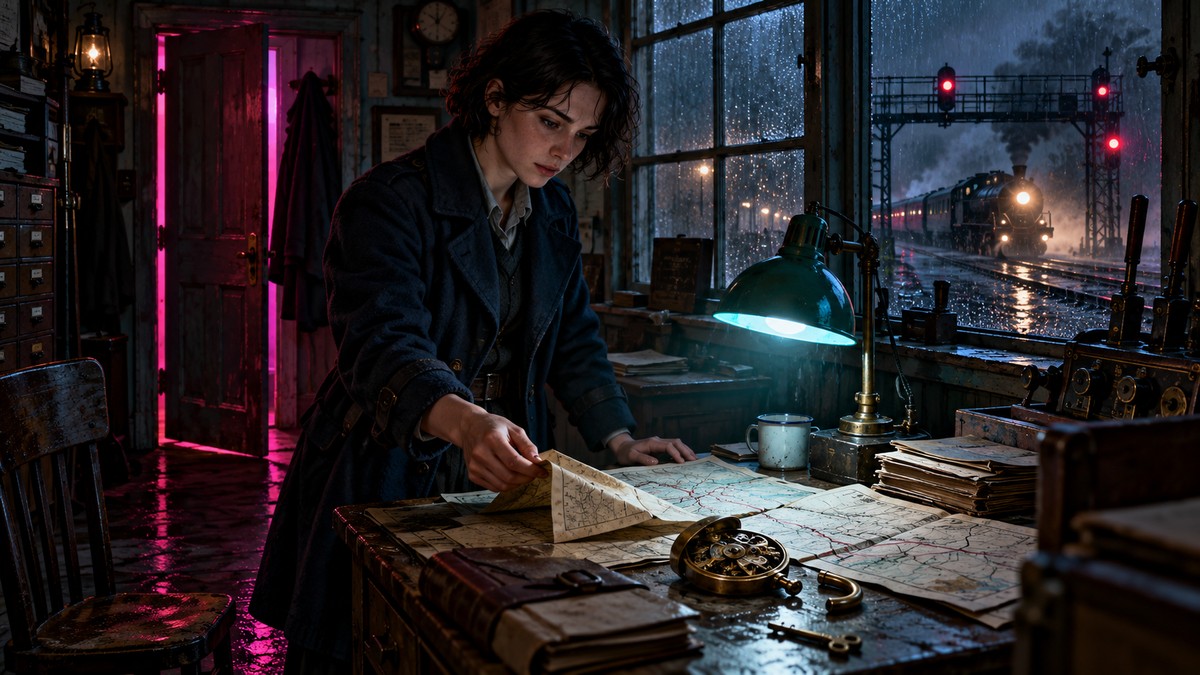
Suppose your opening ends with a railway archivist stealing a route map. The next passage sounds good, but it sends her home to remember her childhood. The map, the waiting train, and the person following her all disappear. Nothing necessarily contradicts her biography. The story has simply stopped dealing with its own consequences.
Here is a practical way to carry those consequences forward. The examples are original editorial illustrations, not recorded outputs or a test of any particular product.
Find the last action that still matters
Read the end of your accepted draft, not the latest version you happened to generate. Underline the action that changed somebody's options. A discovery, promise, refusal, theft, or departure usually gives you something concrete to work with.
In our example, archivist Iona has removed a map from a locked cabinet. She promised a colleague she would photograph it without taking it. A train shown on the map leaves at midnight. Someone has just tried the signal-room door.
The next scene does not need another explanation of Iona's profession. It needs to deal with the stolen map and the door. Ask: because this happened, what can no longer stay the same? That question keeps the continuation connected even when you change location, pace, or viewpoint.
If your difficulty is a character changing personality or knowing facts they never learned, use the separate character-consistency guide. Here, the focus is scene progression: carrying unfinished business into a new piece of action.
Make a handoff, not a second synopsis
A synopsis records the route you have traveled. A scene handoff tells you where to put your foot next. Keep enough recent prose to preserve the immediate setting and voice, then add a short note about the next task.
| Handoff field | Iona's current scene | What it prevents |
|---|---|---|
| Last accepted action | She takes the original map | Restarting before the theft |
| Immediate consequence | Her colleague's trust is now at risk | Treating the theft as cost-free |
| Active pressure | Someone tries the locked door | Opening with unrelated reflection |
| Next scene job | Leave without exposing the map | Wandering into a different adventure |
| Stop point | The visitor notices the empty cabinet | Solving the entire mystery at once |
Notice what is missing: the station's full history, every supporting character, and the eventual ending. Include those only if they constrain this scene. You are choosing the relevant context, not trying to compress a novel into five labels.
An open question also needs a status. “Who changed the railway route?” remains unknown. “Did Iona take the map?” does not. Keeping both as mysteries would undo a decision the reader already witnessed.
Give the continuation one dramatic task
“Continue with tension” describes an effect. “Iona must get past the visitor without showing the stolen map” gives the scene something to do.
Choose a task with a visible outcome. Persuade the visitor to leave. Hide the evidence before the cabinet is checked. Admit the theft and ask for help. Those are different scenes, so select one rather than asking the model to satisfy all three.
The stop point matters just as much. If you want to explore an awkward encounter, stop at a new complication. If this is the story's final scene, resolving the central question may be exactly right. A continuation should move far enough to change the situation, but not automatically consume every remaining event.
A scene-sized progression
- ActionIona takes the map.
- PressureThe door handle turns.
- ChoiceShe conceals it and opens the door.
- New costThe visitor asks about the cabinet.
Each step changes the available choices. The scene advances without explaining the whole conspiracy.
Use a continuation brief you can inspect
Paste your accepted ending into the final section of this template. Adapt the instructions to the input your writing tool actually supports. This is a writing brief, not a claim that every platform has matching controls.
Continue from the final action in the accepted excerpt below.
Write one scene in close third person from Iona's viewpoint.

Established events: Iona took the original route map. She had
promised her colleague she would only photograph it.
Current pressure: Someone is trying the signal-room door.
Immediate goal: Get past the visitor without revealing the map.
Unresolved question: Who changed the route, and why?
Scene boundary: Stop when the visitor notices the empty cabinet.

Keep the theft consequential. Do not repeat the opening,
explain the conspiracy, or jump forward to the train journey.
Use observable action and dialogue before extended reflection.
Any new fact must fit what has already happened.

Accepted excerpt:
[Paste the ending you are keeping, including its final action.]
Specific instructions still need review. The brief gives you criteria for evaluating a continuation; it does not guarantee compliance. If the result introduces a useful surprise, you can change the plan deliberately. Just distinguish a new decision you want from drift you accepted because the prose sounded finished.
Compare consequence with repetition
Here is the same transition handled two ways. Open each example and look at what happens to the stolen map.
A continuation that circles back
Iona studied the station records, wondering what secrets they contained. She had spent years among these shelves, waiting for something extraordinary to happen. Outside, the rain reminded her how alone she was.
The problem: the paragraph could appear before the theft. It does not use the changed situation, the approaching visitor, or the broken promise.
A continuation that carries the cost forward
The handle turned again. Iona folded the map once, hiding the railway seal against her coat, and opened the door with her other hand.
“You're late,” she said.
The visitor looked past her. “And you've opened the wrong cabinet.”
What changes: she conceals evidence, chooses a bluff, and discovers that the visitor recognizes the cabinet. The larger explanation stays unresolved.
The second example is not better because it contains more action words. It makes Iona's earlier choice matter. A quiet version could work too: she might confess to her colleague over the telephone while the visitor waits. The useful test is consequence, not speed.
Keep accepted prose separate from possibilities
If you ask for three possible continuations, label them as alternatives. Do not paste all three into the story's reference as though they happened.
Imagine one option has Iona burn the map, another has her conceal it, and a third has her hand it over. Pick one before continuing. Otherwise the next prompt contains incompatible histories, and repairing the result becomes harder than making the original choice.
Keep a small record outside the generated text: accepted ending, rejected branches, next unresolved obligation. You do not need elaborate software for this. A plain document with clearly named sections is enough. After a substantial revision, update the handoff from the revised scene rather than from memory.
Use summaries without treating them as evidence
Some writing systems provide summaries or lore references. Their presence does not remove the need to check what they contain. SillyTavern's Summarize documentation warns that model-generated summaries can omit details or introduce inaccuracies and may need manual correction. Its World Info documentation describes dynamically inserting reference information into prompts. These are distinct mechanisms, not a promise that every earlier scene will remain available.
For a scene handoff, verify the decisive action against your accepted prose. “Iona investigated the map” is an inadequate summary if the important change was stealing it after promising not to. Correct that loss of meaning before asking for the next scene.
You can request a draft handoff from an AI, but read it as an interpretation. Mark uncertain inferences as uncertain. Do not let a summary turn a suspicion into a fact or quietly resolve a question the story is still asking.
Repair drift at the first unsupported move
When a continuation goes wrong, locate the first sentence that abandons the scene's task. If Iona abruptly boards the train, revising the final paragraph will not restore the confrontation that was skipped.
Ask for a bounded revision: keep the opening through the door being opened, then replace the passage that jumps to the platform. Preserve the visitor's accusation and stop before Iona answers it. This gives you a smaller piece to judge than regenerating the entire chapter.
Use a final check before accepting the scene: What did the earlier action cause? What decision happened here? What new obligation carries forward? If those answers are identical to the previous scene's answers, the continuation may have repeated the setup rather than advanced it.
Frequently asked questions
How much previous text should I include?
Include the ending needed to establish the immediate action and voice, plus relevant constraints. There is no universal paragraph count. If a continuation misses something essential, first check whether your excerpt or handoff actually supplied it.
Should every scene end on a cliffhanger?
No. An agreement, departure, or quiet realization can provide a clear handoff. The next scene needs a reason to follow, not necessarily danger. A resolved argument can create a new task, such as keeping the promise that ended it.
Can I switch from roleplay to written fiction?
Yes, but choose which events from the exchange belong in the story first. Our story generation and roleplay comparison explains the difference in control. Do not assume context automatically transfers between experiences.
What should I try first?
Choose one unfinished scene and write its five-line handoff. Then start a writing session in DeepFiction with the accepted ending and one specific next-scene task. Judge the new passage by what it carries forward, not just how smoothly it reads.
Documentation checked September 24, 2026. Product references describe documented behavior; the railway examples and continuation method are original editorial material.